
Towards Solving the Gilbert-Pollak Conjecture via Large Language Models
Abstract
Lay Summary
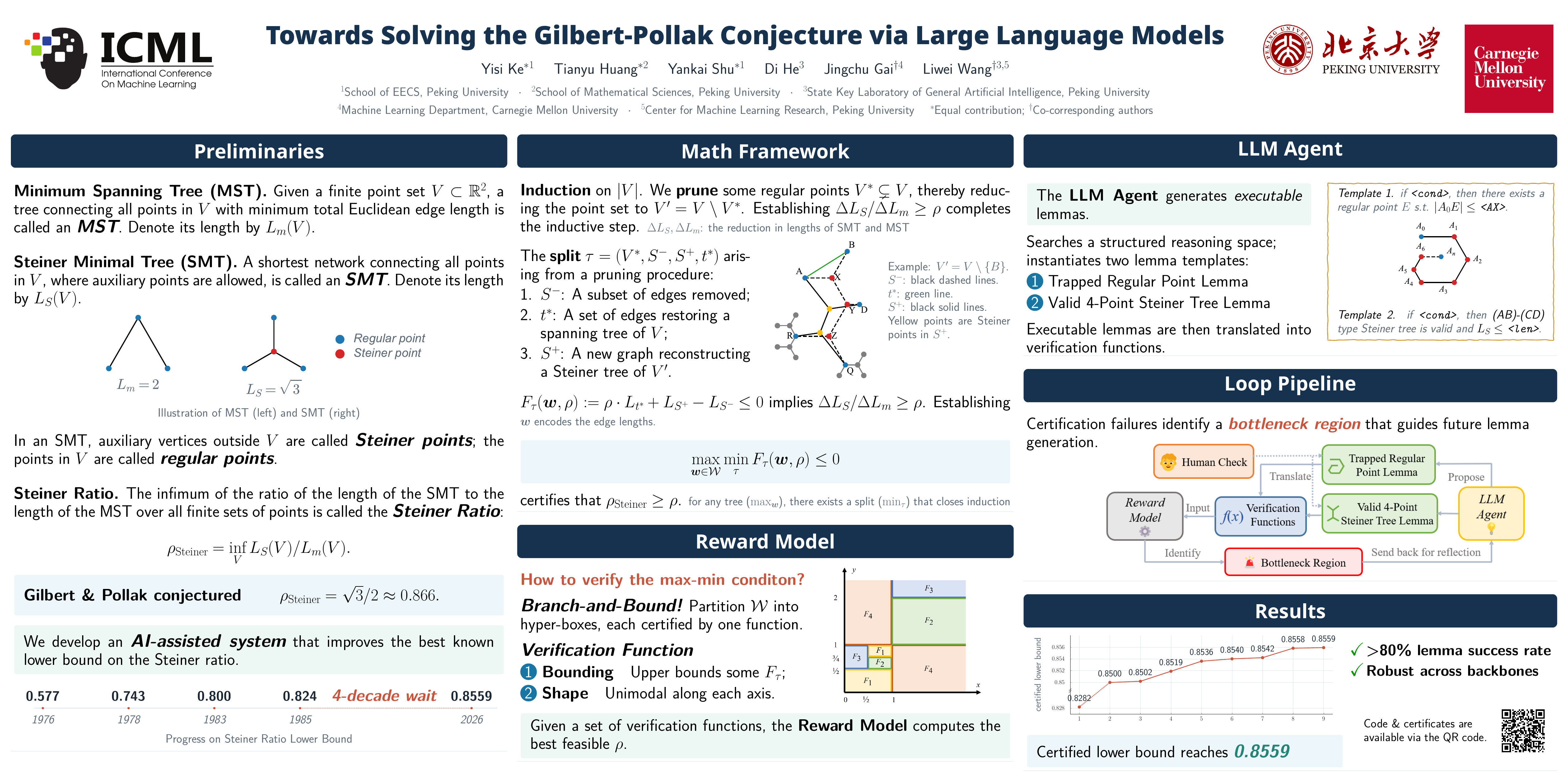
How can we connect locations with the shortest possible network, such as cables, roads, or communication links? A common baseline is the minimum spanning tree, which connects locations directly; adding extra junctions can make the network shorter. The Steiner ratio measures how short this improved network can be relative to the baseline. In 1968, Gilbert and Pollak conjectured that this ratio is always at least 0.866, but the best general lower bound had stayed at 0.824 since 1985. We study whether large language models can help make progress on this open problem. Rather than asking an AI system to prove the conjecture end to end, we let LLMs propose geometric lemmas within a structured, compositional space. These lemmas are converted into "verification functions" that certify a lower bound. When verification fails, the system identifies where the current lemmas are insufficient, guiding the next round of lemma proposals. This loop raises the certified lower bound for the Steiner ratio to 0.8559, close to the conjectured value 0.866. More broadly, the work suggests a practical pattern for AI-assisted mathematics: combine AI-generated modular proof ingredients with evaluators that provide rigorous assessment and targeted feedback, allowing the system to improve iteratively.