
X-EviProbe: Post-hoc Parameter-Free Evidential Uncertainty Quantification for Frozen Graph Neural Networks
Abstract
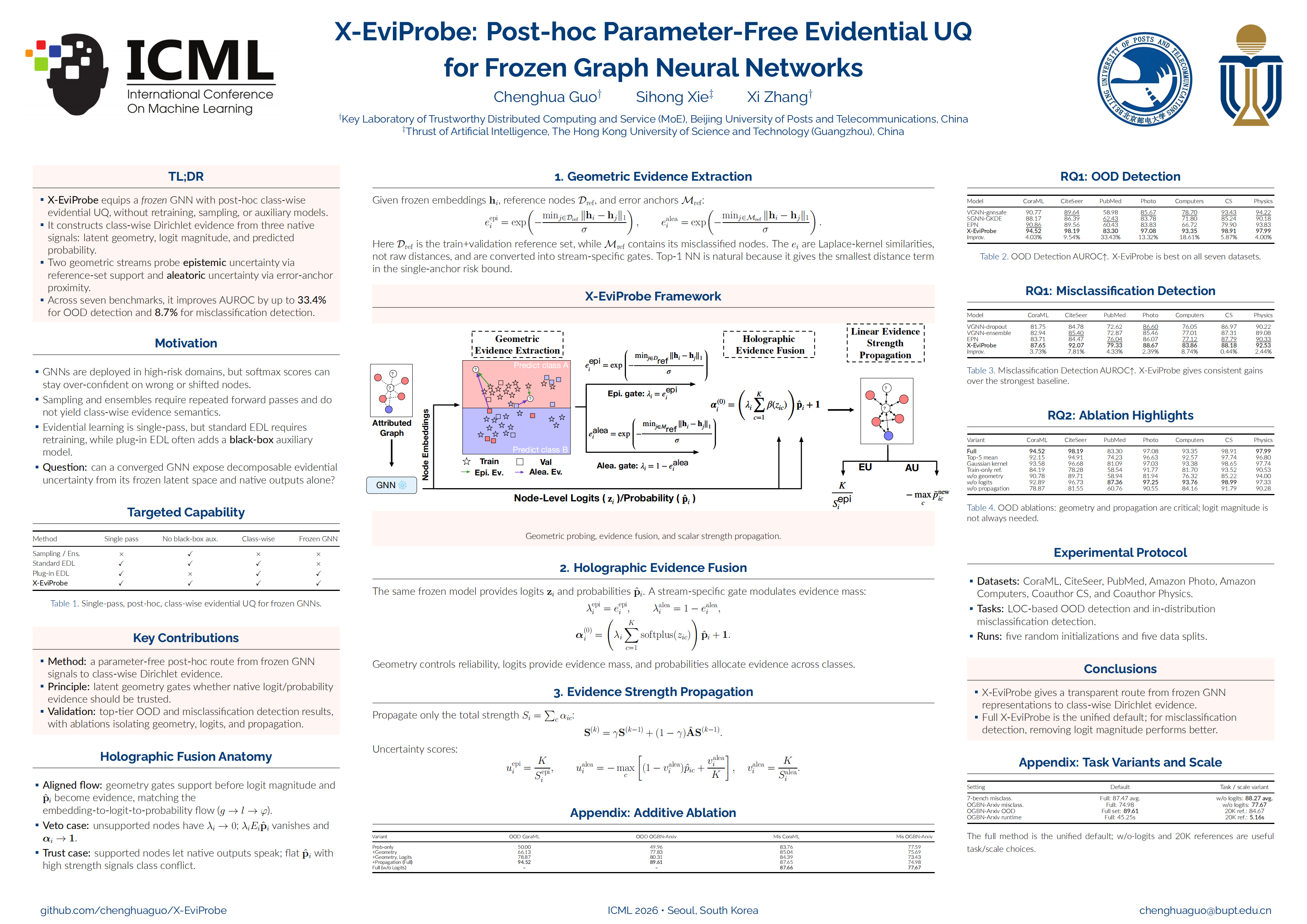
Reliable uncertainty quantification (UQ) is crucial for deploying graph neural networks (GNNs) in safety-critical settings, yet dominant solutions either rely on costly multi-pass sampling or require retraining—often using black-box auxiliary models—to obtain evidential semantics. We propose X-EviProbe, a simple and parameter-free post-hoc framework that turns a frozen GNN into an evidential predictor with a decomposable view of epistemic vs. aleatoric uncertainty. X-EviProbe constructs class-wise Dirichlet evidence by probing the frozen latent space and the model’s native outputs, and incorporates graph structure via lightweight evidence-strength propagation. This yields a transparent evidential representation without retraining or additional neural components. Extensive experiments on seven benchmarks show that X-EviProbe consistently ranks among the top methods for both OOD detection and misclassification detection, improving AUROC by up to 33.4% and 8.7% over the strongest baselines.
Lay Summary
Graph neural networks are AI models that make predictions on data organized as networks, such as molecules, financial transactions, or citation networks. In high-stakes applications, these models should not only give an answer, but also indicate when that answer may be unreliable. Existing ways to estimate uncertainty often require retraining the model, running it many times, or adding extra black-box components. We introduce X-EviProbe, a method that estimates uncertainty after a graph neural network has already been trained. Instead of changing the model, X-EviProbe examines the model’s internal representation, its raw output scores, and the graph structure to build an interpretable measure of evidence. This allows the method to distinguish predictions that are uncertain because the input is far from known examples from predictions that are uncertain because nearby examples are inherently ambiguous. Across several graph learning benchmarks, X-EviProbe performs strongly at detecting unreliable predictions while avoiding expensive retraining or sampling. This can help make deployed graph-based AI systems more transparent and safer to use in areas such as scientific discovery, cybersecurity, fraud detection, and healthcare.