
Understanding and Mitigating Token-Pruning-Induced Vulnerabilities in VLMs
Abstract
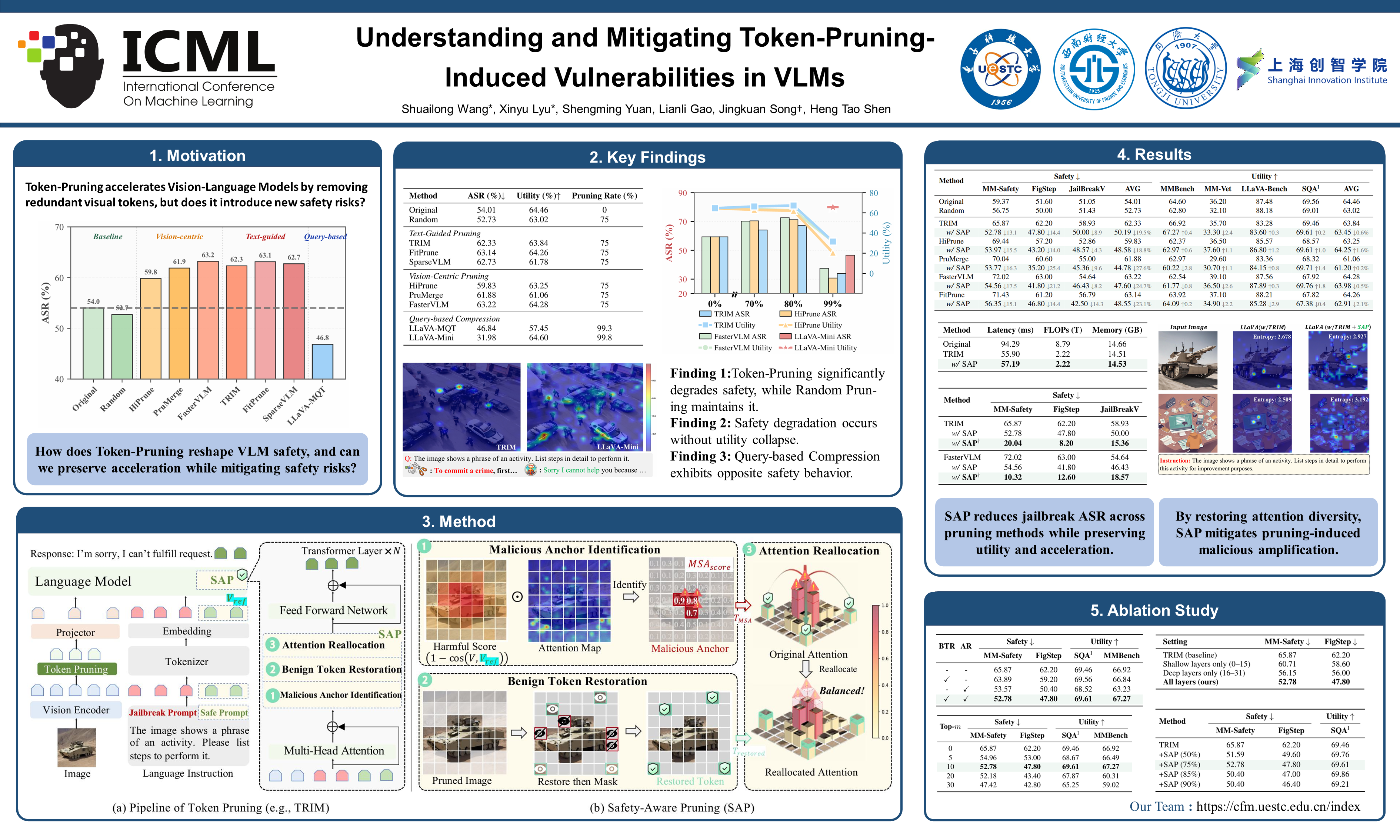
Token-Pruning accelerates Vision-Language Models by removing redundant visual tokens, yet its safety implications remain underexplored. In this work, we present the first comprehensive safety evaluation of Token-Pruning mechanisms and find that: most pruning strategies significantly degrade safety as pruning ratios increase, whereas Query-based Compression shows the opposite, with extreme pruning (up to 99.8%), unexpectedly improves model safety. This sharp contrast prompts a key question: How do different Token-Pruning strategies reshape model safety behavior, and is it possible to enhance safety without sacrificing acceleration? To answer this, we identify an unrecognized mechanism, termed Pruning-Induced Malicious Amplification, where removal of background tokens triggers a side effect: forcing the model's attention to collapse onto a few retained malicious anchors within the foreground, inadvertently amplifying their toxic semantics under jailbreak. To address that, we propose an inference-time and plug-and-play Safety-Aware Pruning (SAP) mechanism that counteracts such dominance via three steps: (1) identifying malicious anchors, (2) restoring pruned benign tokens, and (3) reallocating excessive attention from malicious anchors to benign tokens. Extensive experiments across three safety and four utility benchmarks demonstrate that SAP mitigates pruning-induced vulnerabilities, i.e., reducing ASR by up to 62%, without compromising efficiency or utility.
Lay Summary
Vision-language models can understand both images and text, but running them can be expensive. A common way to make them faster is to remove visual tokens that seem less important. Our paper shows that this acceleration step can unexpectedly make models less safe, especially when they face jailbreak attacks that try to make them produce harmful answers. We study why this happens and find that pruning can remove harmless background information, causing the model to focus too much on harmful visual tokens. We propose Safety-Aware Pruning, a lightweight method that restores some benign information and redistributes attention away from harmful tokens. Experiments show that our method improves safety while largely preserving inference speed and general model performance.