
ParaTool: Shifting Tool Representations from Context to Parameters
Abstract
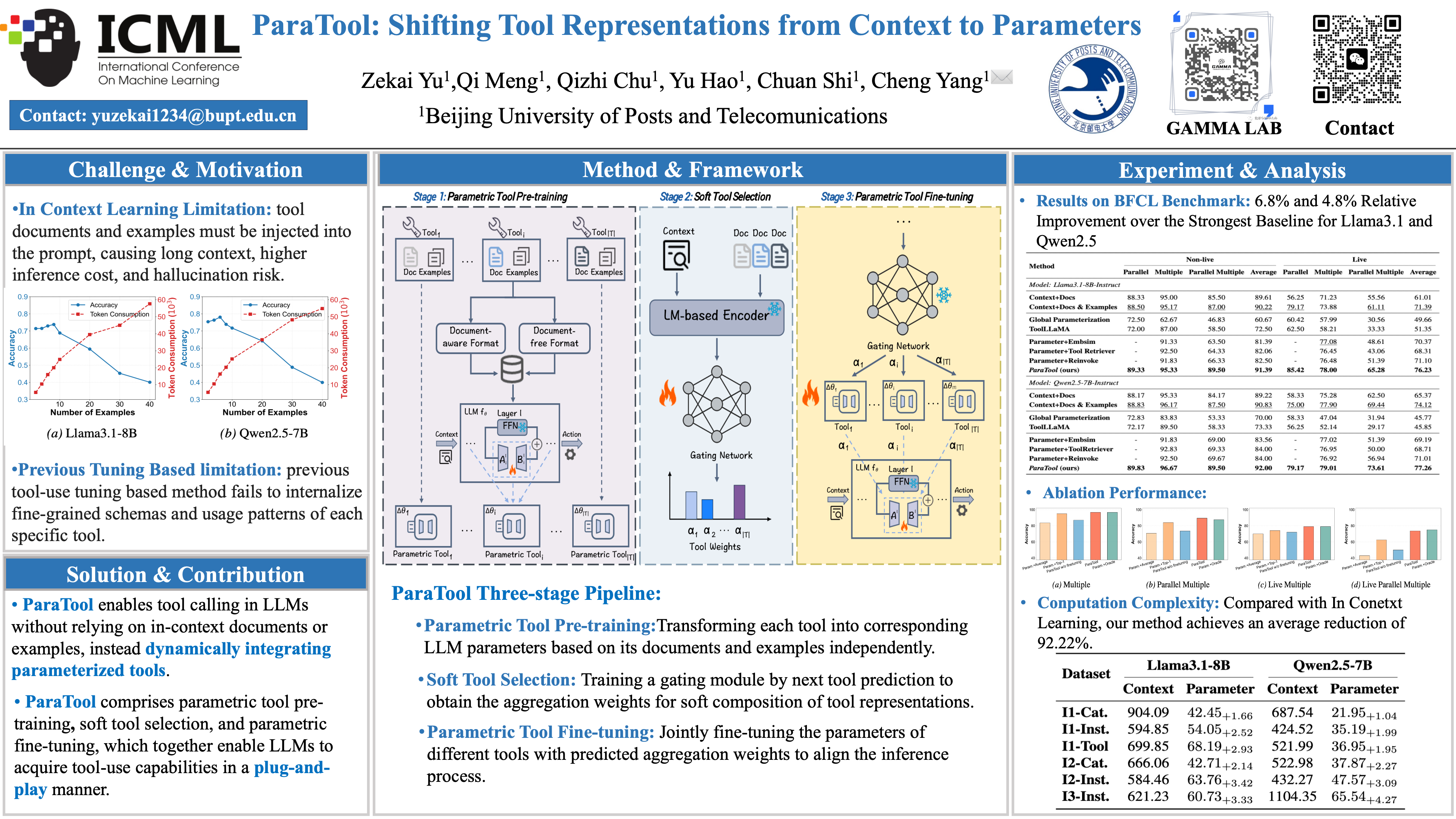
Tool calling extends large language models (LLMs) by enabling grounded interaction with external executable interfaces, thereby supporting environment-coupled problem solving. However, mainstream in-context learning (ICL) approaches typically incorporate detailed tool documentation and usage examples directly into the context. This results in substantial inference overhead and heightened risks of hallucination as the context length grows. Conversely, while tuning-based methods improve general tool-calling capabilities, they often fail to effectively internalize the specific details of previously seen tools, thereby retaining a dependency on in-context documentation. To address these limitations, we propose ParaTool, a framework that projects each tool into a dedicated, loadable set of parameters. By equipping a dynamic integration of these parameterized tools, the LLM can perform tool calling without relying on in-context documents or examples. Specifically, our approach consists of three stages: (1) parametric tool pre-training encapsulates the knowledge of different tools into independent parameter modules; (2) soft tool selection employs a gating network to dynamically weigh and aggregate relevant tool parameters; and (3) parametric tool fine-tuning jointly updates tool parameters to align the training and inference processes. Experiments on Stable ToolBench and BFCL demonstrate that ParaTool significantly outperforms strong ICL-based baselines, achieving superior performance while reducing computational complexity.
Lay Summary
Large language models are becoming more useful by learning to use external tools, such as calculators, search engines, and software APIs. However, current methods often require long tool instructions and examples to be included in the input every time. This increases computation and can make the model more likely to misuse tools. We propose ParaTool, a framework that stores knowledge about each tool in a small, separate set of model parameters instead of repeatedly describing the tool in text. For each task, the model learns to select and combine the most relevant tool parameters, allowing it to call tools without relying on long in-context documentation. Because tool knowledge is stored in reusable components, the model can avoid rereading lengthy manuals when it needs to use a tool. This makes tool use more efficient and may reduce errors caused by overly long inputs. Our results suggest a step toward AI assistants that can work with many tools more reliably, without depending on tool manuals being provided every time.