
DEGAP: Dynamic Entropy-Guided Attention Perturbation for Contrastive Decoding in Large Vision-Language Models
Abstract
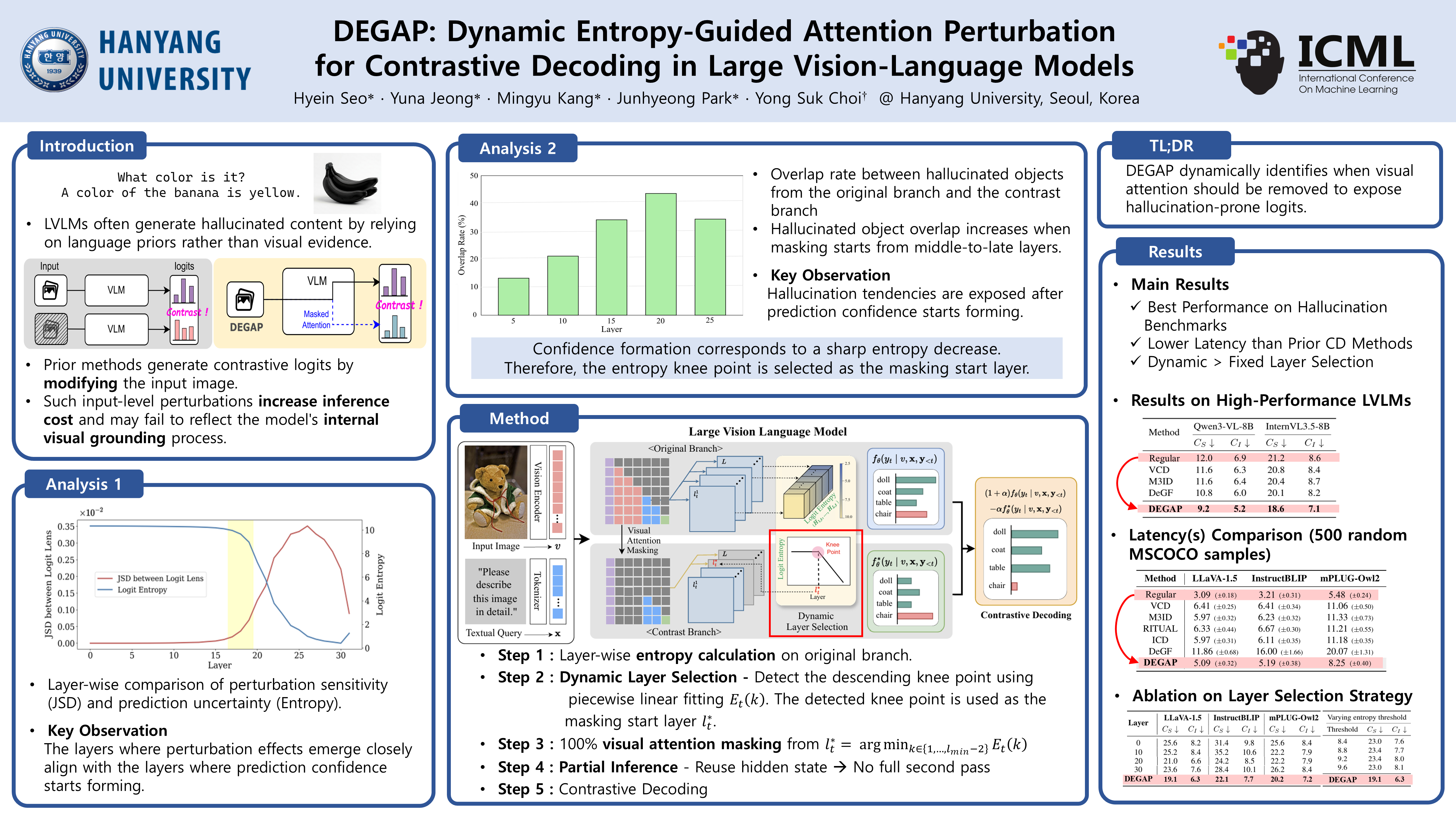
Large Vision–Language Models (LVLMs) have shown outstanding performance across various multimodal tasks, but they still suffer from hallucinations, where they generate incorrect information by relying on language priors without visual grounding. To alleviate this issue, prior work has explored contrastive decoding approaches that compare the output of an original LVLM with that of a contrast branch. However, existing methods typically generate contrast logits through preprocessing of the input image. Such input-level perturbations fail to sufficiently reflect the model’s internal degree of visual reliance during the decoding process. To address this limitation, we propose Dynamic Entropy-Guided Attention Perturbation (DEGAP) for contrastive decoding in LVLMs. DEGAP performs contrastive decoding by directly perturbing visual attention and leveraging the resulting logits, without requiring any additional image preprocessing. To this end, we analyze the layer-wise effects of visual attention perturbations and, based on these observations, dynamically select the layers at which attention perturbation is applied according to the model’s confidence. Experimental results on seven benchmarks demonstrate that DEGAP effectively mitigates various types of hallucinations and consistently outperforms state-of-the-art methods in general VQA performance.
Lay Summary
Large Vision-Language Models (LVLMs) can understand both images and text, making them useful for tasks such as image captioning and visual question answering. However, these models sometimes generate incorrect information that is not actually supported by the image, a problem known as hallucination. In this paper, we propose a simple and efficient method to reduce these hallucinations without retraining the model. Instead of modifying the input image or adding extra training data, our method directly masks visual attention during response generation. Experiments on multiple benchmarks show that our method produces more accurate and visually grounded responses while requiring less computational overhead than previous contrastive decoding approaches.