
Active Budget Allocation for Efficient Scaling Law Estimation via Surrogate-Guided Pruning
Abstract
Lay Summary
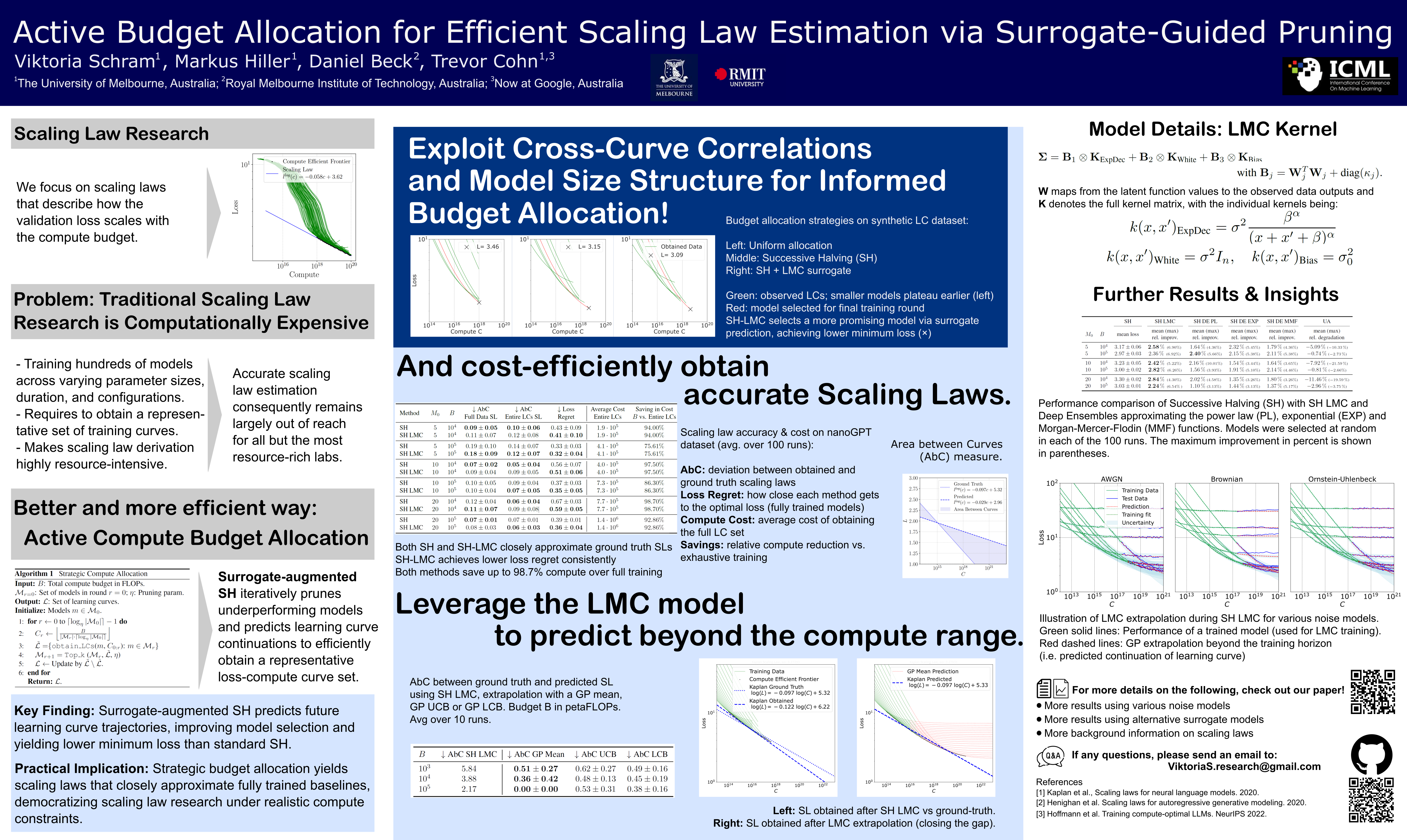
Training large AI language models is extremely expensive, often requiring hundreds of individual training runs to understand how performance scales with increasing computational resources. This knowledge, captured in so-called scaling laws, is invaluable for making informed decisions about how to train and deploy these models efficiently. Yet the process of estimating these scaling laws has itself remained surprisingly wasteful: researchers typically train every candidate model until completion, even when many of those runs contribute little useful information. We address this by asking a simple but underexplored question: can we strategically decide which models to train, and for how long, to obtain accurate scaling laws at a fraction of the usual cost? We adapt a resource allocation technique called Successive Halving and augment it with probabilistic surrogate models that predict how a model's performance will evolve before it has finished training. This allows us to identify and invest compute budget in the most promising models early, while stopping less useful ones sooner. Our experiments show that this approach recovers accurate scaling laws while reducing computational costs by up to 98.7%, making scaling law research more accessible to the broader research community, including institutions without access to the massive compute budgets currently required by state-of-the-art approaches.