
Autoregressive Direct Preference Optimization
Abstract
Lay Summary
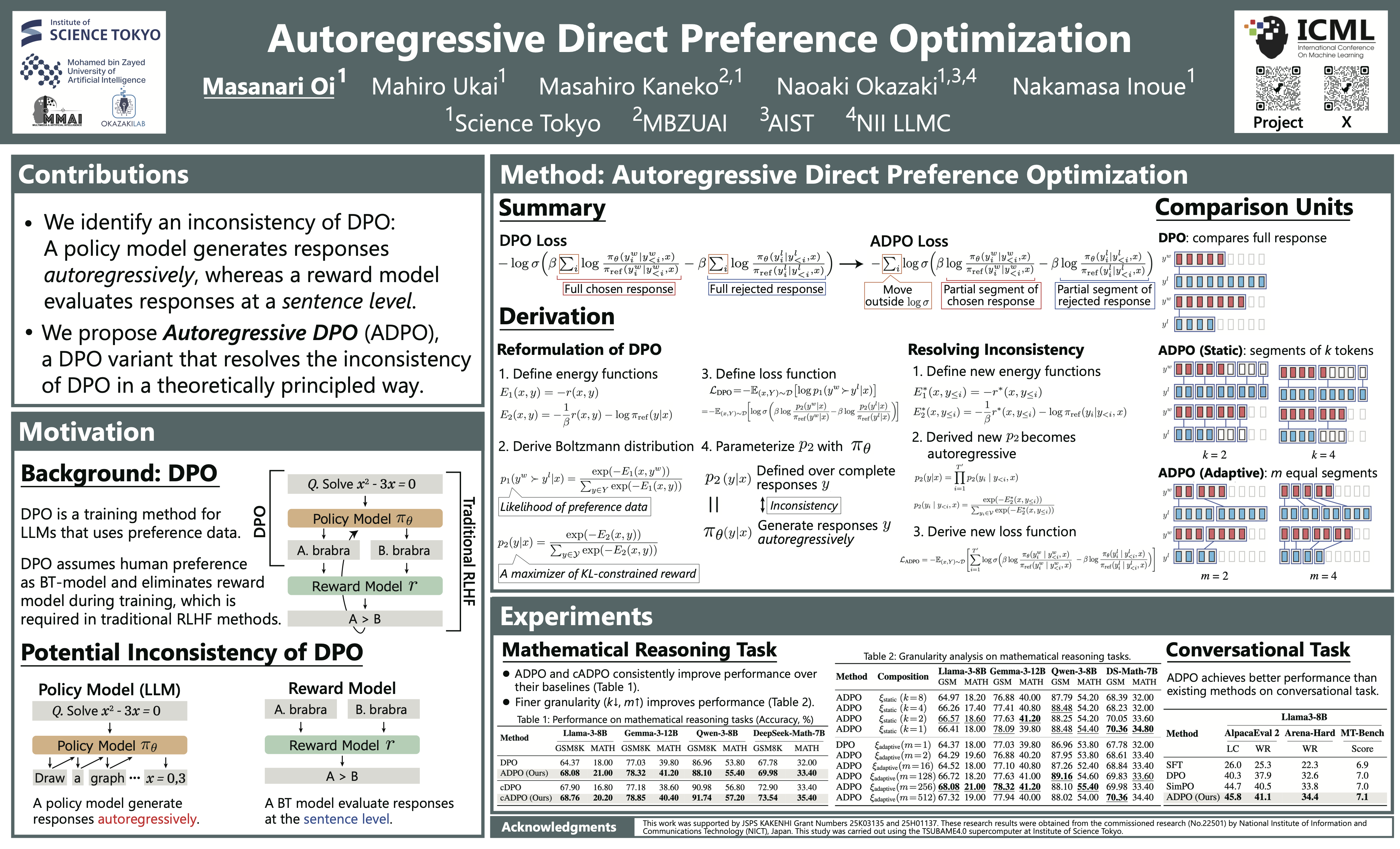
Large language models (LLMs) are increasingly trained to match human preferences, for example, to give helpful, harmless, and honest answers. A key technique for this is Direct Preference Optimization (DPO), which teaches the model to prefer "good" responses over "bad" ones by comparing pairs of examples. However, DPO has a subtle internal inconsistency: it treats each response as a single whole when deciding which is better, even though LLMs actually generate text one word (token) at a time, left to right. We fixed this inconsistency by introducing Autoregressive DPO (ADPO), which applies the preference comparison at each step of generation rather than only at the end. This leads to a cleaner mathematical formulation and reveals a previously unrecognized distinction between two notions of length: the length of a response as measured by the model versus as measured by human feedback. Experiments across mathematical reasoning and conversational tasks show that ADPO consistently outperforms standard DPO, offering a theoretically sounder and practically stronger approach for aligning LLMs with human preferences.