
PATRA: Pattern-Aware Alignment and Balanced Reasoning for Time Series Question Answering
Abstract
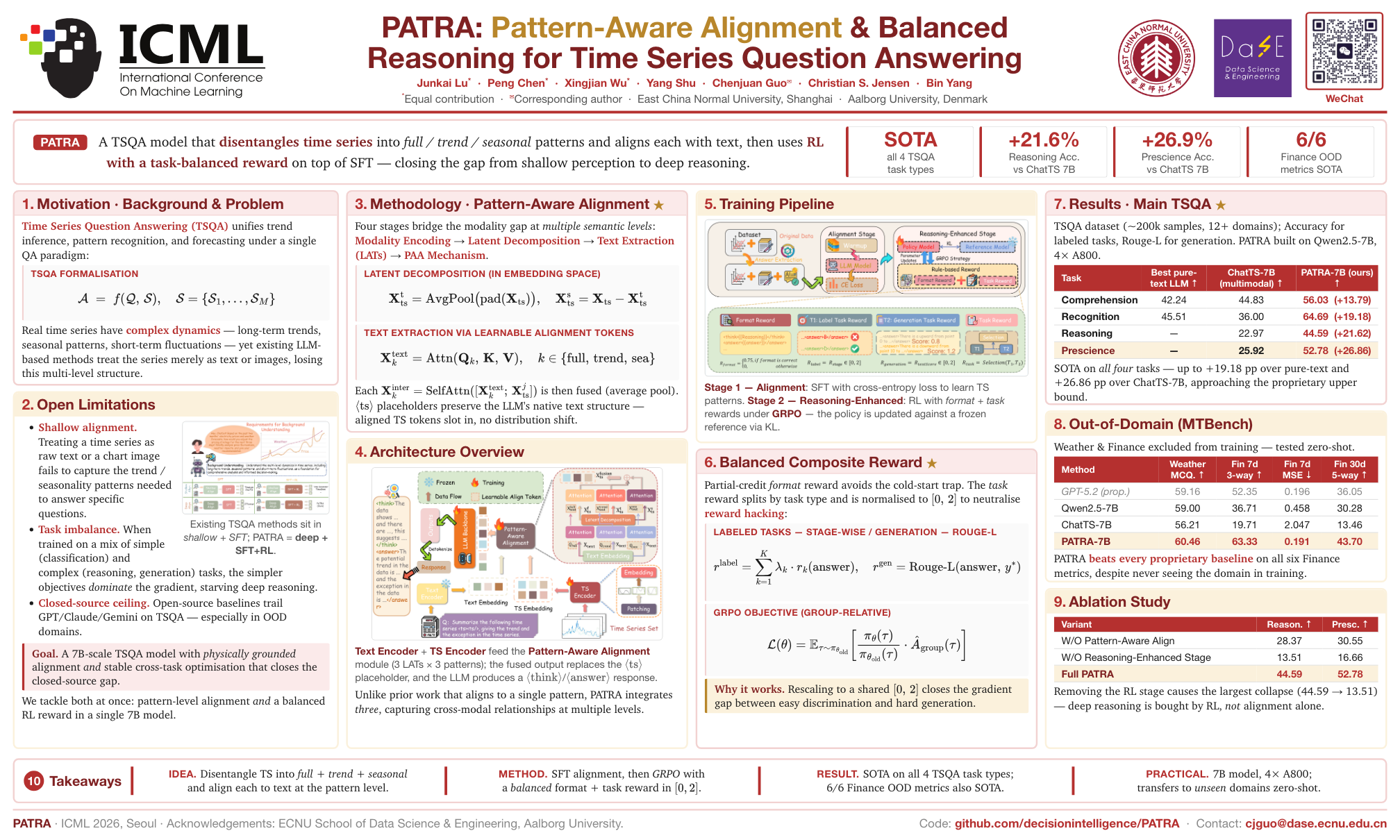
Time series reasoning demands both the perception of complex dynamics and logical depth. However, existing LLM-based approaches exhibit two limitations: they often treat time series merely as text or images, failing to capture the patterns like trends and seasonalities needed to answer specific questions; and when trained on a mix of simple and complex tasks, simpler objectives often dominate the learning process, hindering the development of deep reasoning capabilities. To address these limitations, we propose the Pattern-Aware Alignment and Balanced Reasoning model (PATRA), introducing a pattern-aware mechanism that extracts trend and seasonality patterns from time series to achieve deep alignment. Furthermore, we design a task-aware balanced reward to harmonize learning across tasks of varying difficulty, incentivizing the generation of coherent Chains of Thought. Extensive experiments show that PATRA outperforms strong baselines across diverse Time Series Question Answering (TSQA) tasks, demonstrating superior cross-modal understanding and reasoning capability.
Lay Summary
Time series data, such as weather records, electricity usage, and stock prices, are widely used in real-world decision making. Recently, researchers have explored using large language models to answer questions about such data. However, existing methods often struggle to understand important patterns over time, such as long-term trends or repeating cycles, and they may fail on questions that require deeper reasoning. In this work, we introduce PATRA, a new approach that helps language models better understand and reason about time series data. Our method teaches the model to focus on meaningful patterns while also improving its ability to handle both simple and complex questions. This allows the model to produce more accurate and coherent explanations when answering questions about time series. We evaluate it on a variety of TSQA benchmarks and show that it consistently performs better than existing approaches. These improvements could support future intelligent systems for areas such as finance, healthcare, energy, and environmental monitoring, where understanding time-dependent data is essential.