
Training-Free Rate-Distortion-Perception Traversal With Diffusion
Abstract
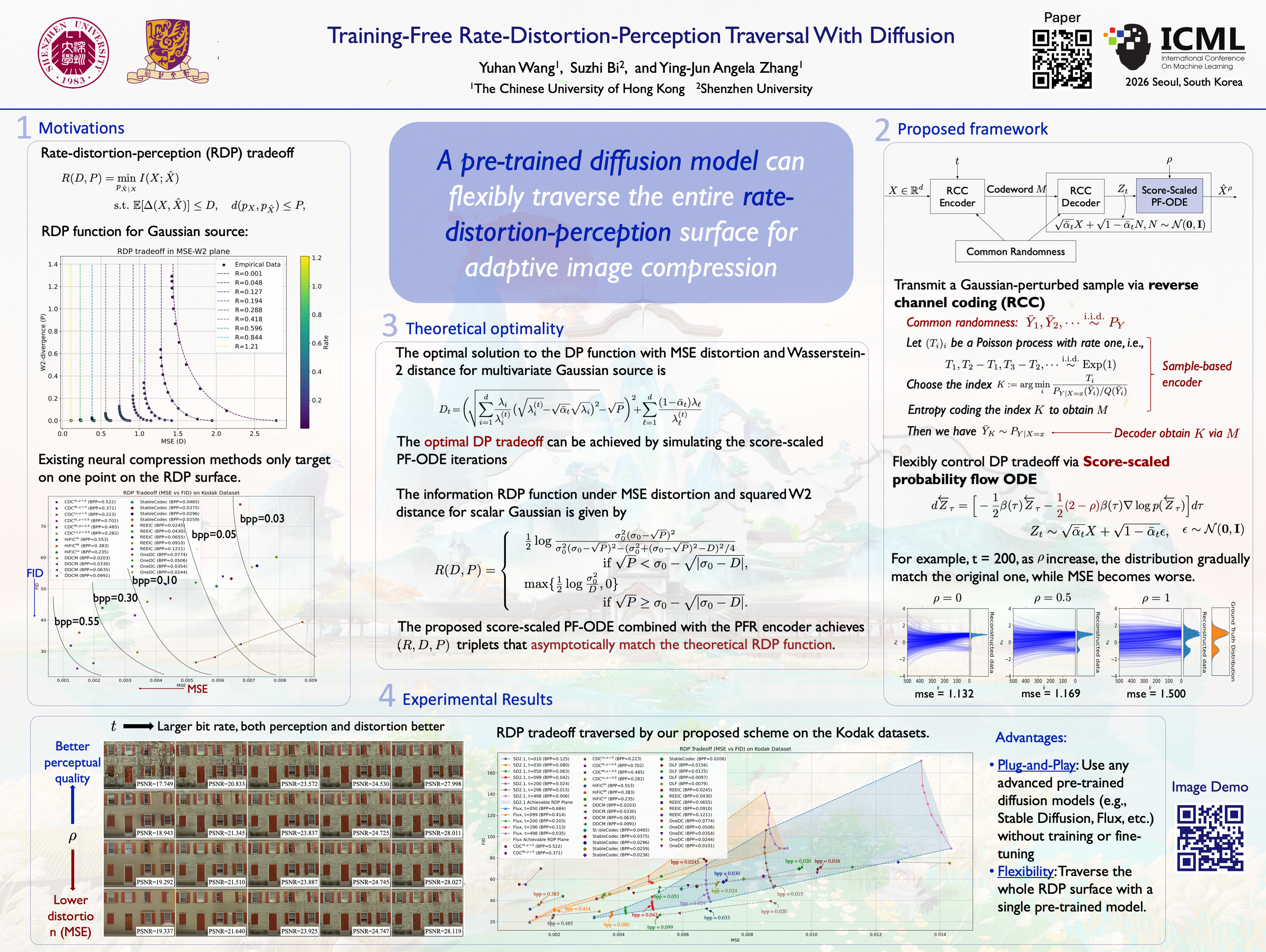
The rate-distortion-perception (RDP) tradeoff characterizes the fundamental limits of lossy compression by jointly considering bitrate, reconstruction fidelity, and perceptual quality. While recent neural compression methods have improved perceptual performance, they typically operate at fixed points on the RDP surface, requiring retraining to target different tradeoffs. In this work, we propose a training-free framework that leverages pre-trained diffusion models to traverse the entire RDP surface. Our approach integrates a reverse channel coding (RCC) module with a novel score-scaled probability flow ODE decoder. We theoretically prove that the proposed diffusion decoder is optimal for the distortion-perception tradeoff under AWGN observations and that the overall framework with the RCC module achieves the optimal RDP function in the Gaussian case. Empirical results across multiple datasets demonstrate the framework's flexibility and effectiveness in navigating the ternary RDP tradeoff using pre-trained diffusion models. Our results establish a practical and theoretically grounded approach to adaptive, perception-aware compression.
Lay Summary
Just as there are a thousand Hamlets in a thousand readers' eyes, now a single model can seamlessly shift to a thousand angles of image compression. When compressing images to save digital space, we traditionally balance the file size against how closely the pixels match the original image. However, mathematically minimizing pixel-level accuracy often leads to blurry or unnatural images to the human eye. Modern compression aims for a three-way balance: small file sizes, pixel accuracy, and realistic visual quality. Unfortunately, current AI compression tools require developers to train a brand-new model every time they want to adjust this specific balance. To solve this, this research introduces a "training-free" framework powered by diffusion models, similar to the AI used in popular image generators. By tweaking a newly developed mathematical dial called a "score-scaled" decoder, users can seamlessly balance between pixel-perfect accuracy and beautiful, realistic textures on the fly. This breakthrough matters because it offers ultimate flexibility for everyday technology. Instead of storing dozens of massive AI models for different internet speeds or display preferences, devices can use just one single model to perfectly adapt to any user's compression needs. This saves vast amounts of time, energy, and digital storage.