
Balancing Fidelity and Diversity in Diffusion Models via Symmetric Attention Decomposition: Hopfield Perspective
Abstract
Lay Summary
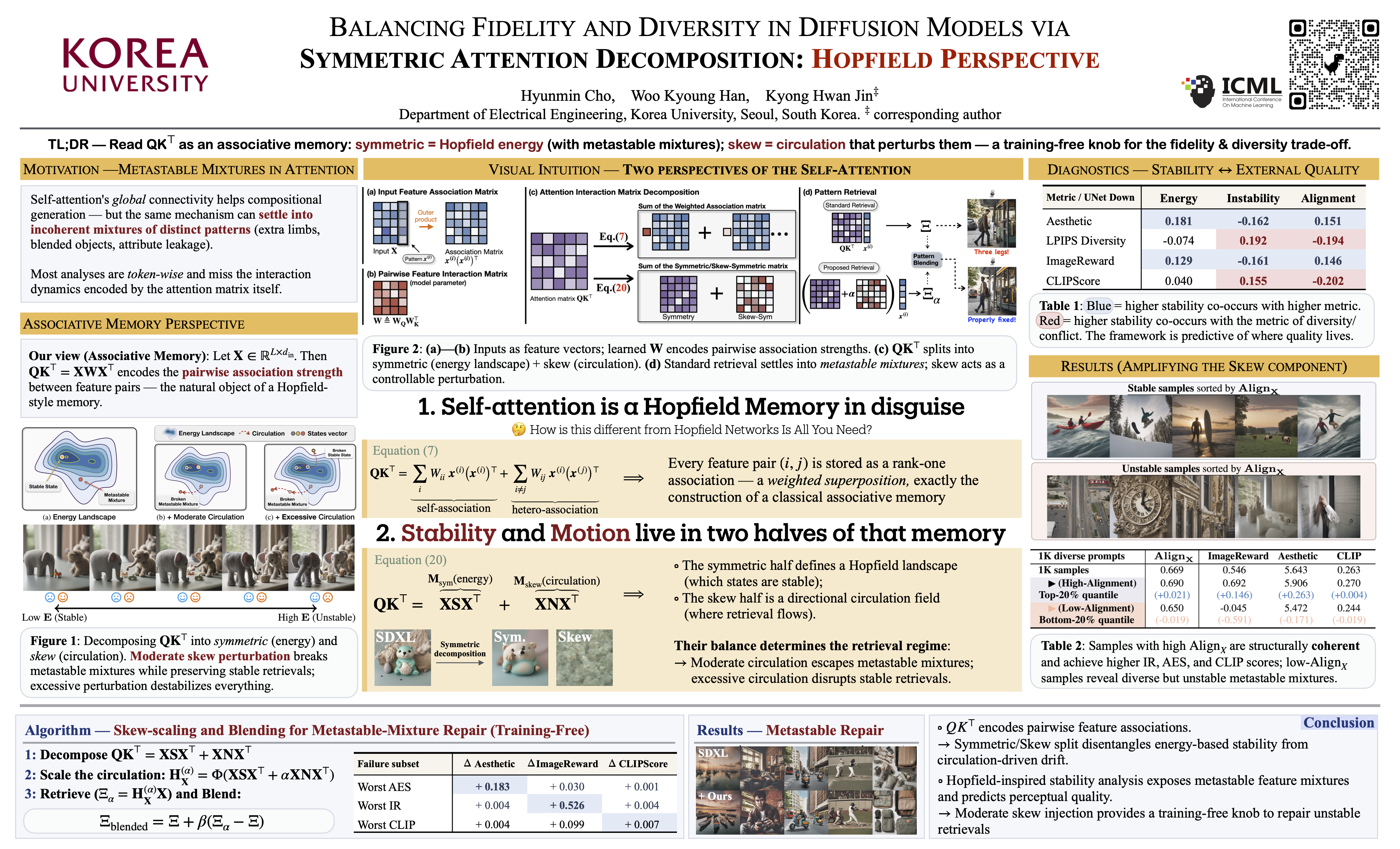
AI image generators can create rich and detailed pictures, but they sometimes produce strange errors, such as an animal with three legs or objects whose shapes and textures are incorrectly blended. These errors often come from attention, a key mechanism that lets different parts of an image influence one another during generation. Attention is useful because it helps the model connect related visual pieces into a coherent scene. However, the same process can also create wrong connections, making it difficult to separate helpful interactions from harmful ones. We study attention as a kind of associative memory, where one visual piece can bring related pieces to mind. From this view, attention is not only a way to combine image parts, but also a map of how those parts interact. We show that this map can be split into two components: one encourages stable, coherent structures, while the other creates directional movement that can help the model escape confused mixtures. By adjusting this movement, we can sometimes repair images that are stuck in flawed configurations, while too much adjustment can disturb images that were already well formed. This perspective helps explain why attention can both improve image coherence and produce visual confusion. It may also help make future image generators easier to understand, adjust, and trust.