
Seeking Commonality, Preserving Specificity: A Spectral-Aware Hierarchical Framework for Cross-City Road Representation Learning
Abstract
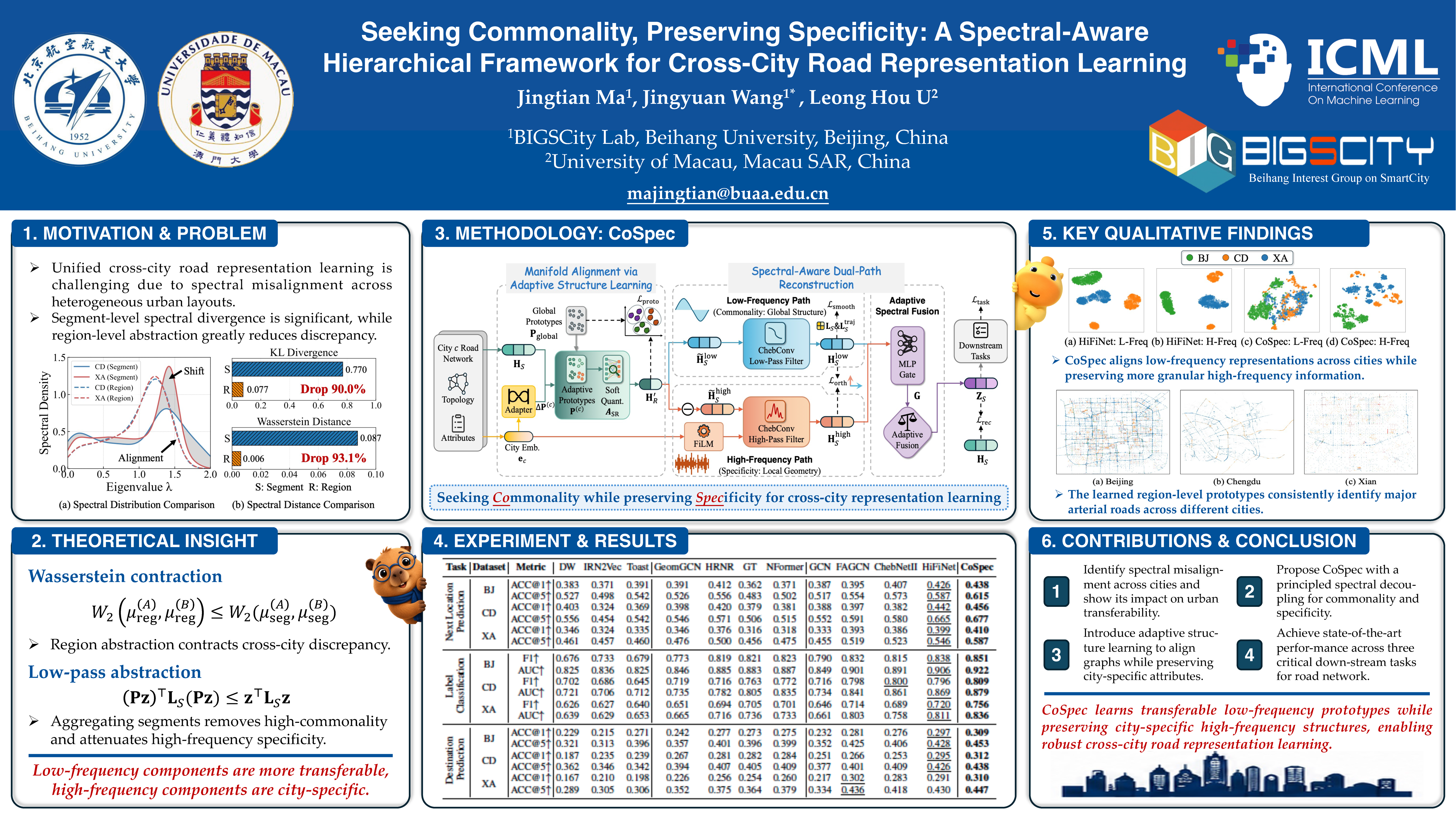
Learning unified road representations across diverse cities is a pivotal challenge in urban computing. However, existing approaches predominantly focus on single-city modeling, failing to handle the distribution shifts caused by heterogeneous urban layouts. We identify spectral misalignment, manifested as the significant divergence of spectral distributions across different cities, as the primary barrier preventing standard Graph Neural Networks from capturing universal patterns. To bridge this gap, we propose CoSpec, a framework that disentangles road networks into shareable low-frequency commonalities and city-specific high-frequency specificities. CoSpec employs a hierarchical dual-path architecture where the low-frequency path aligns global functional semantics via adaptive prototypes, while the high-frequency path modulates local geometric residuals to fit specific urban textures. Theoretical analysis shows CoSpec bounds the Wasserstein distance between city distributions, and extensive experiments demonstrate its superior generalization over state-of-the-art baselines.
Lay Summary
Road networks are fundamental to many urban computing applications, such as route planning, traffic prediction, and mobility analysis. However, a model trained on one city often performs poorly in another because cities can have very different road layouts, local structures, and traffic-related functions. This paper studies how to learn road representations that can transfer across cities while still respecting each city’s unique structure. Our key observation is that different cities may share high-level functional patterns, such as arterial roads and regional connections, even though their detailed geometric layouts differ. We propose CoSpec, a framework that separates these shared city-level patterns from local city-specific variations. It organizes road networks hierarchically and uses a spectral perspective to distinguish smoother, transferable patterns from sharper local structural details. This design helps the model capture what is common across cities while adapting to what is specific to each city. The resulting representations can improve cross-city generalization and reduce the need to collect large amounts of labeled data whenever road network models are deployed in a new city.