
CorrSteer: Generation-Time LLM Steering via Correlated Sparse Autoencoder Features
Abstract
Lay Summary
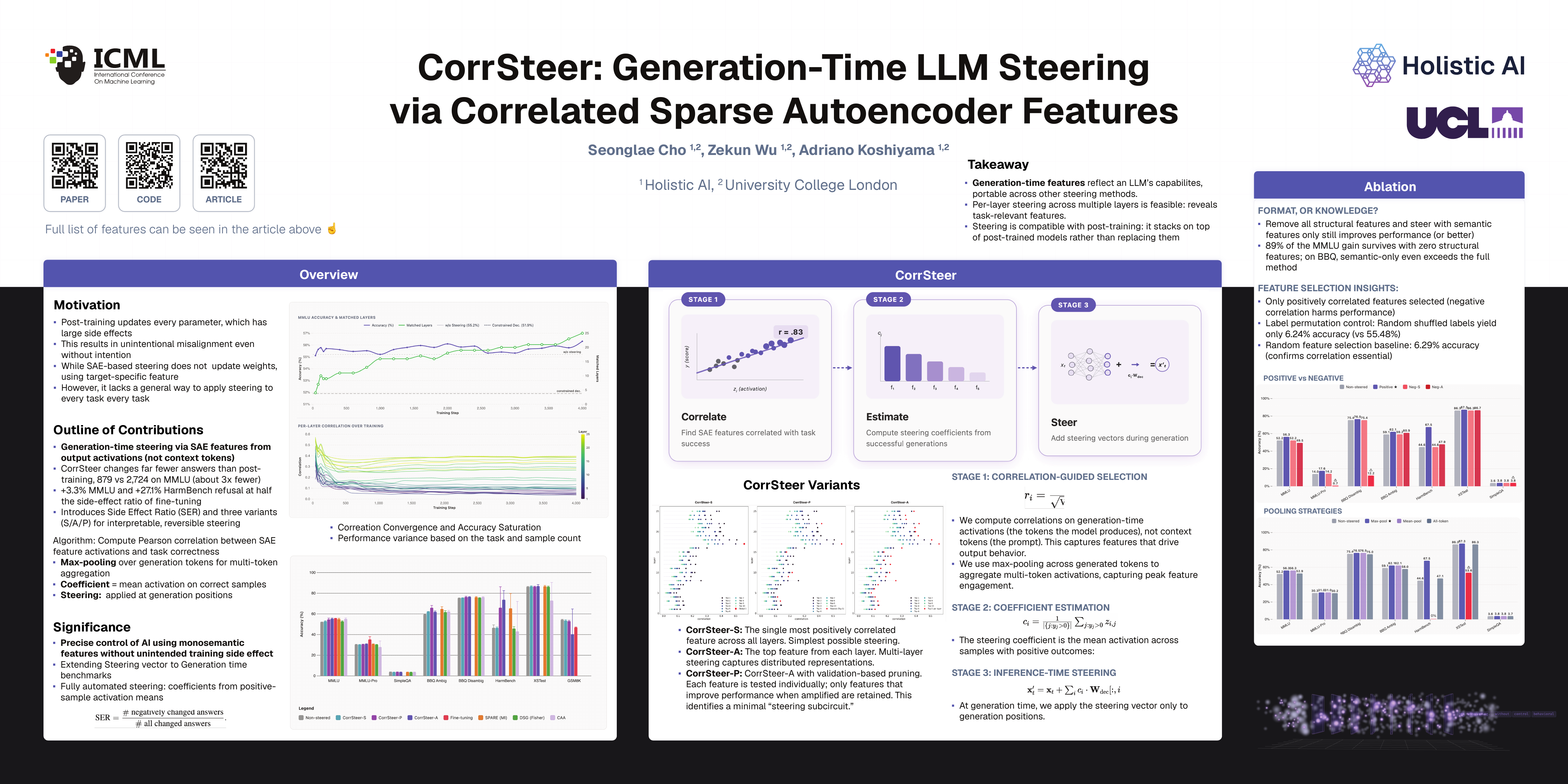
Problem. Adjusting a large language model toward a specific behavior, such as better accuracy, refusing harmful requests, or reducing bias, is usually done by fine-tuning, which acts like editing a genome with a shotgun: it hits the target but quietly damages unrelated abilities. Lighter alternatives that adjust the model's internal signals exist, but they need paired good/bad examples or huge memory, and they pick what to amplify from the input prompt rather than the actual output behavior. Solution. We introduce CorrSteer, an automated method that watches which interpretable building blocks light up while the model produces correct answers, then amplifies those blocks across every layer in real time as it writes. We pick blocks by correlating their activity with task success, then verify the link by amplifying each block and checking whether performance improves. We also introduce the Side Effect Ratio, a simple measure of how many unrelated answers change per improved answer. Impact. CorrSteer matches fine-tuning accuracy on knowledge tasks while halving the side-effect cost, works on any task that can be scored correct or incorrect, and the chosen blocks are mostly semantic concepts that humans can read, offering a continuous safety dial that can be tuned or turned off without retraining.