
Reinforcing Real-world Service Agents: Balancing Utility and Cost in Task-oriented Dialogue
Abstract
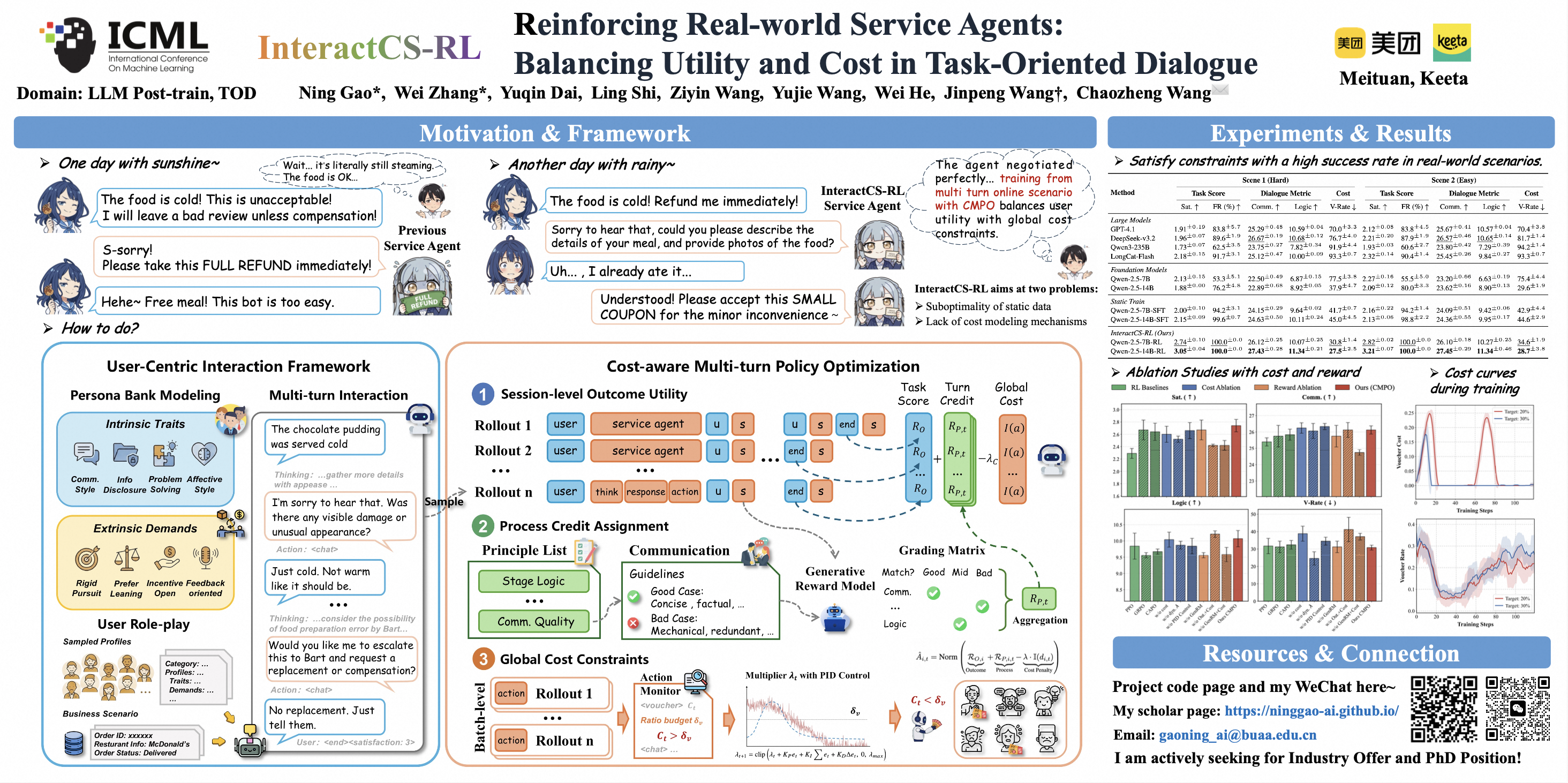
The rapid evolution of Large Language Models (LLMs) has accelerated the transition from conversational chatbots to general agents. However, effectively balancing empathetic communication with budget-aware decision-making remains an open challenge. Since existing methods fail to capture these complex strategic trade-offs, we propose InteractCS-RL, a framework that reframes task-oriented dialogue as a multi-granularity reinforcement learning process. Specifically, we first establish a User-centric Interaction Framework to provide a high-fidelity training gym, enabling agents to dynamically explore diverse strategies with persona-driven users. Then, we introduce Cost-aware Multi-turn Policy Optimization (CMPO) with a hybrid advantage estimation strategy. By integrating generative process credits and employing a PID-Lagrangian cost controller, CMPO effectively guides the policy to explore Pareto boundary between user reward and global cost constraints. Extensive experiments on customized real business scenarios demonstrate that InteractCS-RL significantly outperform other baselines across three evaluation dimensions. Further evaluation on tool-agent-user interaction benchmarks verify InteractCS-RL robustness across diverse domains. The source code and data are available at https://github.com/NingGao-Ai/InteractCS-RL.
Lay Summary
AI chatbots are quickly evolving into capable digital assistants, but deploying them in real-world customer service presents a unique challenge: they must balance keeping customers happy with protecting the company's cost line. Existing AI systems struggle with this complex balancing act. To solve this, we introduce InteractCS-RL, a new training framework for AI agents. First, we built a realistic "virtual practice gym" where the AI can safely practice interacting and negotiating with simulated customers of various personalities. Second, we designed a smart learning method that rewards the AI for good communication skills while strictly enforcing a budget. This teaches the AI to find the perfect "sweet spot" between maximizing user satisfaction and minimizing business costs. Our tests demonstrate that AI trained in this environment significantly outperforms previous models, paving the way for smarter, more practical, and cost-aware AI agents in everyday business scenarios.