
MMPD-Bench: Bridging Multimodal Fission with Multi-Polarimetric Modalities Decomposition
Abstract
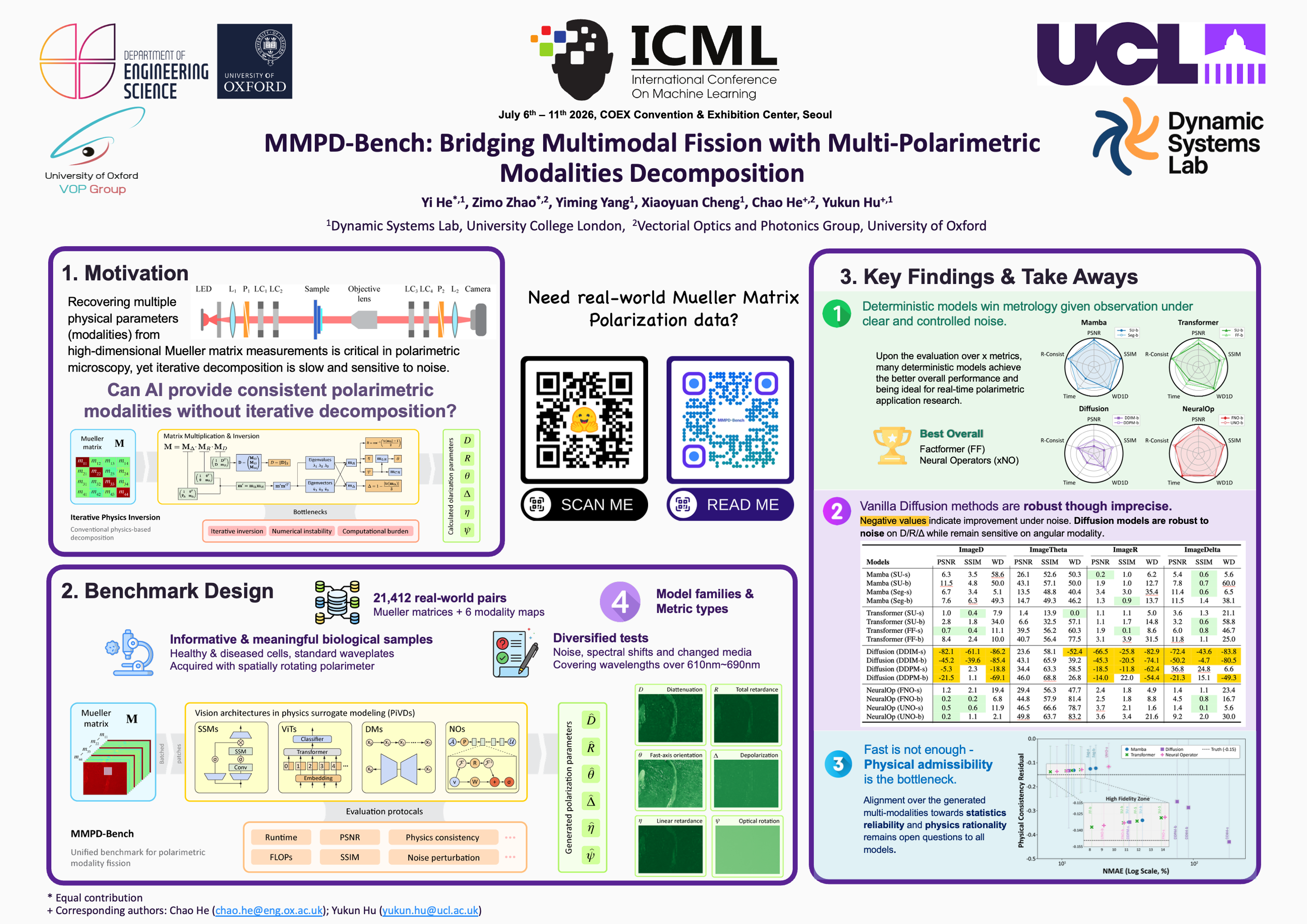
Recovering multiple physical parameters from high-dimensional optical measurements remains challenging in computational optics. We present MMPD-Bench, a pioneering benchmark that reframes multi-polarimetric modalities decomposition from Mueller matrix observations as a modality fission problem under the multi-modal learning paradigm. By replacing iterative numerical inversion with deep surrogate models, MMPD-Bench provides data, standardized solutions and evaluations to address the multi-physics modalities generation challenge. We benchmark representative architectures to this problem, including state-space models, vision transformers, conditional diffusion models, and neural operators, under a multi-faceted evaluation protocol that jointly assesses perceptual fidelity, physical consistency, robustness, and computational efficiency. Our analysis reveals non-trivial trade-offs between accuracy and robustness in accelerated high-fidelity polarimetric decomposition, highlighting key limitations of existing surrogates. To support reproducible research, we open-source the full codebase, together with a large-scale dataset of 21,412 high-resolution Mueller matrix observations acquired through extensive polarimetric measurements. We invite the community to further advance the intersection of polarization optics and multimodal representation learning.
Lay Summary
Polarised light can reveal hidden information about biological tissues and materials, but extracting this information is often slow and computationally demanding. MMPD-Bench is, to our knowledge, the first public dataset and systematic benchmark for AI-based Mueller matrix polarimetric decomposition. It provides real polarimetric measurements and a unified testbed for evaluating modern AI models in terms of accuracy, robustness, efficiency, and physical consistency. By filling a key gap in optical AI research, MMPD-Bench aims to support the development of trustworthy AI tools for computational optics, biomedical imaging, and scientific measurement.