
LLMInertia: Adaptive Counter-Inertial Reasoning to Improve Evidence Faithfulness in Large Language Models
Abstract
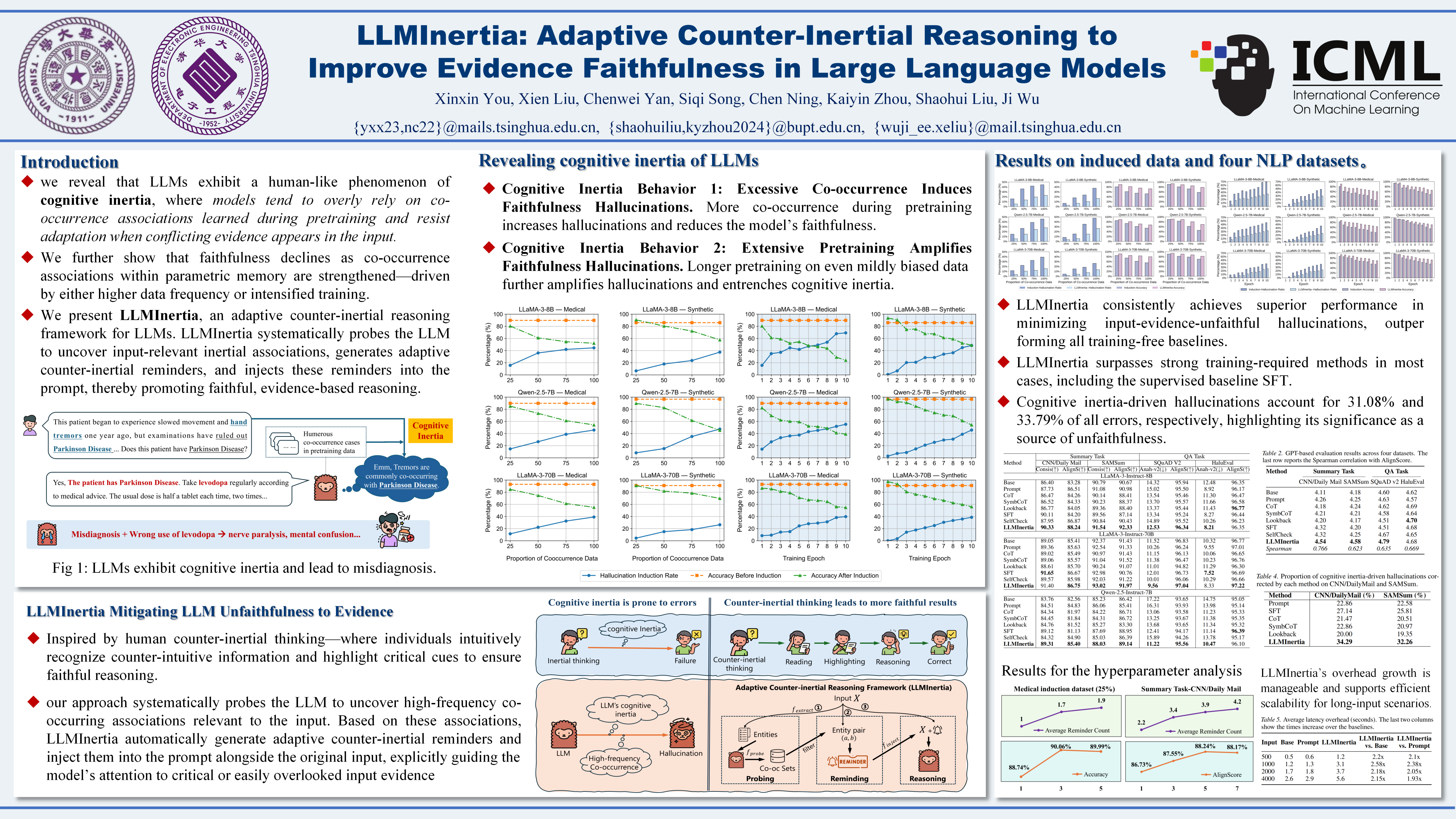
Large Language Models (LLMs) frequently generate output that contradicts explicit input evidence, limiting their reliability in real-world applications. We identify cognitive inertia in LLMs—a tendency to overly rely on co-occurrence associations learned during pretraining and to resist adaptation when conflicting input evidence appears—as a critical factor behind such hallucinations. We further empirically show that adherence to input evidence declines as co-occurrence associations are strengthened—driven by either higher data frequency or intensified training. Inspired by human counter-inertial thinking, we propose an adaptive counter-inertial reasoning framework that probes input-related cognitive inertia in the LLM and generates adaptive counter-inertial reminders, which are then injected into the prompt to promote evidence-based reasoning. Experiments on co-occurrence induction datasets show that LLMInertia reduces hallucination rates by up to 35\% and improves accuracy by up to 35.68\%. Extensive evaluations on four context-rich summarization and QA datasets, across three LLM backbones of varying scales, further validate its effectiveness and robustness. Our work provides new insight into the causes of input-unfaithful hallucinations in LLMs, contributing to the development of more reliable AI.
Lay Summary
Current large language models, like those behind AI chatbots, sometimes give answers that contradict the evidence in the user’s prompt. We discovered that one main reason is “cognitive inertia”—the model’s strong tendency to repeat patterns it learned during training, even when they go against new information. To solve this, we developed an adaptive approach that detects when the model is overly relying on old patterns. It then creates targeted reminders, based on the latest input, to encourage the AI to focus on the current evidence. These reminders are added to the prompt, guiding the model towards more reliable responses. This method helps the model generate responses that are more faithful to the input information, such as a patient’s condition in healthcare or case details in legal settings, making LLM outputs more reliable.