
Escaping the Likelihood Trap: Geometric Diversity Optimization for Long-Form Image Captioning
Abstract
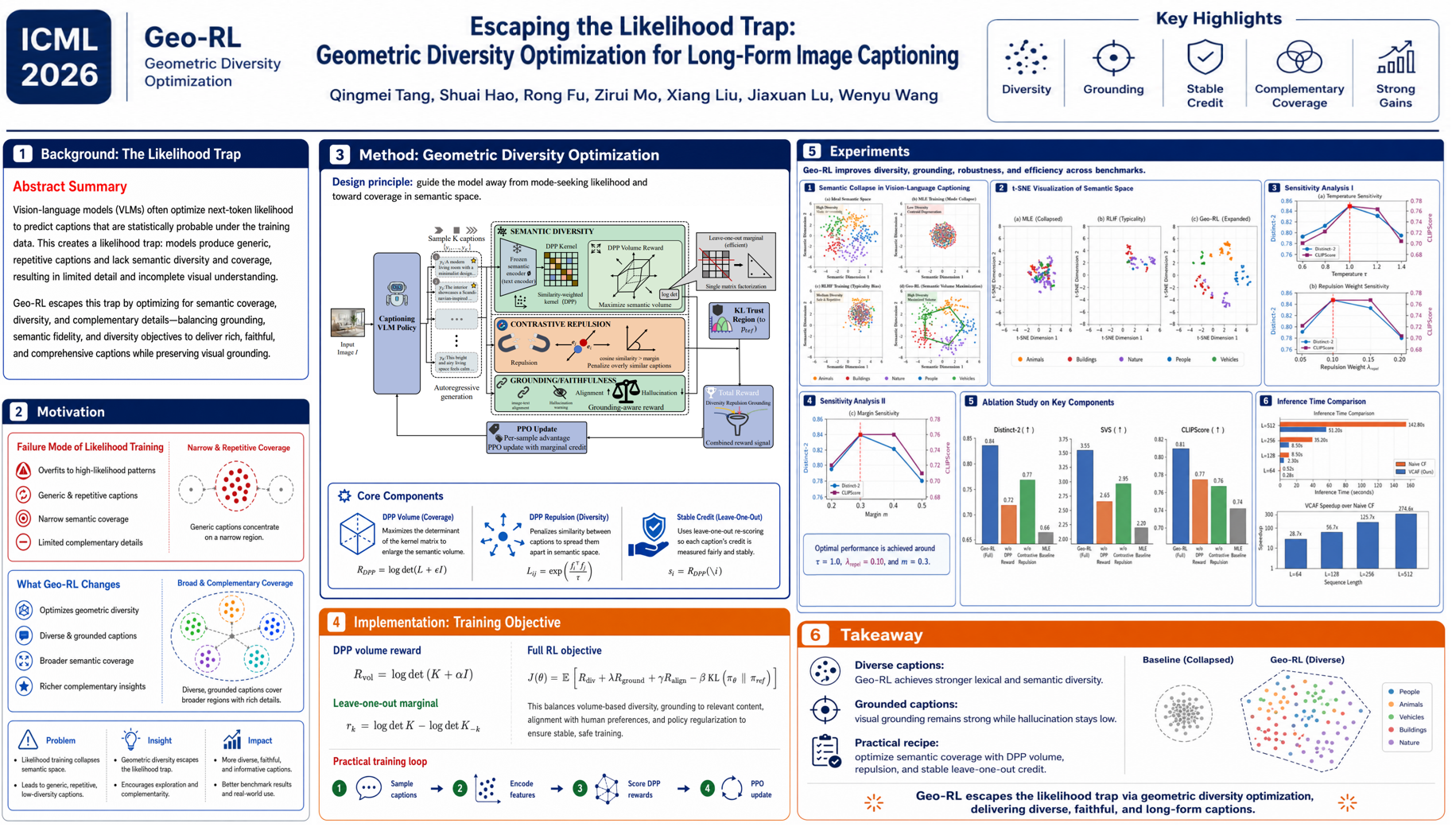
The utility of Vision-Language Models (VLMs) in reasoning and auditing tasks hinges on their ability to exhaustively describe visual scenes. However, current models exhibit a pathology we term the Likelihood Trap: standard alignment objectives, specifically MLE and KL-regularization, drive generation toward generic, high-probability templates, systematically suppressing fine-grained details. To overcome this, we introduce Geo-RL, a framework that shifts the objective from probabilistic likelihood to geometric coverage. Geo-RL reformulates caption generation as maximizing the volume of a parallelotope in semantic space. By leveraging Determinantal Point Processes (DPPs), we enforce orthogonality among sampled descriptions, ensuring that they span the image's full semantic support. Crucially, we derive a closed-form leave-one-out marginal reward, enabling stable policy optimization. Empirically, Geo-RL escapes the trap, achieving a significant improvement in semantic richness and detail coverage without compromising visual grounding.
Lay Summary
When AI models are asked to describe an image, they often get stuck repeating the most obvious details and miss the richer context of the scene. This paper introduces a new training approach that encourages AI to generate a diverse set of descriptions for a single image, capturing different perspectives, objects, and background details. Instead of just rewarding the AI for a single accurate sentence, our method rewards it for producing a group of captions that are both highly accurate and meaningfully different from one another. By measuring and maximizing the "spread" of meanings across these descriptions, our approach helps AI systems provide a much more comprehensive and varied understanding of visual scenes, moving beyond repetitive outputs to truly capture the full story of an image.