
CoverPruneGS: Coverage-Preserving Structured Pruning for Hierarchical 3D Gaussian Splatting from Sparse-View Monocular Videos
Abstract
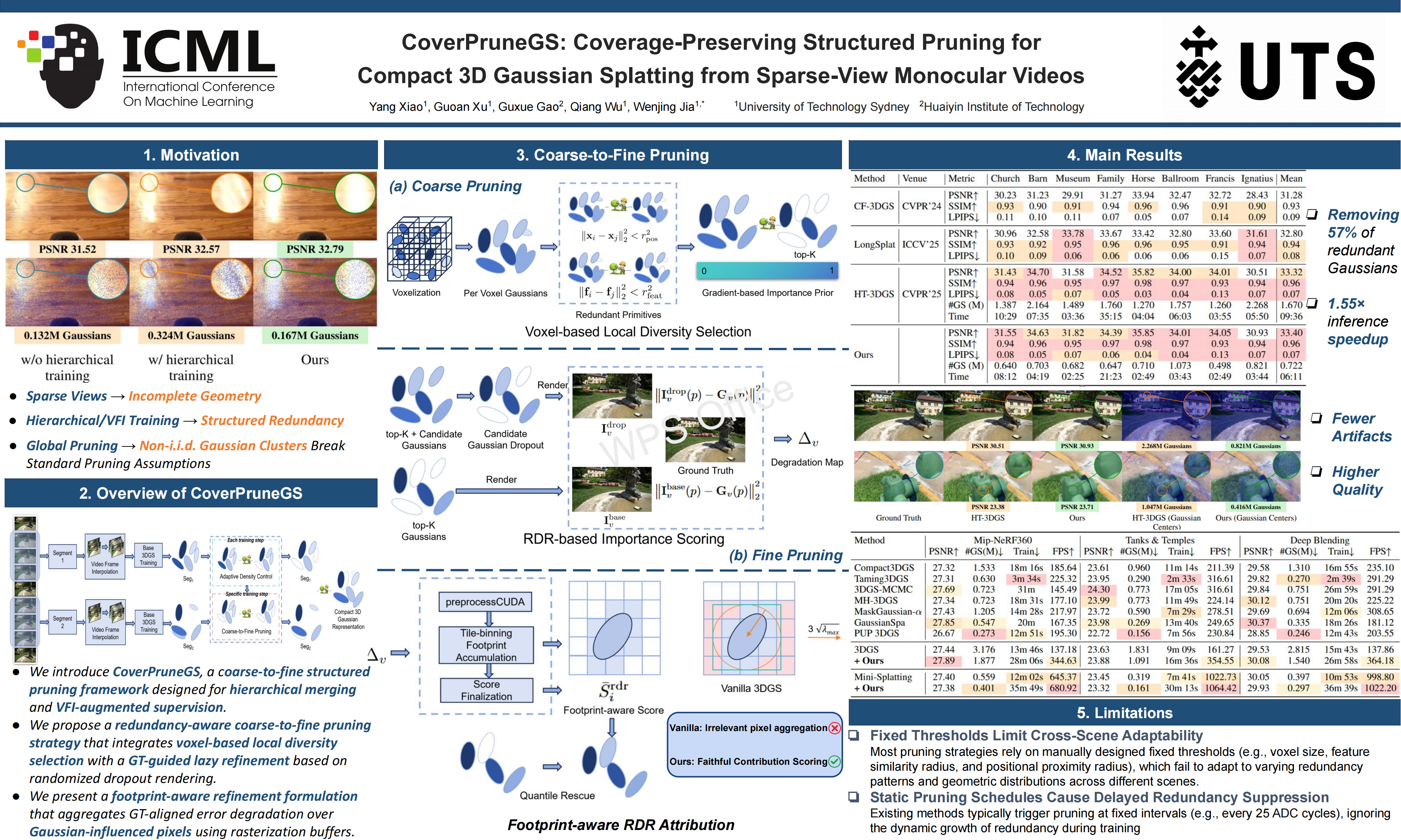
Reconstructing complete yet compact 3D Gaussian Splatting (3DGS) representations from sparse-view monocular videos remains a significant challenge. While hierarchical training with Video Frame Interpolation (VFI) improves coverage, its correlated pseudo-views and repeated merging accumulate structured, non-i.i.d. redundancy, violating the implicit independence assumptions of standard pruning methods and rendering global thresholding ineffectual. We propose CoverPruneGS, a coverage-preserving structured pruning framework specifically designed for hierarchical 3DGS. Our approach implements a coarse-to-fine pruning pipeline using voxel-based local diversity selection and ground-truth-guided lazy refinement via randomized dropout rendering. To ensure reliable refinement, we introduce a footprint-aware CUDA attribution mechanism. By aggregating ground-truth-aligned error degradation across Gaussian-influenced pixels, we generate faithful importance scores that enable precise, quantile-based "rescue" of essential primitives. Experimental results across multiple datasets demonstrate that CoverPruneGS substantially reduces Gaussian counts by 56.8\% and significantly accelerates inference speeds, all while enhancing or maintaining the quality of novel view synthesis.
Lay Summary
Building detailed 3D scenes from only a few video views is difficult because large parts of the environment are never clearly observed. Recent methods try to solve this by generating additional intermediate video frames and repeatedly merging partial 3D reconstructions together. While this improves scene coverage, it also creates many duplicated and highly similar 3D elements, making the final model unnecessarily large and inefficient. In this work, we introduce a new framework called CoverPruneGS to make 3D scene reconstruction both compact and accurate. Instead of removing 3D elements using simple global rules, our method first analyzes small local regions of the scene to identify duplicated structures, then carefully verifies whether removing them would actually harm image quality. This allows the system to safely eliminate redundant information while preserving important geometric details. Our method significantly reduces the number of 3D elements and speeds up rendering, while maintaining or even improving visual quality. These improvements make high-quality 3D reconstruction more practical for applications such as virtual reality, digital content creation, robotics, and autonomous systems operating under limited visual observations.