
Motion Dynamics Learning for Few-Shot Embodied Adaptation
Abstract
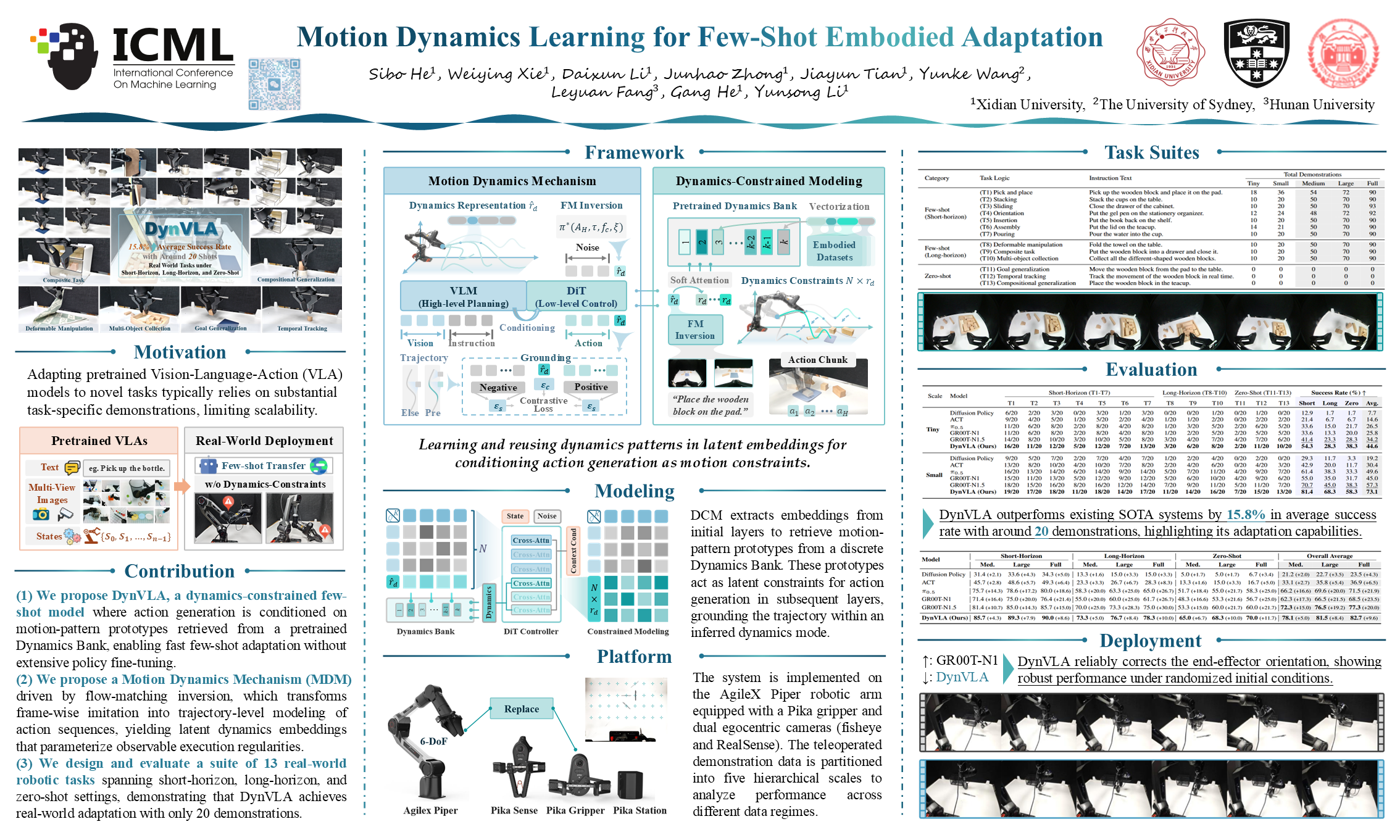
Vision-Language-Action (VLA) models have shown strong potential for robotic manipulation, yet adapting pretrained models to novel tasks typically relies on substantial task-specific demonstrations, limiting scalability. Current VLA methods mostly focus on action imitation, which ignores the richer structure contained in trajectories. In contrast, motion dynamics governing how actions evolve over time are more informative and transferable, making them better suited for few-shot adaptation. Motivated by this idea, we propose DynVLA, a few-shot adaptation system that reformulates VLA learning from action imitation to trajectory-level motion dynamics modeling. Specifically, we propose Motion Dynamics Mechanism (MDM), which distills latent embeddings from trajectories via flow-matching inversion, yielding compact representations that capture dynamics. We further design Dynamics-Constrained Modeling (DCM). DCM projects these inferred representations onto a Dynamics Bank, which stores prior motion knowledge pretrained from diverse demonstrations. By grounding action generation in these learned priors, the system enables interpolating between existing action paradigms to represent novel dynamics modes. Experiments on 13 real-world tasks demonstrate that DynVLA outperforms existing SOTA systems by 15.8\% in average success rate with around 20 demonstrations, highlighting its adaptation capabilities in real-world scenes. Our code is available at https://github.com/trantor2nd/Motion-DynVLA.
Lay Summary
Robotic models are becoming better at understanding images, language instructions, and actions together, but adapting them to new real-world tasks still often requires many human demonstrations. This makes robot learning expensive and difficult to scale, especially when a robot needs to perform a new manipulation task with only a few examples. In this work, we introduce DynVLA, a method that helps a robot learn from the way movements unfold over time, rather than only copying individual actions. The key idea is to reuse movement patterns learned from previous robot experience and use them to guide action generation for new tasks. This allows the robot to produce more reliable behaviors when only limited demonstrations are available. We evaluate DynVLA on 13 real-world tabletop manipulation tasks, including picking, placing, pouring, folding, multi-step object collection, and tasks involving new instructions. With around 20 examples for most training tasks, DynVLA achieves a 15.8% higher average success rate than the strongest comparison method. These results suggest that learning reusable movement patterns can make robot adaptation more data-efficient and reliable in practical settings.