
KAST-BAR: Knowledge-Anchored Semantically-Dynamic Topology Brain Autoregressive Modeling for Universal Neural Interpretation
Abstract
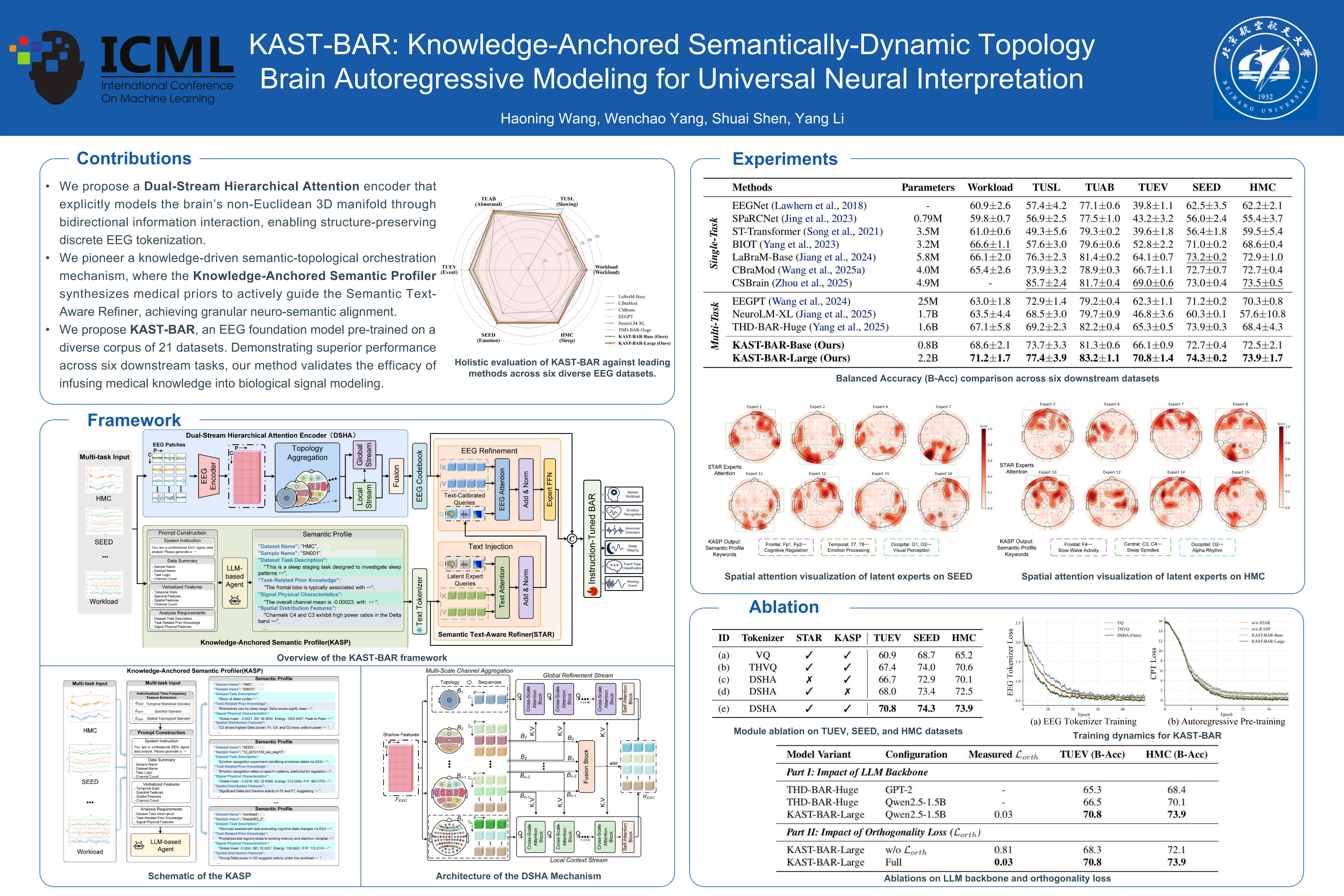
While EEG foundation models have shown significant potential in universal neural decoding across tasks, their advancement remains constrained by the inadequacy modeling of complex spatiotemporal topology, as well as the inherent modality gap between low-level physiological signals and high-level textual semantics. To address these challenges, we propose a Knowledge-Anchored Semantically-Dynamic Topology Brain Autoregressive Model (KAST-BAR), which dynamically aligns physiological representations derived from multi-level brain topology with an expert-level semantic space. Specifically, we design a Dual-Stream Hierarchical Attention (DSHA) encoder that accurately captures the brain's intrinsic non-Euclidean topology by modeling local temporal dynamics with global spatial contexts. On this basis, a Knowledge-Anchored Semantic Profiler (KASP) is proposed to synthesize physically-grounded and instance-level textual profiles, which subsequently drive a Semantic Text-Aware Refiner (STAR) to dynamically reconstruct EEG representations using Latent Expert Queries. By conducting large-scale pre-training on 21 diverse datasets to build a foundation model, KAST-BAR effectively integrates expert-level medical knowledge into EEG signal representations, consistently achieving state-of-the-art performance across six downstream tasks. Our code is available at https://github.com/KAST-BAR/KAST-BAR
Lay Summary
Interpreting brain waves with artificial intelligence is highly challenging. There is a massive gap between complex electrical signals and the high-level medical language doctors use to understand them. To bridge this gap, we developed KAST-BAR, a versatile foundational AI model for brain signals. Unlike previous methods that often treat brain signals merely as isolated streams of data, our model understands the spatial relationships between sensors. It captures how different brain regions coordinate as a unified network, allowing for a far more accurate interpretation of the brain's internal state. Furthermore, we built a "virtual medical expert" into the system. This expert translates raw physical data into descriptive text—such as noting abnormal low-frequency waves. This text then actively guides the AI, telling it exactly which brain regions to focus on for specific tasks, like looking for signs of deep sleep or emotional changes. We trained this foundation model on a massive collection of brain data from over 1,600 people. It demonstrated exceptional performance across various tasks, from detecting clinical seizures to analyzing emotions. Ultimately, this work brings us closer to creating highly reliable, universal brain-computer interfaces to assist doctors in neurological diagnostics.