
Unleashing the Representational Power of Fourier Shapes for Attacking Infrared Object Detection
Abstract
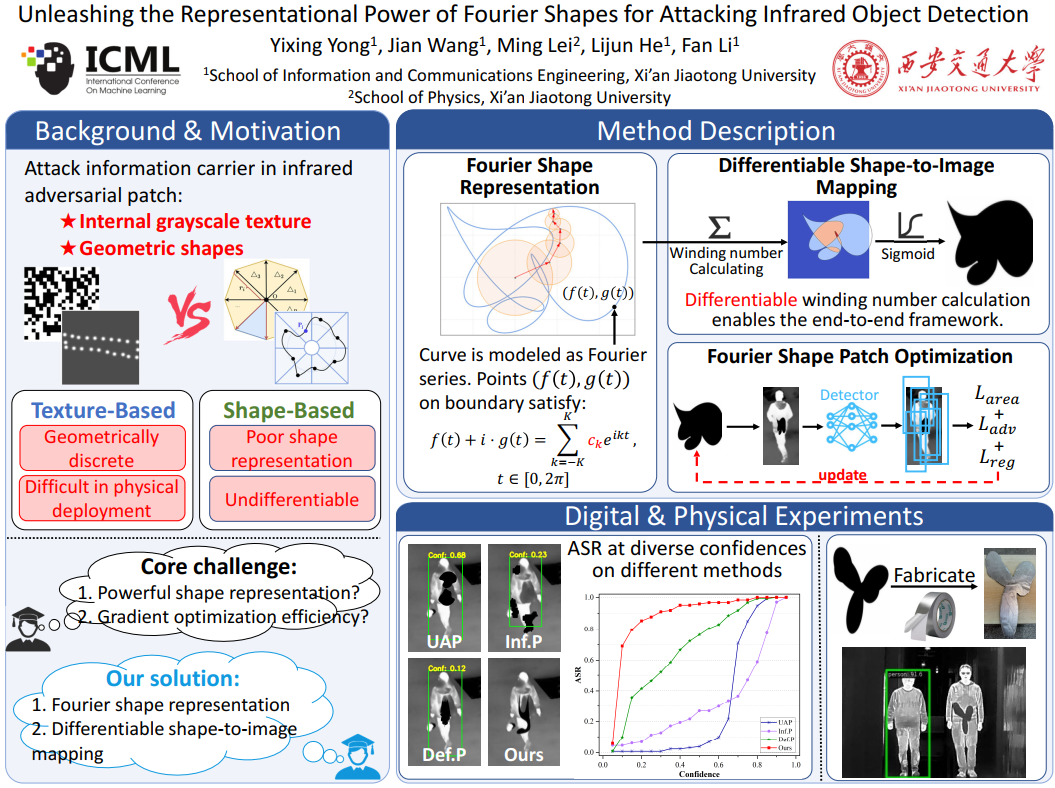
Infrared object detection is crucial for perception in autonomous driving and surveillance but remains vulnerable to physical adversarial attacks. Unlike in the RGB domain, where attacks rely on color texture, infrared attacks must manipulate thermal signatures, making the geometry shape of heat-blocking materials the primary adversarial information carrier. Current shape-based methods suffer from a fundamental trade-off between representational capability and optimization power, limiting their attack effectiveness. In this work, we overcome this dilemma by introducing learnable Fourier shapes to the infrared domain. We utilize an end-to-end differentiable framework where a compact set of Fourier coefficients, defining the shape boundary, is analytically mapped to a pixel-space mask via the winding number theorem. This enables efficient gradient-based optimization to generate potent shapes that cause human targets to evade detection. Extensive digital and physical experiments provide a comprehensive evaluation and validate our superior performance. Our resulting physical patch achieves striking robustness, successfully evading detectors across diverse distances, angles, poses, and individuals, and achieves over 88% attack success rate at distances greater than 25m (conf.=0.5). Code is available at https://github.com/Yongyx99/Fourier-shape-attack.
Lay Summary
Thermal infrared cameras are critical for autonomous driving and night surveillance because they “see” targets’ heat instated of light. However, some specific geometric patches can induce misdetections in AI-driven infrared object detection. Current attacks have limited shape representation, restricting their ability to find the most effective adversarial shape. To overcome this, we borrow the concept of Fourier Series in the field of signal processing. By parameterizing the boundary coordinates as linear combinations of periodic functions, a set of Fourier coefficients can be mapped to arbitrary shape. We leverage this representation to develop adversarial patches tailored for infrared object detection. Our findings demonstrate that these optimized shapes successfully enable human targets to evade from infrared object detection algorithms, and even be effective after physically printing with heat-blocking material. By unleashing the representational power of Fourier shapes, this work provides a potent new way for physical adversarial attacks in infrared domain, ultimately driving the development of more robust AI system.