
Efficient, Validation-Free Intrinsic Quality Estimation for Large-Scale Face Recognition Datasets
Abstract
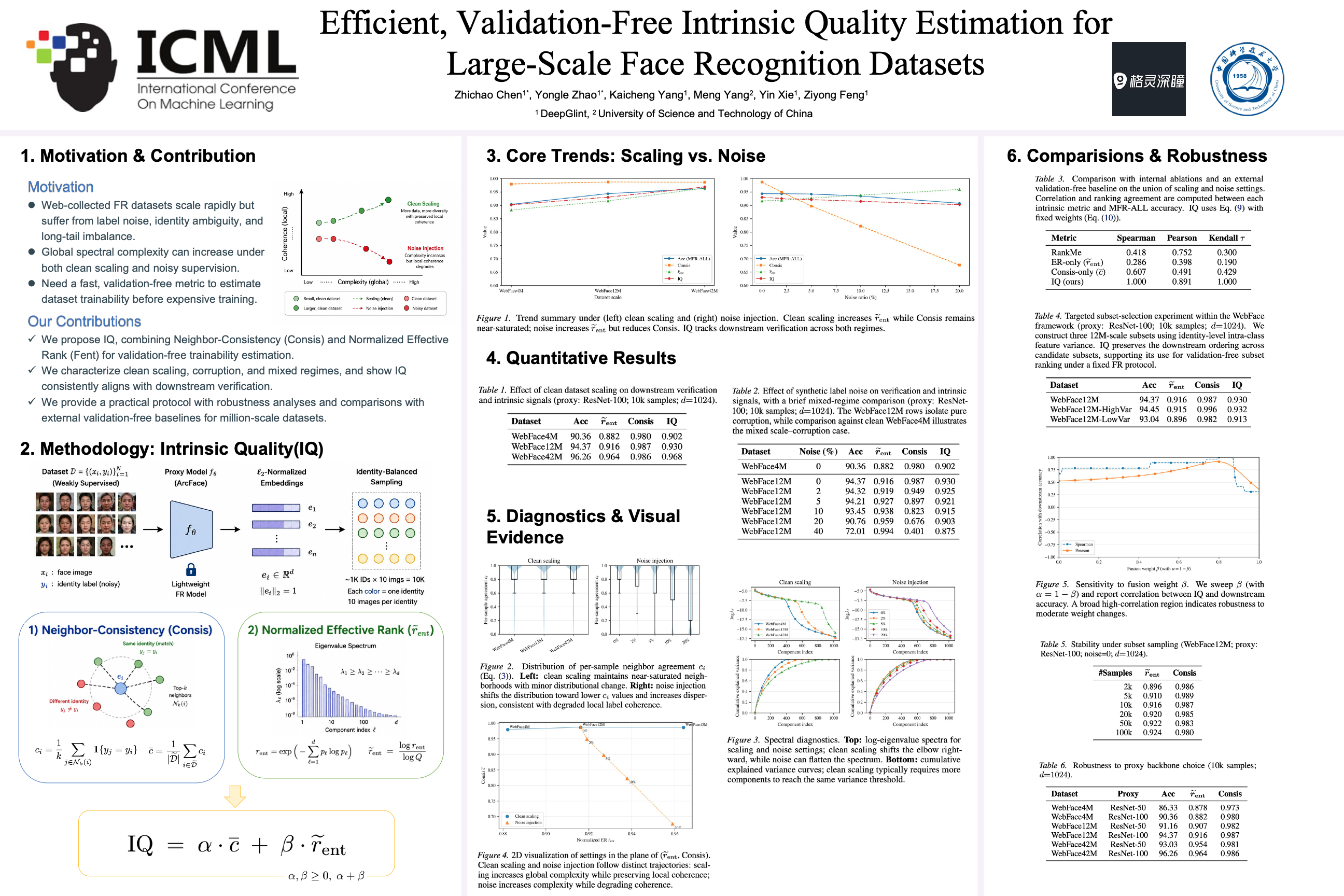
We propose Intrinsic Quality (IQ), a validation-free metric designed to estimate the inherent potential of face recognition (FR) datasets to produce high-performance models without the need for full-scale training. IQ integrates two components: (i) a Neighbor-Consistency Score that quantifies local identity label agreement via nearest neighbors, and (ii) Global Representation Subspace Complexity (Effective Rank, ER), which captures the underlying embedding geometry and dataset diversity. IQ allows for rapid evaluation using lightweight proxy models or data subsets, facilitating dataset diagnosis and curation prior to resource-intensive full-scale training. We describe an experimental protocol tailored to clean, noisy, and mixed‑quality FR datasets, and outline evaluation methodologies to validate IQ’s predictive power for downstream performance.
Lay Summary
Large face recognition systems are often trained on millions of images, but building a good training dataset is difficult. Web-collected face datasets may contain mislabeled identities, duplicates, or other forms of noise, and the usual way to tell whether a dataset is useful is to fully train a model on it, which is expensive and slow. This makes it hard to quickly compare dataset variants or decide whether additional data collection and cleaning are worthwhile. In this work, we propose a lightweight metric called Intrinsic Quality (IQ) for estimating the training value of a face recognition dataset before full-scale training. IQ combines two signals from a small proxy model: whether nearby face embeddings tend to share the same identity label, and how broadly the embeddings spread in the representation space. Across clean scaling, synthetic label noise, and subset-selection experiments, IQ tracks downstream verification performance more reliably than using either signal alone. We see IQ as a practical tool for dataset diagnosis and ranking under a fixed face recognition pipeline, rather than a universal measure of dataset quality. In particular, it does not by itself measure fairness, privacy, or deployment suitability.