
Unbiased Dynamic Pruning for Efficient Group-Based Policy Optimization
Haodong Zhu ⋅ Ren Yangyang ⋅ Yanjing Li ⋅ Mingbao Lin ⋅ Linlin Yang ⋅ Xuhui Liu ⋅ Xiantong Zhen ⋅ haiguang liu ⋅ Baochang Zhang
Abstract
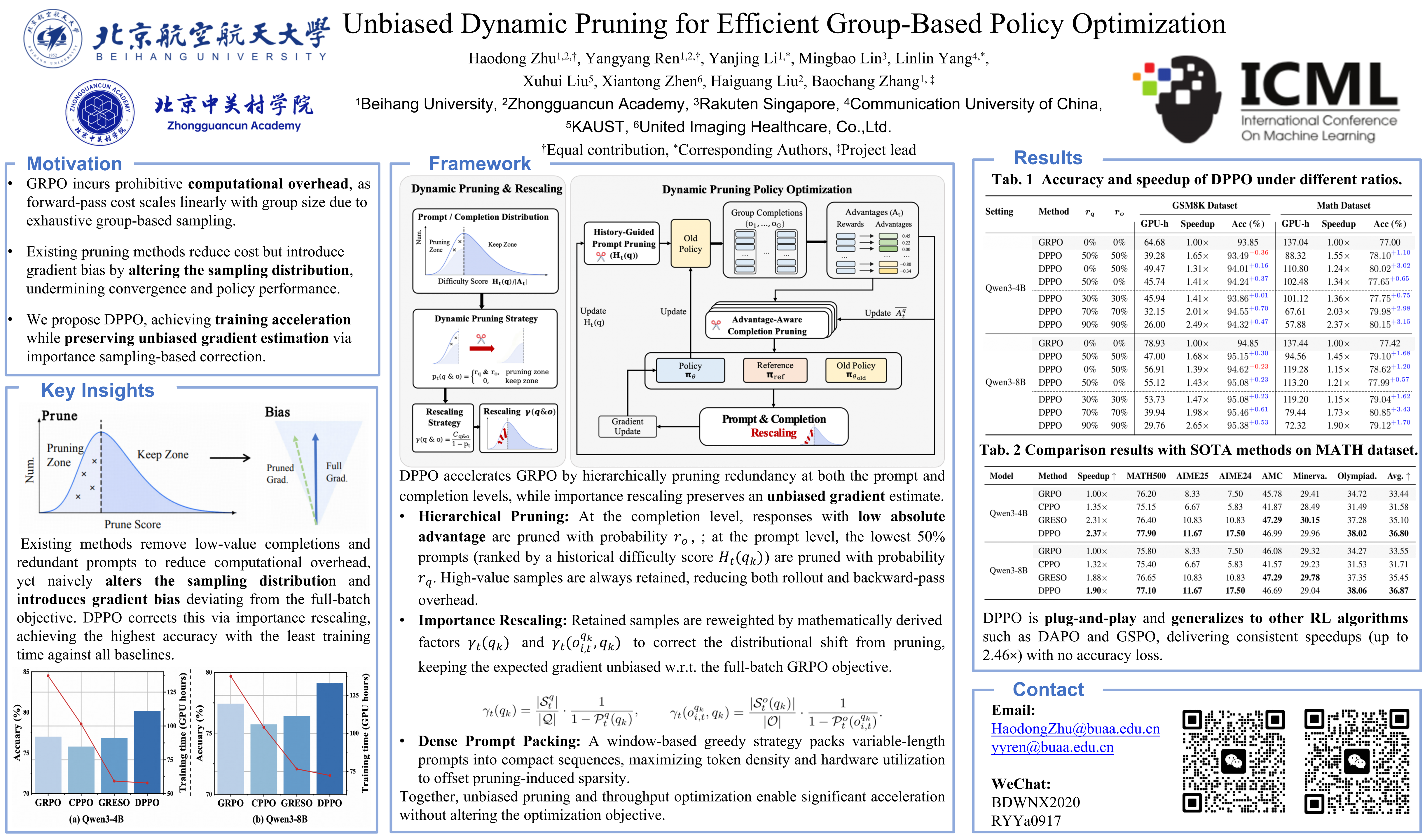
Group Relative Policy Optimization (GRPO) effectively scales LLM reasoning but incurs prohibitive computational costs due to its extensive group-based sampling requirement. While recent selective data utilization methods can mitigate this overhead, they could induce estimation bias by altering the underlying sampling distribution, compromising theoretical rigor and convergence behavior. To address this limitation, we propose Dynamic Pruning Policy Optimization (DPPO), a framework that enables dynamic pruning while preserving unbiased gradient estimation through importance sampling-based correction. By incorporating mathematically derived rescaling factors, DPPO significantly accelerates GRPO training without altering the optimization objective of the full-batch baseline. Furthermore, to mitigate the data sparsity induced by pruning, we introduce Dense Prompt Packing, a window-based greedy strategy that maximizes valid token density and hardware utilization. Extensive experiments demonstrate that DPPO consistently accelerates training across diverse models and benchmarks. For instance, on Qwen3-4B trained on MATH, DPPO achieves 2.37$\times$ training speedup and outperforms GRPO by 3.36\% in average accuracy across six mathematical reasoning benchmarks.
Lay Summary
To make AI language models better at reasoning, such as solving math problems, they are trained with reinforcement learning, a trial-and-error process in which the model generates many candidate answers for each problem and is rewarded for the good ones. This makes training powerful but very slow and expensive. A common shortcut is to discard some answers to save time, but this usually skews the training and weakens the final model. Our method discards only redundant answers and mathematically re-weights the rest, so the training stays accurate and yields the same result as keeping every answer, only much faster. As a result, we train reasoning models about 2.37$\times$ faster while maintaining or even improving their accuracy, lowering the time, cost, and energy needed to build capable AI.
Video
Chat is not available.
Successful Page Load