
Influence-Disentangled Federated Training: Learning Models That Are Easy to Unlearn
Abstract
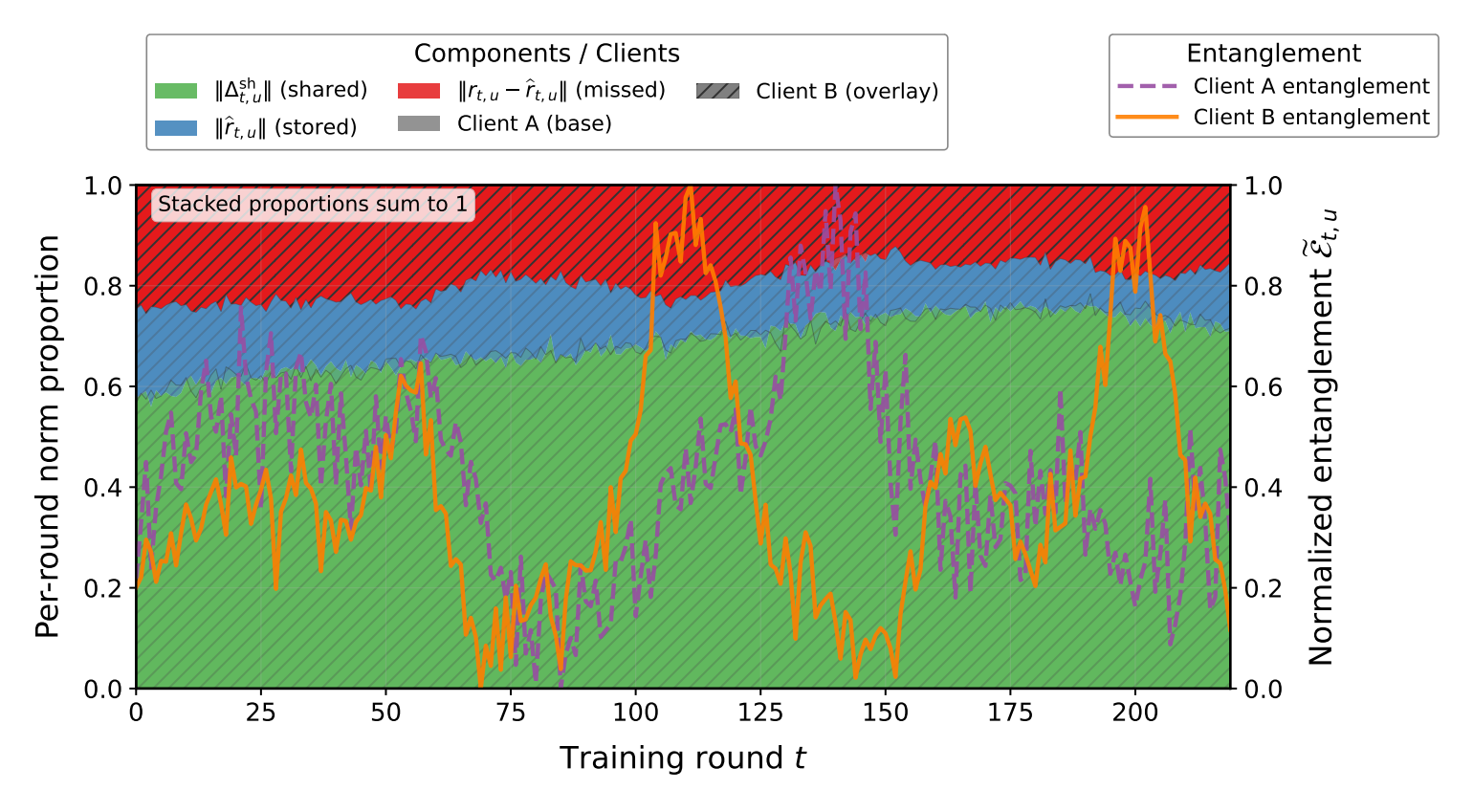
Federated learning increasingly faces deletion requests that require client-level unlearning without sacrificing model quality, yet a client’s influence is often deeply entangled after many rounds of aggregation. We aim to make unlearning fast, stable, and predictable by reducing the gap to leave-one-out retraining under realistic heterogeneity. We propose Influence-Disentangled Federated Training (IDFT), which instruments standard FedAvg with training-time influence logging: each round’s updates are decomposed into shared covarying directions and a client-separable residual trace, and an entanglement-aware shrinkage suppresses non-removable components. Deletion then becomes a single subtraction followed by a short anchored repair, yielding a stability-style characterization of retrain fidelity driven by the unremoved residual. Across representative benchmarks, IDFT consistently attains the lowest retrain gap (Avg. Gap) on multiple dataset--architecture pairs and improves the fidelity--cost frontier, matching retrain-level forgetting with substantially lower communication/compute than history-heavy baselines. These results suggest a practical pathway to unlearning-friendly federated systems by designing for removability during training rather than relying solely on post-hoc corrections.
Lay Summary
AI models are often trained using information from many users, devices, or organizations. When one participant later asks to remove their contribution, the safest approach is usually to train the model again without them, but this can be slow and expensive. This paper introduces IDFT, a way to make such removal easier. During training, IDFT keeps a compact record of the parts of learning most specific to each participant while separating them from broadly shared knowledge. When a removal request arrives, the system subtracts that participant’s recorded contribution and performs a short cleanup step. Experiments show that IDFT can closely match full retraining while using much less time, computation, and communication, making data removal more practical for real-world AI systems.