
Uni-DocRobust: Universal Plug-and-Play Robustness Enhancement for Multi-modal LLMs via Feature Restoration
Abstract
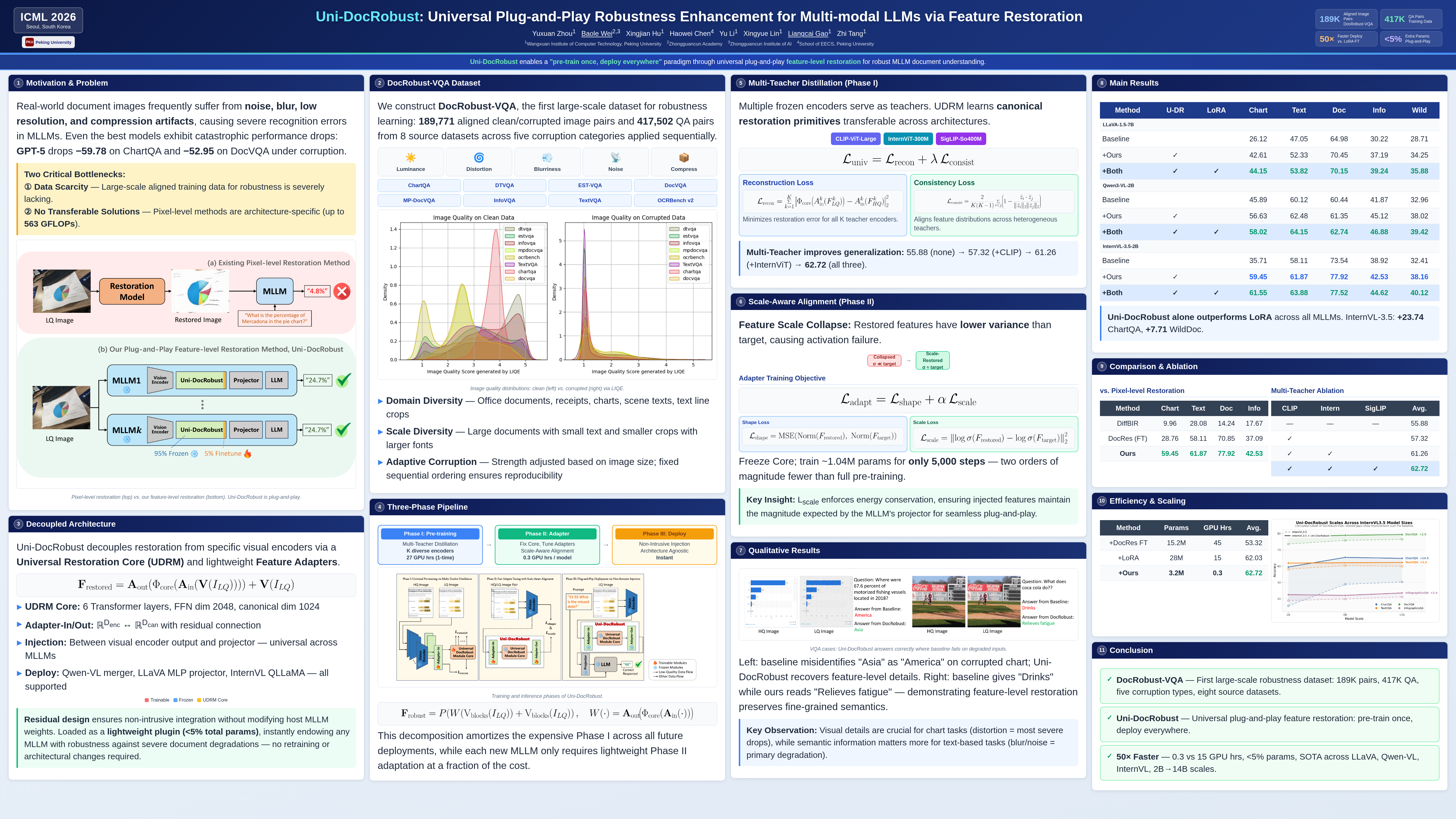
Real-world degradations, such as noise, blur, and low resolution, significantly impair the performance of Multi-modal Large Language Models (MLLMs) in document understanding tasks. Despite recent advancements, progress in this field remains stifled by two critical bottlenecks: the scarcity of large-scale, aligned training data necessary for learning robustness, and the lack of transferable restoration solutions across diverse MLLM architectures. To bridge the data gap, we first present DocRobust-VQA, a large-scale dataset explicitly constructed to support robustness training. Comprising 189K aligned clean/corrupted document image pairs and 417K QA pairs, it provides the first substantial corpus for fine-tuning MLLMs to handle varying degradation conditions. Leveraging this data, we propose Uni-DocRobust, a universal plug-and-play framework that decouples restoration capabilities from specific visual encoders. Our method employs a frozen Universal Restoration Core pre-trained in a canonical feature space via multi-teacher distillation, which can be seamlessly integrated into target MLLMs (e.g., Qwen-VL, InternVL) through lightweight Feature Adapters. Extensive experiments demonstrate that Uni-DocRobust significantly enhances robust performance on MLLMs and enables a cost-effective ``pre-train once, deploy everywhere'' paradigm for robust MLLM deployment.
Lay Summary
Problem In everyday scenarios, AI systems are frequently tasked with interpreting blurry, noisy, or low-resolution document images, such as historical archives or smartphone photos of receipts. Although Large Language Models (LLMs) are incredibly capable, they still struggle to read these degraded documents accurately, while traditional "fix-the-pixels-first" restoration methods are computationally expensive and inefficient for downstream tasks. Solution To overcome these limitations, we developed a "plug-and-play" enhancement framework named Uni-DocRobust, alongside introducing a large-scale training dataset, DocRobust-VQA, featuring 189K image pairs to teach AI models how to handle degradation. Instead of trying to clean up the image pixel-by-pixel, our lightweight module acts like "corrective lenses" for the AI, repairing the broken semantic information deep within the model's feature space. Crucially, it employs a "pre-train once, deploy everywhere" strategy, allowing it to be seamlessly and cheaply attached to various existing AI architectures without altering their original structures. Impact This novel approach significantly boosts the ability of AI models to accurately understand documents under severe, real-world visual conditions. By drastically reducing the computational overhead required to achieve such robustness, our framework paves the way for deploying highly capable, efficient document AI systems across diverse, resource-constrained environments.