
The Labyrinth and the Thread: Rethinking Regularizations in Sequential Knowledge Editing for Large Language Models
Abstract
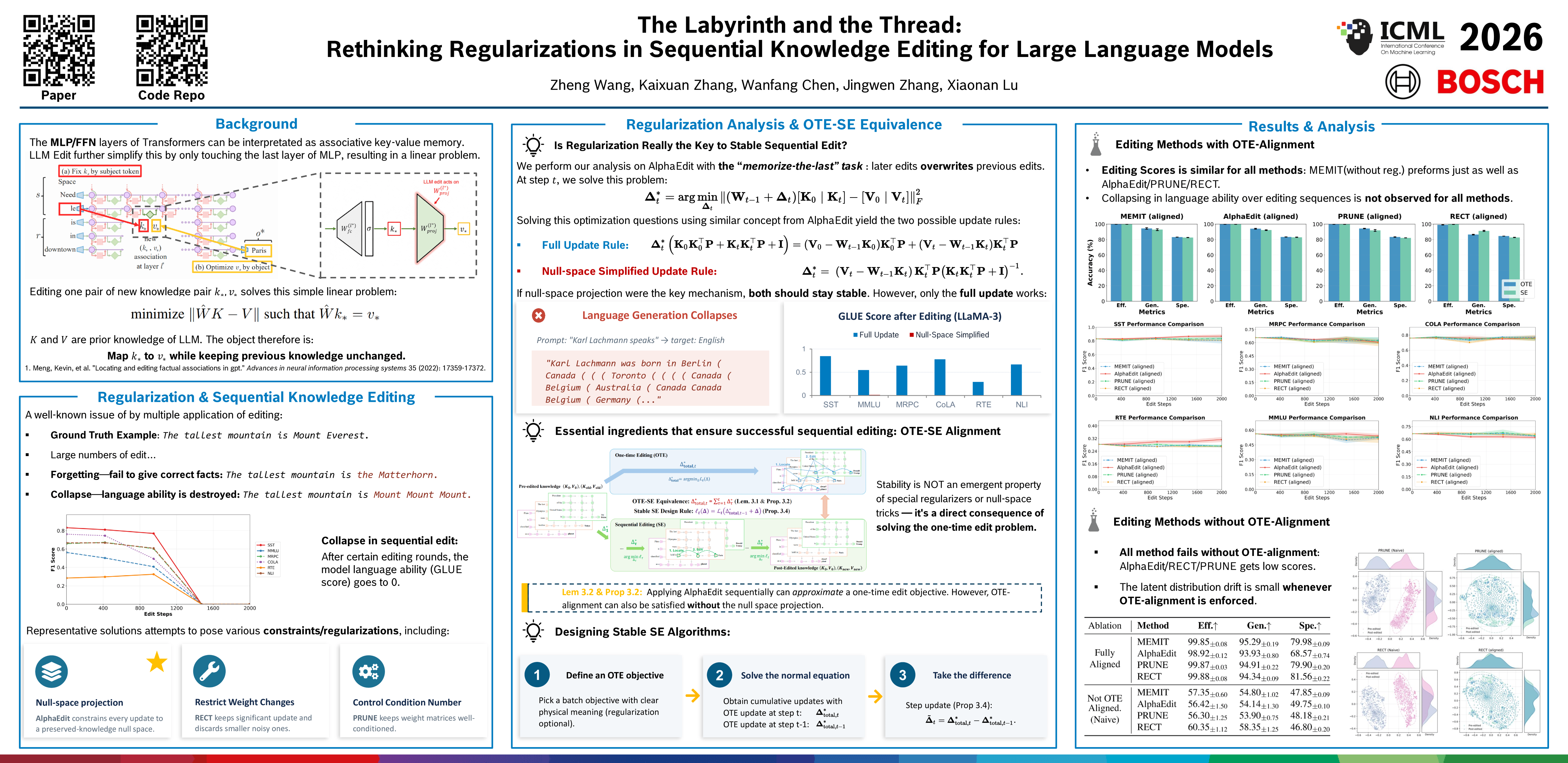
Sequential editing of structured knowledge in large language models allows targeted factual updates without retraining, yet existing methods often rely on complex regularization or constraint mechanisms whose necessity remains unclear. In this work, we systematically investigate the mechanisms underlying effective and stable sequential editing. Specifically, we first analyze the empirical success of AlphaEdit and establish, via a rigorous optimization analysis, the formal equivalence between one-time and sequential editing. Building on this insight, we generalize the equivalence to a broader class of editing objectives, demonstrating that stability emerges naturally from properly accounting for accumulated editing constraints, rather than from specialized regularization or null-space operations. We empirically confirm that many commonly used regularization strategies are unnecessary for reliable sequential updates. Furthermore, we extend our framework to handle conflicting edits, ensuring robust and consistent behavior under contradictory updates. Ultimately, our work provides Ariadne's thread through the labyrinth of sequential editing, charting a path toward simpler, more interpretable, and dependable knowledge updates. Our code is available at https://github.com/Wangzzzzzzzz/OTE-SE-Alignment.
Lay Summary
Large language models can contain outdated or incorrect facts. One way to fix this is to edit the model so that it updates a specific piece of knowledge without retraining the entire model. However, when many facts are edited one after another, later edits can accidentally damage earlier ones or disrupt other knowledge. This paper studies why some methods can make these updates reliably. Many existing approaches use extra safeguards, such as special constraints or regularization techniques, to prevent edits from interfering with each other. We show that these safeguards are not the main source of stability. Instead, stability comes from making each individual edit behave as if all edits had been applied together at once. Based on this insight, the paper shows that sequential knowledge editing can be made simpler, easier to understand, and more reliable. We support this with both mathematical analysis and experiments. We also study cases where a new edit contradicts an earlier one, and propose a more consistent way to handle such conflicts. Overall, the work helps explain why sequential knowledge editing works and points toward simpler methods for keeping language models up to date.