
Correcting Visual Blur Induced by Attention Distraction to Reduce Hallucinations: Algorithm and Theory
Abstract
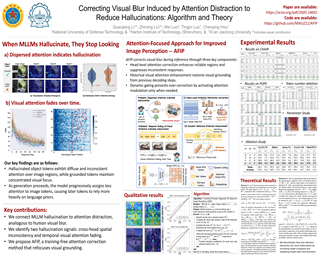
Multimodal large language models (MLLMs) frequently suffer from object hallucinations, yet the visual perceptual mechanism underlying this failure remains poorly understood. In this work, we reveal that hallucinations are strongly associated with a human-like attention distraction phenomenon, where humans under divided focus experience degraded visual clarity and produce inaccurate descriptions, while in models the same mechanism manifests as spatial inconsistency in multi-head attention and temporal fading of attention to image tokens during decoding. We further provide theoretical insights that attention dispersion increases model complexity and degrades classification generalization. Motivated by these findings, we propose an Attention-Focused Approach for Improved Image Perception (AFIP), which corrects attention distraction via cross-head attention enrichment and reinforces visual grounding through dynamic historical attention enhancement. Extensive experiments on multiple benchmarks and models validate the effectiveness of AFIP without additional training.
Lay Summary
Multimodal large language models frequently exhibit object hallucinations. We identify two core underlying causes, i.e., inconsistent multi-head attention and progressive attenuation of visual focus during autoregressive decoding. These behaviors closely resemble humans becoming inattentive and experiencing blurred visual perception. To address this, we introduce AFIP a training-free paradigm that rectifies attention discrepancies across heads and reinforces historical visual awareness. Extensive evaluations demonstrate that AFIP substantially curtails hallucinatory outputs and delivers robust performance.