
Learning to Rank from Incomplete Rankings
Abstract
Lay Summary
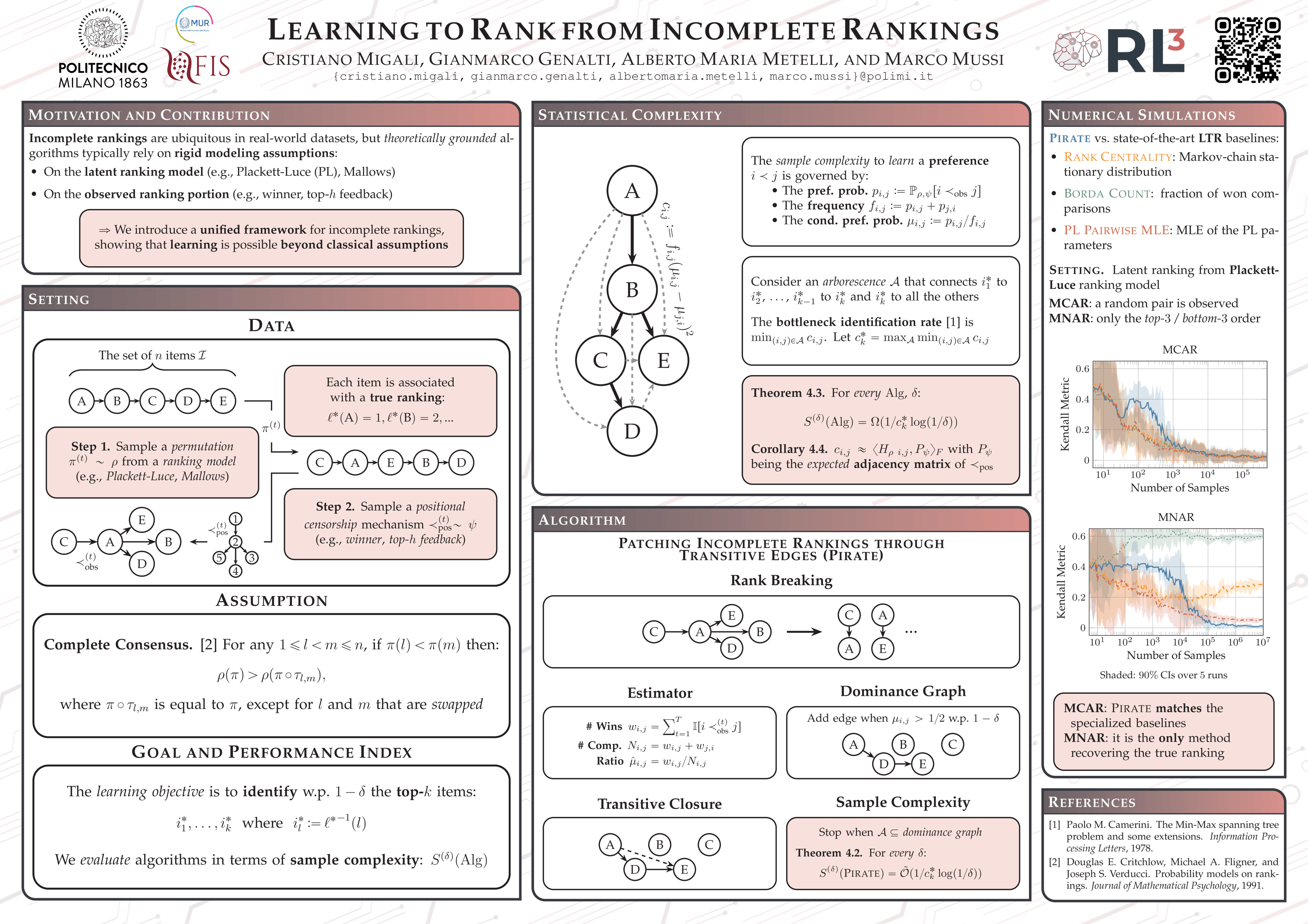
There is an abundance of datasets consisting of human preferences over an assortment of options. These preferences are often sparse, in the sense that a person rarely expresses a preference for every possible pair of options, but rather provides comparative feedback regarding only a few. In particular, users are more likely to provide feedback on items they strongly like or strongly dislike. This bias makes it difficult to reliably aggregate the information to learn their true underlying preferences. To this end, we introduce a mathematical model that accurately captures this specific sparseness in human feedback, alongside an algorithmic solution to aggregate this information effectively. Ultimately, our approach allows systems to uncover the true ranking of items even when the provided data is highly fragmented and biased. This ensures that real-world applications—from recommender systems to AI training—can make more reliable decisions based on how humans naturally express their choices.