
iTryOn: Mastering Interactive Video Virtual Try-On with Spatial-Semantic Guidance
Abstract
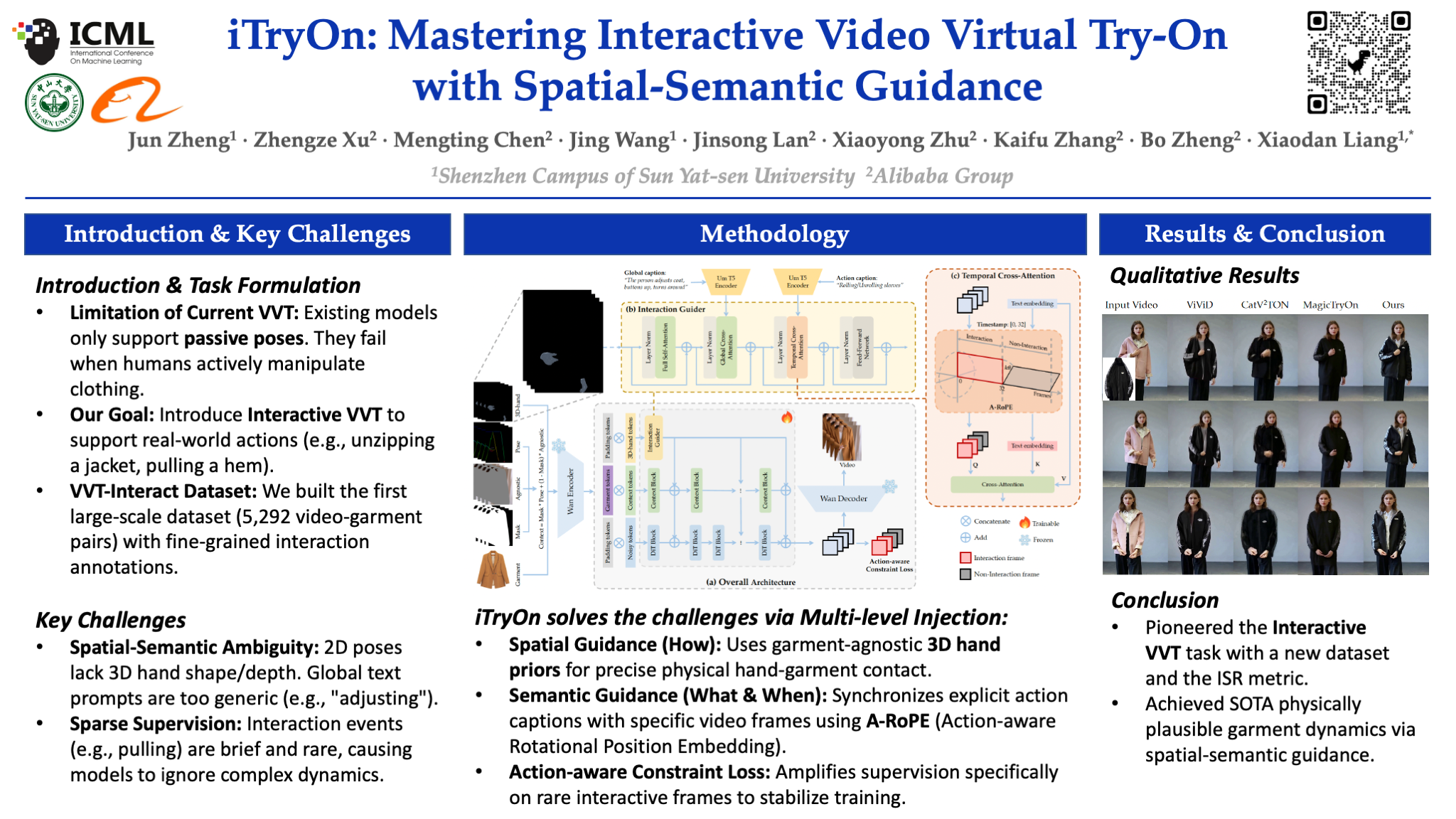
Video Virtual Try-On (VVT) aims to seamlessly replace a garment on a person in a video with a new one. While existing methods have made significant strides in maintaining temporal consistency, they are predominantly confined to non-interactive scenarios where models merely showcase garments. This limitation overlooks a crucial aspect of real-world apparel presentation: active human-garment interaction. To bridge this gap, we introduce and formalize a new challenging task: Interactive Video Virtual Try-On (Interactive VVT), where subjects in the video actively engage with their clothing (e.g., pulling a hem or unzipping a jacket). This task introduces unique challenges beyond simple texture preservation, including: (1) resolving the semantic ambiguity of interactions from standard pose information, and (2) learning complex garment deformations from video where interactive moments are sparse and brief. To address these challenges, we propose iTryOn, a novel framework built upon a large-scale video diffusion Transformer. iTryOn pioneers a multi-level interaction injection mechanism to guide the generation of complex dynamics. At the spatial level, we introduce a garment-agnostic 3D hand prior to provide fine-grained guidance for precise hand-garment contact, effectively resolving spatial ambiguity. At the semantic level, iTryOn leverages global captions for overall context and time-stamped action captions for localized interactions, synchronized via our novel Action-aware Rotational Position Embedding (A-RoPE). Furthermore, we design an action-aware constraint loss to stabilize training and focus the learning process on these critical interactive frames. To facilitate research and evaluation, we construct VVT-Interact, the first large-scale dataset for this task, and propose a novel interaction-aware evaluation metric to quantify the semantic fidelity of interactions. Extensive experiments demonstrate that iTryOn not only achieves state-of-the-art performance on traditional VVT benchmarks but also establishes a commanding lead in the new interactive setting, marking a significant step towards more dynamic and controllable virtual try-on experiences.
Lay Summary
Current video virtual try-on models allow users to see how clothes look in motion, but they are limited to passive poses. If a user actively interacts with the garment—like unzipping a jacket, stretching fabric, or rolling up sleeves—existing systems fail to recreate these complex changes. To solve this, we introduce iTryOn, a new AI framework for Interactive Video Virtual Try-On. We guide the video generation model using 3D hand tracking to show how the hands physically touch the fabric, along with precisely timed text descriptions to explain what action is happening. To support this, we also built the first large-scale dataset specifically focused on human-garment interactions. iTryOn successfully generates highly realistic videos of people actively engaging with virtual garments. This bridges the gap between static displays and real-world apparel presentation, paving the way for truly immersive and lifelike virtual fitting rooms in e-commerce.