
From Optimization to Generalization under Heavy-Tailed Data: The Role of Gradient Clipping
Abstract
Lay Summary
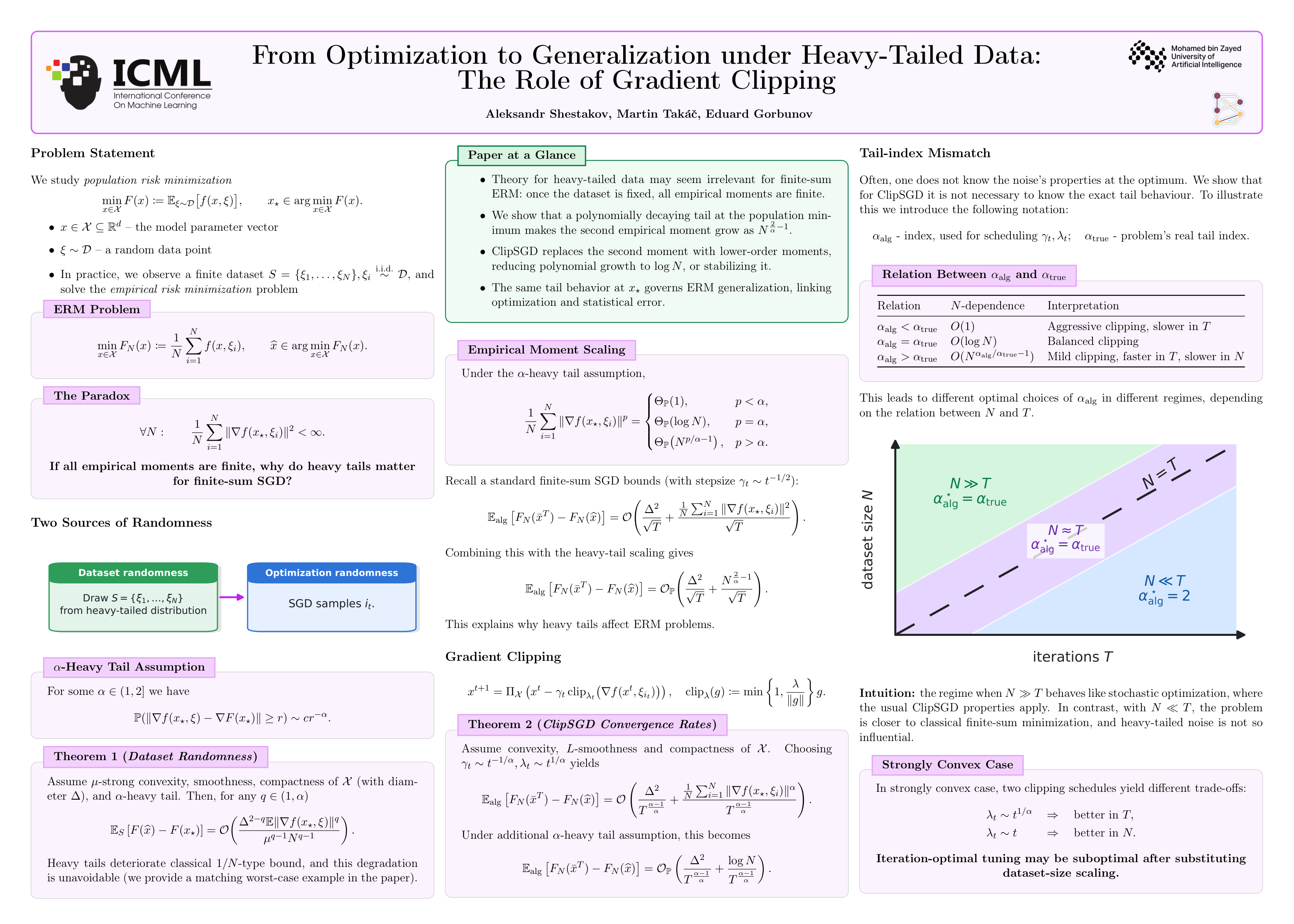
Machine learning models are often trained using stochastic gradient descent (SGD), where updates are computed from randomly selected data samples. In many real-world applications, some samples produce unusually large gradients, creating so-called heavy-tailed noise that can destabilize training. A widely used practical solution is gradient clipping, which limits the size of updates, but its benefits in finite-dataset settings have remained poorly understood. This paper shows that heavy-tailed data can make optimization increasingly difficult as datasets grow larger, because larger datasets are more likely to contain extreme samples that dominate the training dynamics. We prove that standard SGD can suffer from this effect, while gradient clipping prevents such deterioration and maintains favorable convergence guarantees. We also derive new generalization bounds and show that the behavior of gradients near the optimal solution plays a central role in both optimization and generalization. These results provide a theoretical explanation for the effectiveness of gradient clipping in modern large-scale machine learning.