
Hard Labels In! Rethinking the Role of Hard Labels in Mitigating Local Semantic Drift
Abstract
Lay Summary
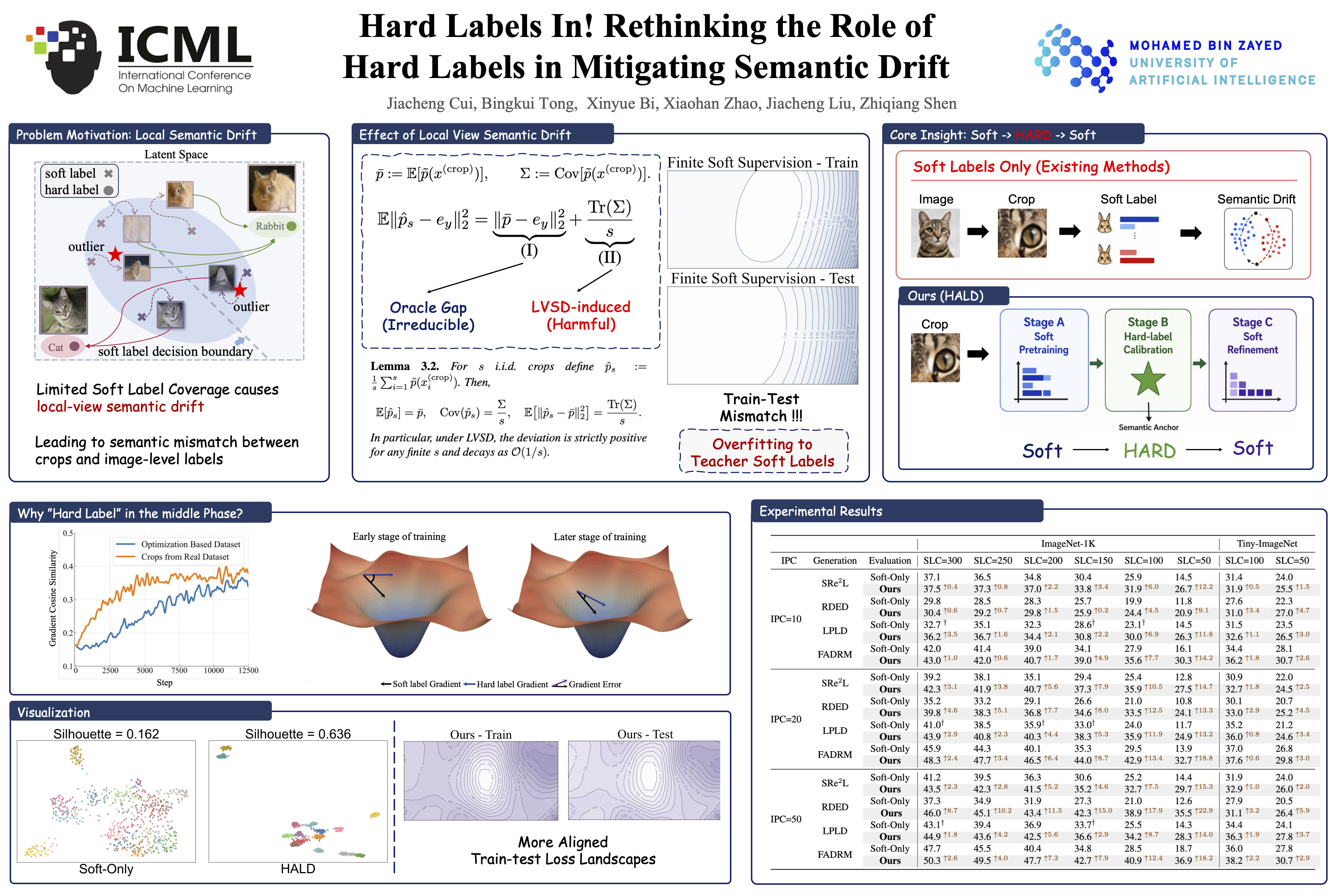
Training modern AI image classifiers often relies on enormous datasets containing millions of pictures, which is slow and expensive. To make this manageable, researchers have developed "dataset distillation", a way to compress huge collections of images into a tiny synthetic substitute that trains models almost as well. The catch is that these compact datasets depend on detailed "soft" guidance labels from a teacher model, and storing those labels can take up more space than the images themselves, sometimes 30 to 40 times more. A natural fix is to keep fewer guidance labels per image, but we found this introduces a hidden problem: when a model only sees small cropped patches of an image, the guidance can drift away from what the picture actually shows, for example, a zoomed-in patch of a cat may look more like a rabbit. We call this local semantic drift. Our solution is to bring back the simple, original class labels (like "cat" or "rabbit") as anchors during a middle stage of training, correcting the drift before fine-tuning resumes. This cuts label storage by up to 100× while substantially improving accuracy on large benchmarks like ImageNet.