
3D MeanFlow: One-Step Point Cloud Completion and Generation via Average-Velocity Transport
Abstract
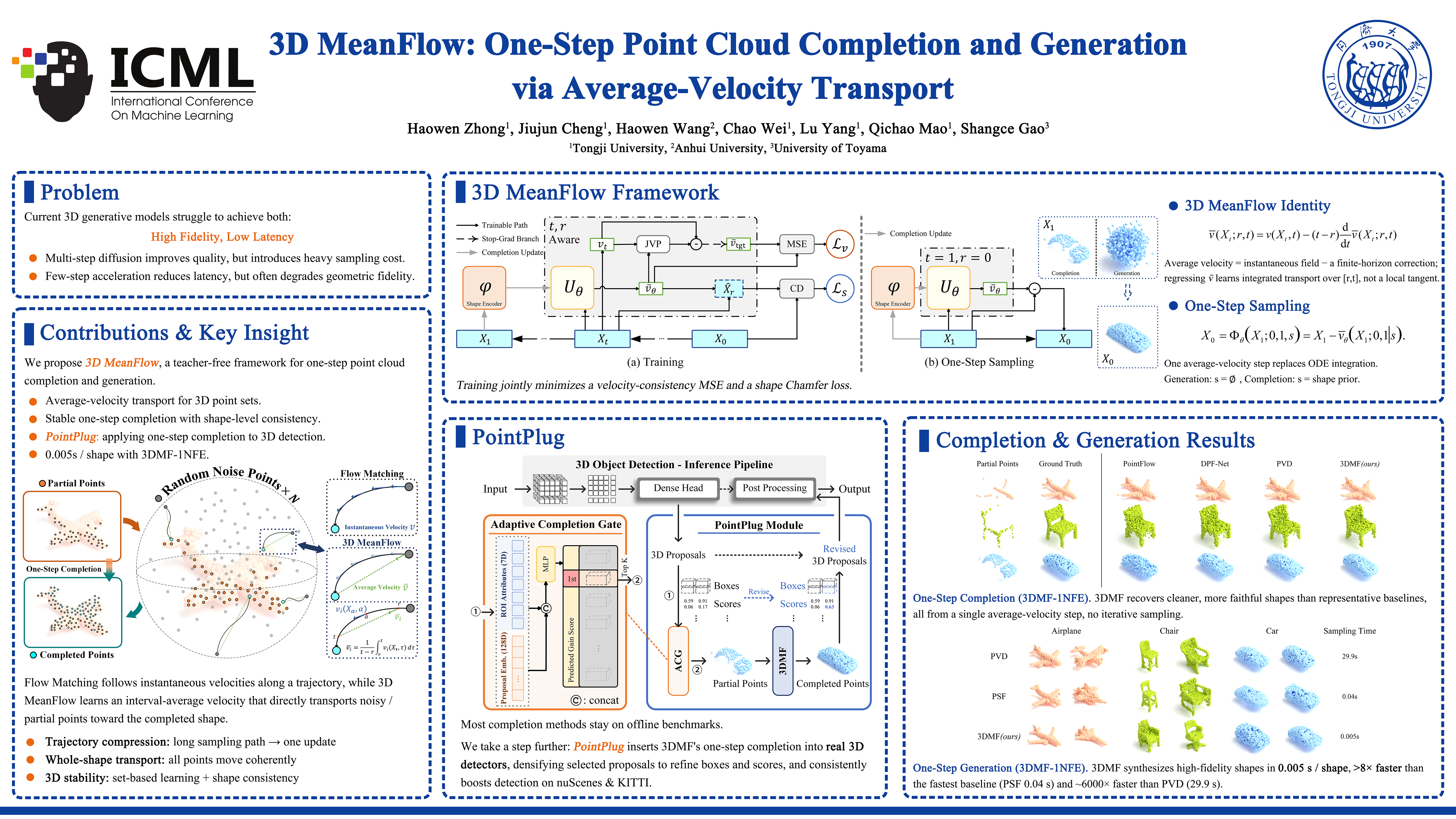
Point cloud completion and generation are important across many 3D tasks, where both fidelity and sampling efficiency matter. Prevailing high-fidelity approaches rely on long sampling schedules, which incur substantial inference latency. Few-step alternatives typically use rectification or distillation, leading to multi-stage training pipelines and potential quality trade-offs. We present 3D MeanFlow (3DMF), a distillation-free model that performs one-step average-velocity transport for point cloud completion and generation. We optimize an instantaneous-average consistency objective and impose a shape-level constraint to stabilize training. Additionally, we introduce PointPlug, integrating completion into 3D object detectors and evaluating its impact. PointPlug uses adaptive selection that balances benefit and latency. Across standard benchmarks, 3DMF achieves one-step sampling with an order-of-magnitude speedup while maintaining competitive fidelity. On nuScenes and KITTI, inserting PointPlug improves all evaluated detectors under comparable settings.
Lay Summary
Many machines that need to understand the 3D world, such as self-driving cars, robots, and virtual-reality headsets, only ever see partial sketches of the objects around them. Filling in the missing parts is essential, but modern AI methods do this slowly, and the faster alternatives rely on fragile multi-stage training pipelines. We wondered whether a single model, trained in one stage, could complete a 3D shape in one step without sacrificing quality. We built such a model, called 3D MeanFlow. Instead of imitating each step of a long sampling trajectory one by one, it learns the average direction of motion across the whole trajectory at once, so a single update can transport a partial point cloud to a complete shape in one step. The training procedure stays simple, with no separate teacher model and no extra fine-tuning stage. Surprisingly, this one-step model matches the accuracy of the slow multi-step methods, while running much faster. 3D MeanFlow generates a complete shape in roughly five milliseconds, about eight times faster than the strongest prior method, making real-time 3D completion practical on everyday hardware. We also show that plugging it into existing 3D object detectors helps them detect distant and sparsely observed vehicles in real driving scenes.