
KITE: Knowledge-Guided Probabilistic Modeling for Time Series Forecasting with Exogenous Variables
Abstract
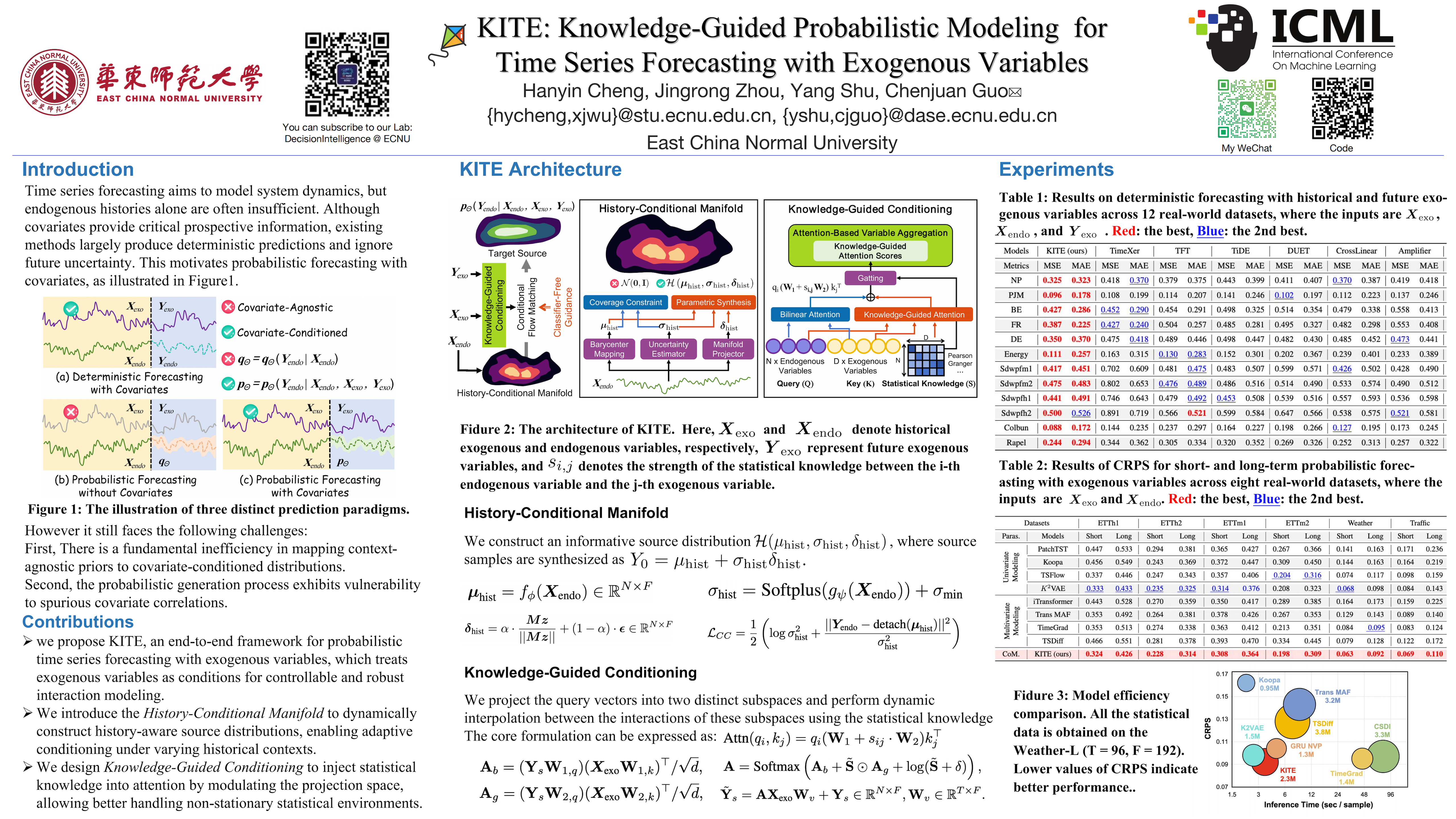
Probabilistic forecasting with exogenous variables is vital for decision-making but remains underexplored compared to deterministic methods. We propose KITE, a knowledge-guided probabilistic modeling framework designed to bridge this gap by addressing two key bottlenecks: (1) topological disparity in sampling initialization and (2) spurious covariate correlations during the iterative conditional generation process. KITE introduces a History-Conditional Manifold to construct an informative source distribution from historical dynamics, effectively anchoring the starting point closer to the target space. Additionally, a Knowledge-Guided Conditioning module is developed to regularize variable interactions using statistical priors, suppressing spurious correlations and enhancing the robustness of covariate conditioning. Extensive experiments demonstrate that KITE outperforms state-of-the-art methods in both deterministic and probabilistic forecasting.
Lay Summary
To plan ahead, people forecast things like electricity prices, river levels, or wind-farm output, and these forecasts improve when we add related outside information such as the weather. But most methods give a single guessed number with no sense of how uncertain it is, which can lead to costly, overconfident decisions. We built KITE, a method that predicts a range of likely futures instead of one number. Rather than starting each prediction from random noise, it starts from an educated guess based on recent history, making it faster and more accurate. It also uses simple statistical clues about which outside factors truly matter, so it isn't misled by coincidental patterns. Across real-world energy, weather, traffic, and finance data, KITE gave more accurate and more trustworthy forecasts than leading existing methods.