
Characterizing Vision-Language-Action Models across XPUs: Constraints and Acceleration for On-Robot Deployment
Abstract
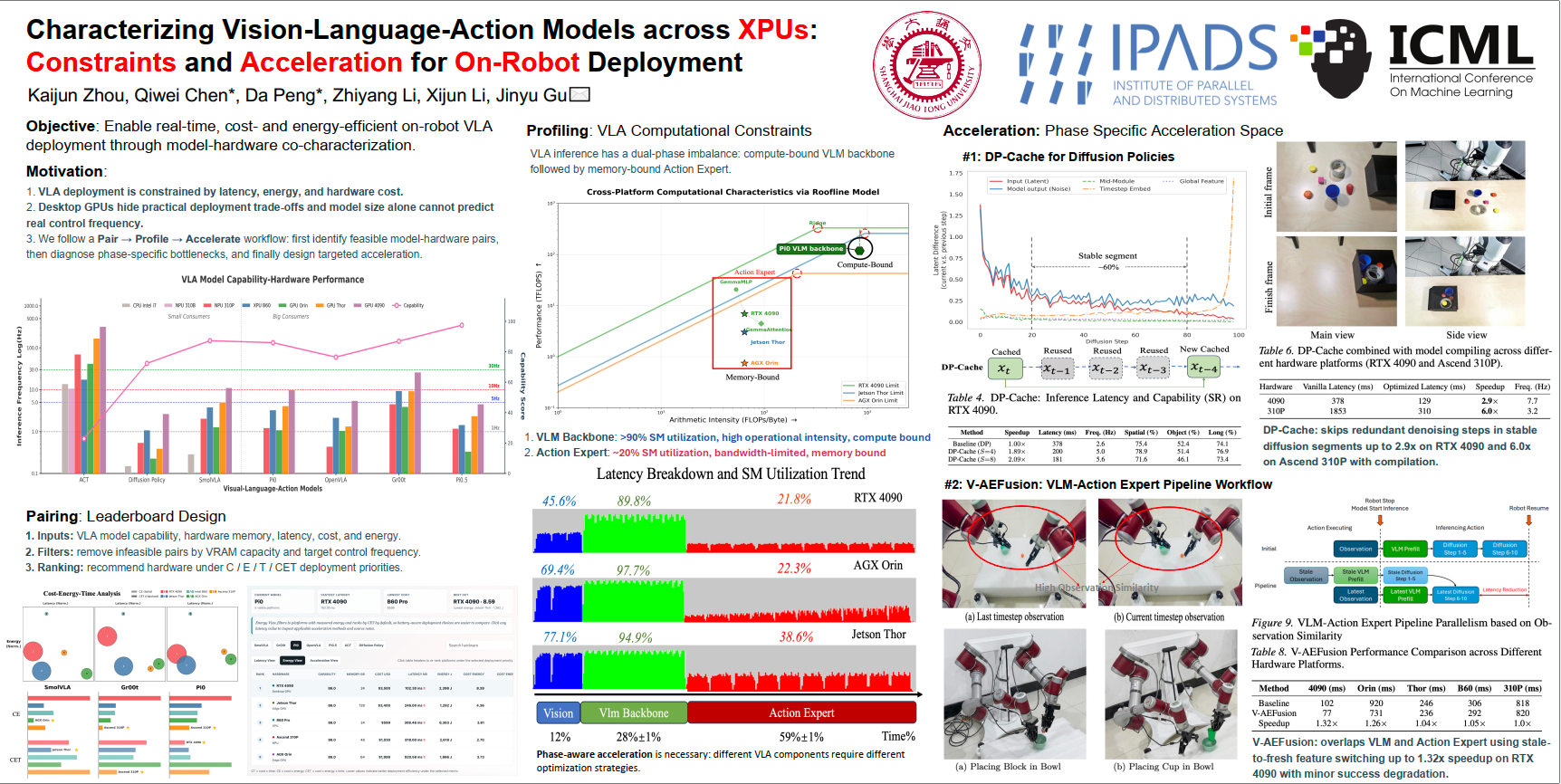
Vision-Language-Action (VLA) models are promising for generalist robot control, but on-robot deployment is bottlenecked by real-time inference under tight cost and energy budgets. Most prior evaluations rely on desktop-grade GPUs, obscuring the trade-offs and opportunities offered by heterogeneous edge accelerators (GPUs/XPUs/NPUs). We present a systematic framework for low-cost VLA deployment via model--hardware co-characterization. First, we build a cross-accelerator leaderboard and evaluate model--hardware pairs under \textbf{CET} (Cost, Energy, Time), showing that ``right-sized'' edge devices can be more cost-/energy-efficient than flagship GPUs while meeting control-rate constraints. Second, using fine-grained SM tracing and Roofline analysis, we uncover a consistent two-phase inference pattern: a compute-bound VLM backbone followed by a memory-bound Action Expert, which induces phase-dependent underutilization and hardware inefficiency. Finally, guided by these insights, we propose \textbf{DP-Cache} and \textbf{V-AEFusion} to reduce diffusion redundancy and enable asynchronous pipeline parallelism, achieving up to (2.9\times) speedup on GPUs and (6\times) on edge NPUs with only marginal success degradation. The example leaderboard website is: \url{https://vla-leaderboard-01.vercel.app/}.
Lay Summary
Robots are starting to use AI systems that can understand images, follow language instructions, and decide how to move. However, these systems are often tested on expensive desktop computers, while real robots need to respond quickly using hardware that is affordable and energy efficient. We study how to run these robot AI systems on practical on-robot hardware. We compare different combinations of AI models and computing devices using three everyday concerns: how much they cost, how much energy they use, and how quickly they respond. We find that smaller, cheaper devices can sometimes be a better choice than powerful desktop GPUs. We also identify where time is being wasted during robot decision-making and use this insight to design two methods that reduce repeated work and let different parts of the system run more efficiently. Our work helps researchers and engineers choose suitable hardware for robots and shows that advanced robot AI can be made much faster, with the trade-off of a small decrease in task performance.