
EvoCF: Multi-Agent Collaboration via Agentic Memory-Driven Evolutionary Counterfactual Planning
Abstract
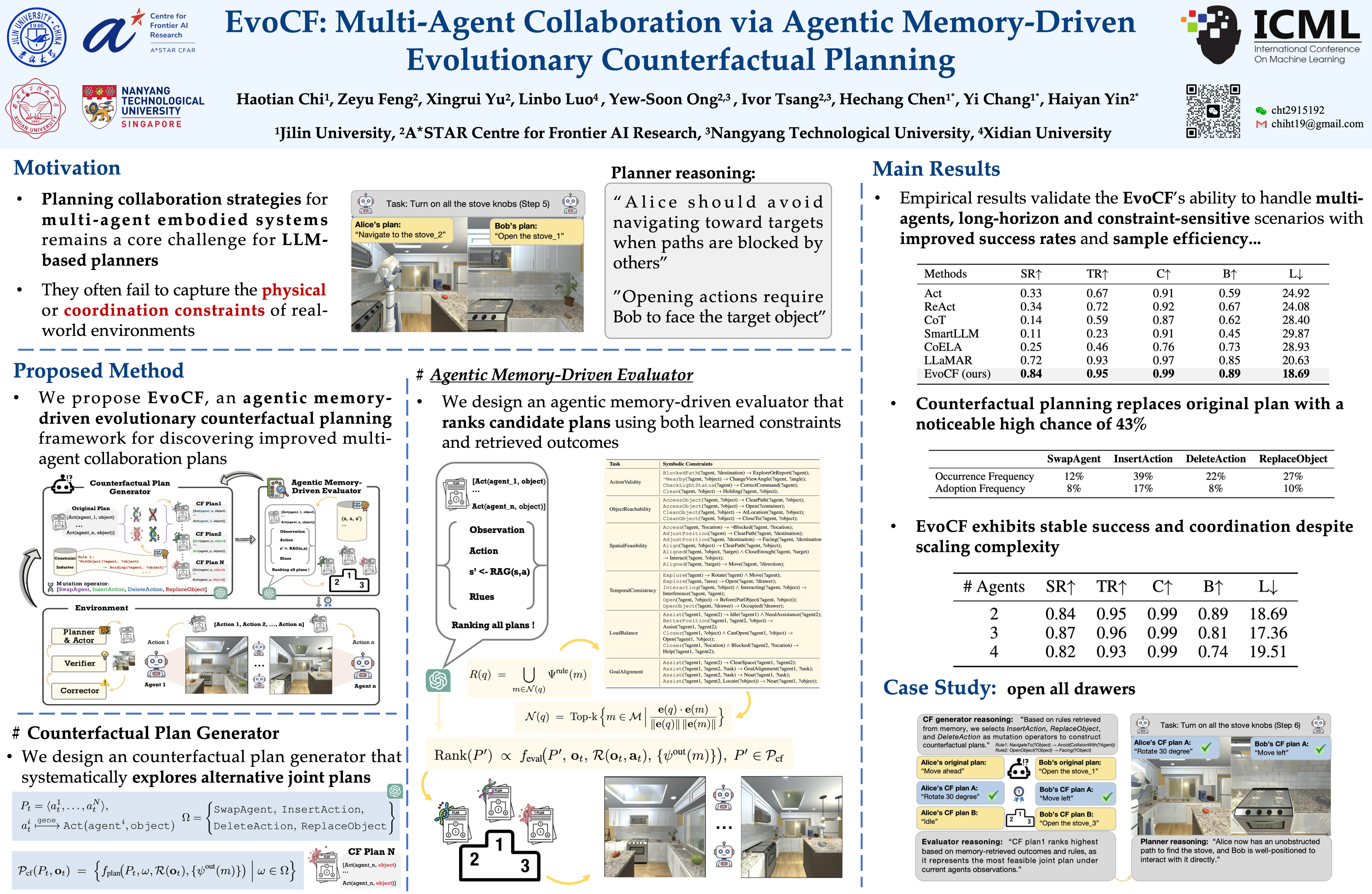
Planning collaboration strategies for multi-agent embodied systems remains a core challenge for LLM-based planners, which often fail to capture the physical and coordination constraints of realworld environments. To address this, we present EvoCF, an agentic memory-driven evolutionary counterfactual planning framework for discovering improved multi-agent collaboration strategies through counterfactual plan generation and evaluation. First, we propose a symbolic constraint inductor that induces reusable symbolic constraints from failures, forming an evolving rule library. Then, we propose an evolutionary counterfactual plan generator that systematically explores semantically consistent plan variants through rule-conditioned mutations, enabling robust collaboration strategies beyond short-sighted one-shot LLM plans. Finally, we design an agentic memory-grounded evaluator that ranks candidate plans using retrieval-augmented evidence, producing interpretable, constraint-aware selections. Across multi-agent embodied simulation benchmarks, EvoCF consistently discovers more robust and executable plans compared to baseline approaches. Our results demonstrate that grounding multi-agent planning in agentic memory and counterfactual reasoning significantly enhances both effectiveness and robustness.
Lay Summary
Getting multiple robots to work together in a home is harder than simply giving each robot a to-do list. A robot may block another robot’s path, try to use an object before it is reachable, or repeat work that a teammate could do better. We developed EvoCF, a planning method that helps a team of AI-controlled robots learn from past mistakes and ask better “what if?” questions before acting. When a previous plan fails, EvoCF turns the failure into simple reusable rules, such as “a robot should face an object before opening it” or “avoid moving through another robot’s path.” It then creates several alternative team plans by changing who does which action, adding missing steps, removing unnecessary actions, or choosing a better object. Instead of blindly trying these plans in the world, EvoCF compares them with similar past experiences stored in memory and selects the most promising one. In simulated household tasks where robots must move, open, pick up, and place objects, EvoCF completed more tasks than strong existing planning methods while using fewer steps. This work suggests that future robot teams can become more reliable by remembering why earlier attempts failed and using that experience to coordinate before problems happen.