
RGMem: Renormalization Group–inspired Memory Evolution for Language Agents
Abstract
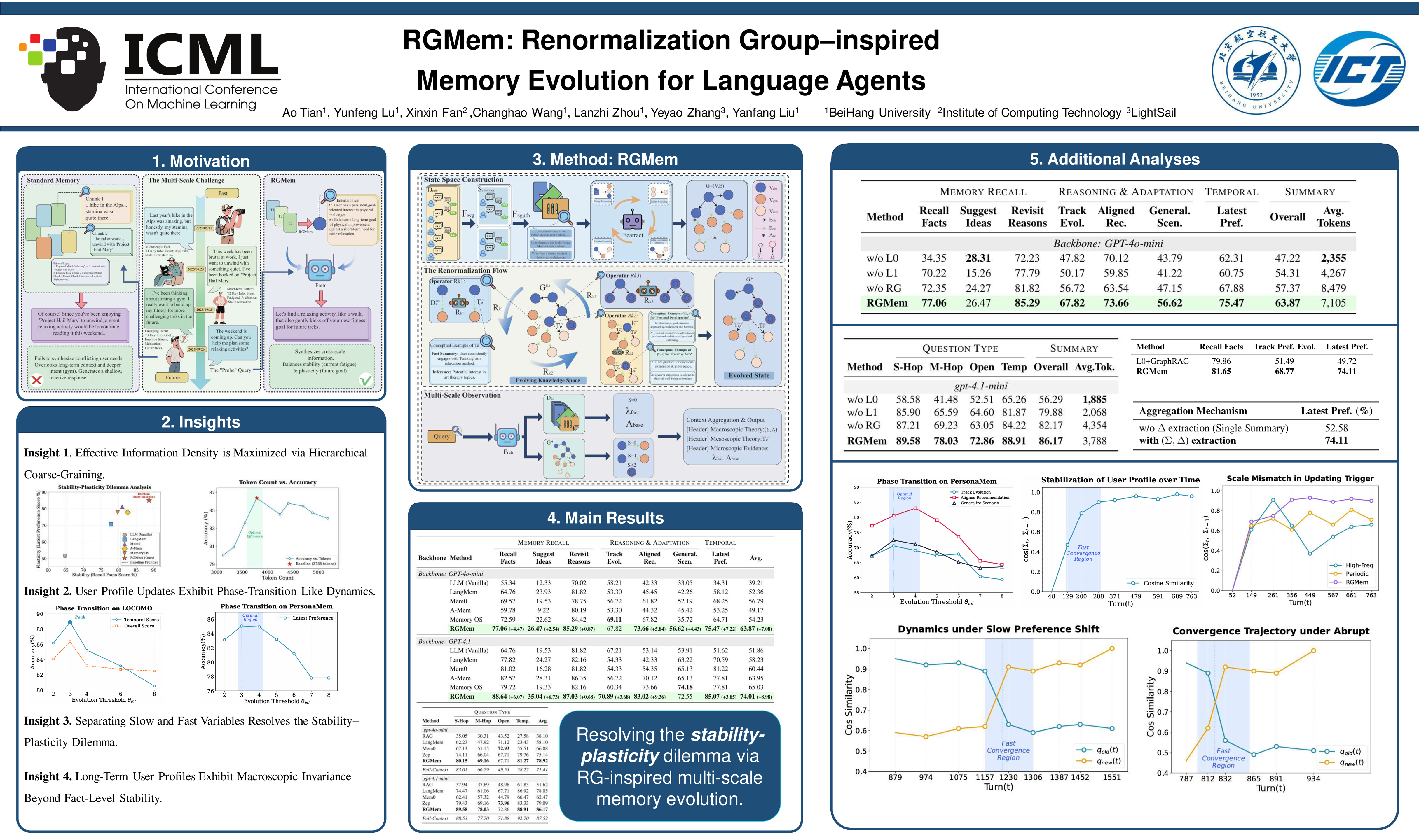
Personalized and continuous interactions are critical for LLM-based conversational agents, yet finite context windows and static parametric memory hinder the modeling of long-term, cross-session user states. Existing approaches, including retrieval-augmented generation and explicit memory systems, primarily operate at the fact level, making it difficult to distill stable preferences and deep user traits from evolving and potentially conflicting dialogues.To address this challenge, we propose RGMem, a self-evolving memory framework inspired by the renormalization group (RG) perspective on multi-scale organization and emergence. RGMem models long-term conversational memory as a multi-scale evolutionary process: episodic interactions are transformed into semantic facts and user insights, which are then progressively integrated through hierarchical coarse-graining, thresholded updates, and rescaling into a dynamically evolving user profile.By explicitly separating fast-changing evidence from slow-varying traits and enabling non-linear, phase-transition-like dynamics, RGMem enables robust personalization beyond flat retrieval or static summarization. Extensive experiments on the LOCOMO and PersonaMem benchmarks demonstrate that RGMem consistently outperforms SOTA memory systems, achieving stronger cross-session continuity and improved adaptation to evolving user preferences.
Lay Summary
Humans naturally remember other people in a flexible way: we keep track of their long-term personality and habits while also adapting to changes in their daily lives. Today’s AI systems struggle to do this well over long periods of time. Many systems simply store large amounts of past conversations, which can become messy, outdated, or confusing as users change over time. In this work, we introduce RGMem, a new memory system that helps AI organize and update information about users more effectively. Instead of treating every memory the same way, RGMem separates short-term details from more stable long-term patterns. Everyday events are collected gradually, and the AI only updates its understanding of a person when enough consistent evidence has accumulated. This approach helps AI avoid overreacting to temporary situations—such as a short-lived hobby, injury, or diet change—while still adapting when a user’s preferences genuinely evolve. Experiments show that RGMem improves long-term personalization, helping conversational AI maintain more consistent and adaptive interactions across extended conversations.