
EAGer: Entropy-Aware GEneRation for Adaptive Inference-Time Scaling
Abstract
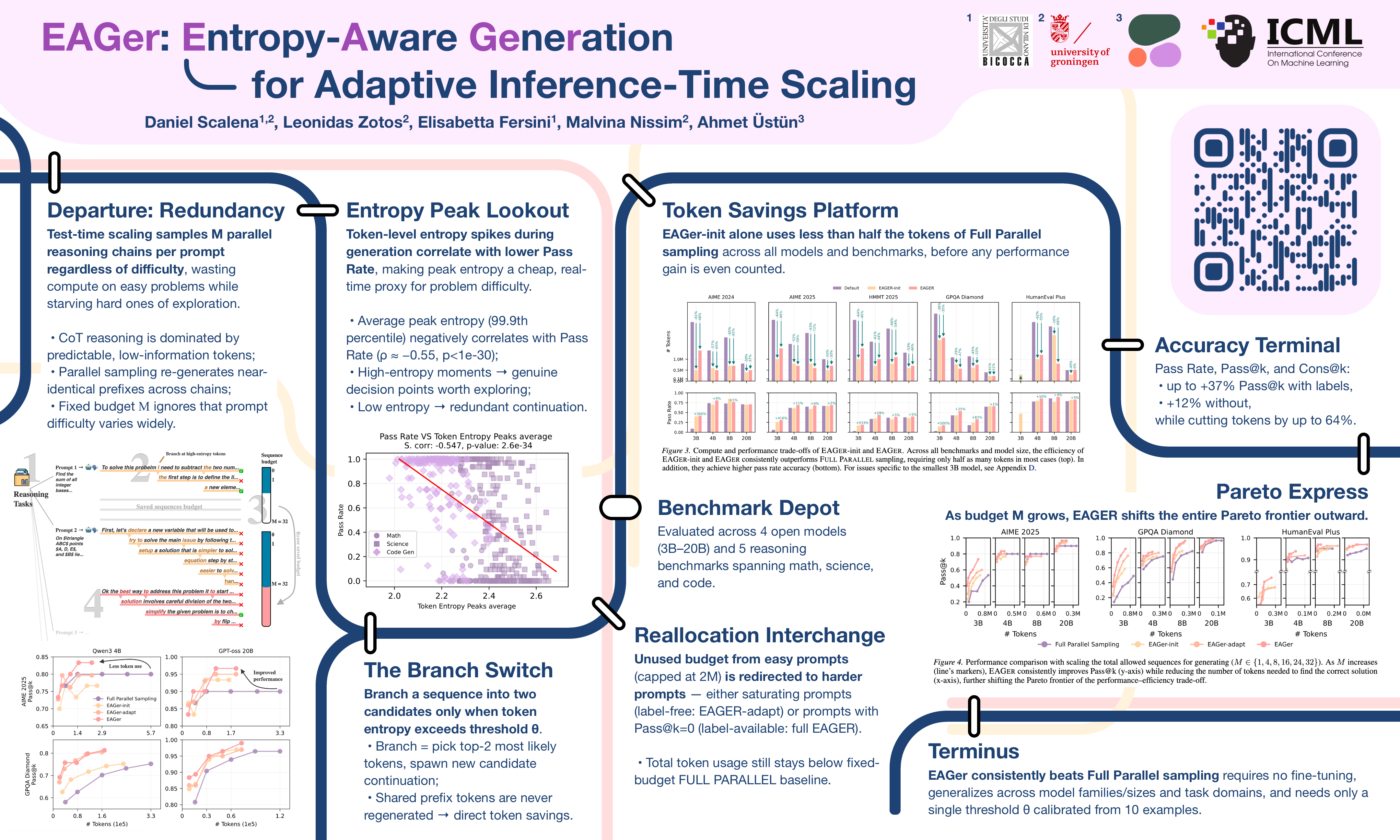
With the rise of reasoning language models and test-time scaling methods as a paradigm for improving model performance, substantial computation is often required to generate multiple candidate sequences from the same prompt. This enables exploration of different reasoning paths toward the correct solution, however, allocates the same compute budget for each prompt. Grounded on the assumption that different prompts carry different degrees of complexity, and thus different computation needs, we propose EAGer, a training-free generation method that leverages model uncertainty through token-wise entropy distribution to reduce redundant computation and concurrently improve overall performance. EAGer allows branching to multiple reasoning paths only in the presence of high-entropy tokens, and reallocates the saved compute budget to instances where exploration of alternative paths is most needed. We validate EAGer across multiple open-source models on complex reasoning benchmarks, with gains specifically demonstrated on AIME 2025. When target labels are accessible -- as in RLVR training pipelines -- EAGer achieves up to +37% in Pass@k and 59% fewer tokens; in test-time settings it still yields +12% in Pass@k and 64% fewer tokens compared to Full Parallel Sampling.
Lay Summary
When AI systems tackle hard problems like math competitions or scientific questions, they often explore many different reasoning paths simultaneously to improve their chances of finding the right answer -- but this is expensive, requiring the same amount of computation regardless of whether the problem is easy or hard. We developed EAGer, a method that makes this process smarter by watching how uncertain the AI is as it generates each word. When the AI is confident, EAGer lets it work alone; when it hesitates at a genuinely tricky step, EAGER branches into multiple reasoning paths right there, avoiding redundant work. Compute saved on easy problems is then redirected to the hard ones that need it most. Across math, science, and coding benchmarks, EAGer finds correct answers up to 37% more often while using up to 65% fewer computing resources compared to standard approaches -- making powerful AI reasoning significantly more efficient and accessible.