
HyPER: Bridging Exploration and Exploitation for Scalable LLM Reasoning with Hypothesis Path Expansion and Reduction
Abstract
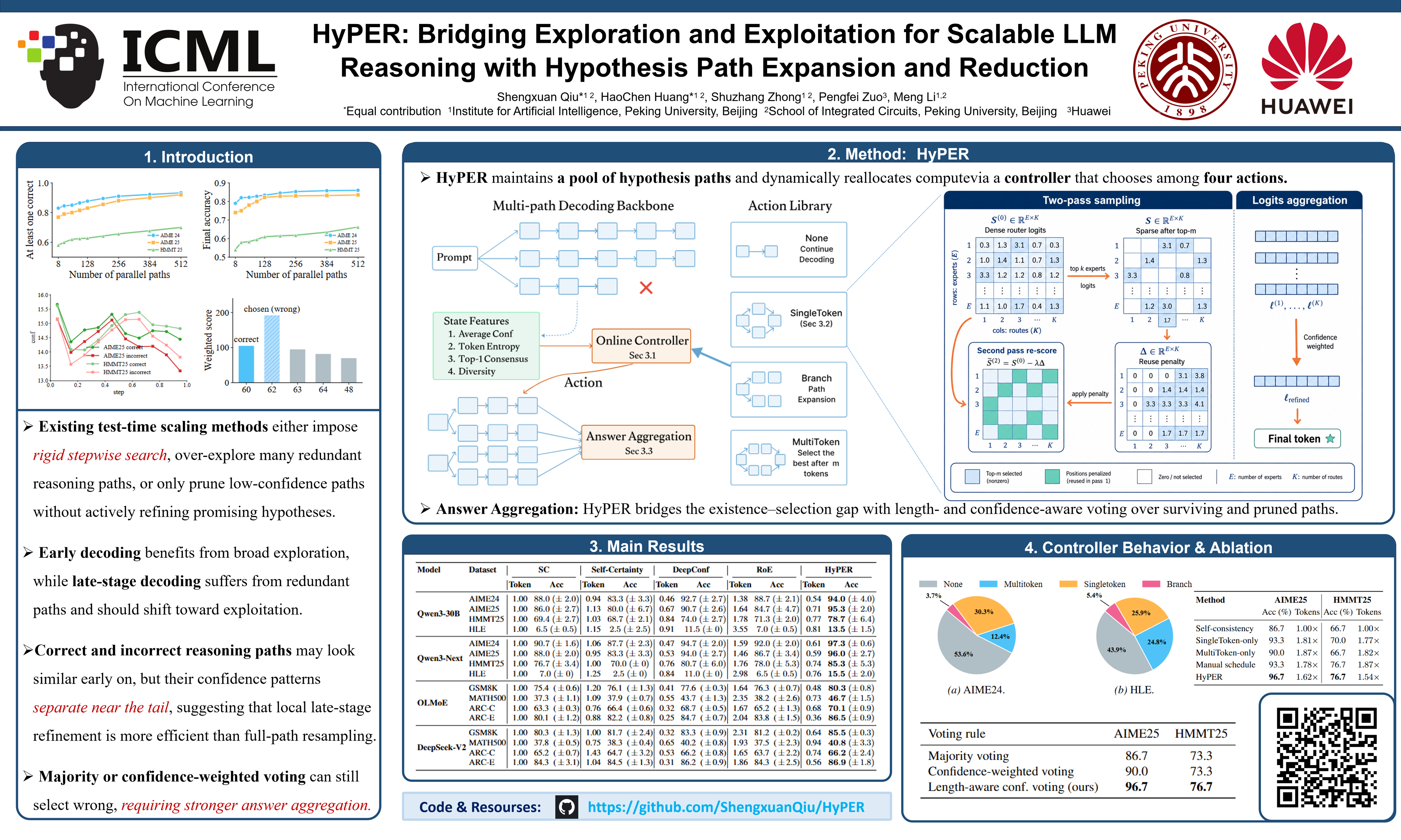
Scaling test-time compute with multi-path chain-of-thought can improve reasoning accuracy, but its gains hinge on an effective exploration–exploitation trade-off. Existing methods handle this trade-off in rigid ways: tree-structured search hard-codes exploration via brittle expansion rules that disrupt post-trained reasoning, while parallel reasoning over-explores redundant hypothesis paths and relies on a weak answer selection strategy. Driven by the insight that the optimal balance is phase-dependent and that correct vs. incorrect paths often diverge only at late stages, we reconceptualize test-time scaling as a dynamic expand–reduce control problem over a pool of hypothesis paths. We introduce HyPER, a training-free online control policy for MoE multi-path decoding that reallocates compute under a fixed budget using lightweight path statistics. HyPER features (i) an online controller that shifts from exploration to exploitation as the hypothesis pool evolves, (ii) an MoE-based token-level refinement primitive for efficient generation-time exploitation without full-path resampling, and (iii) a length- and confidence-aware aggregation rule to bridge the existence–selection gap for reliable answer-time exploitation. Extensive experimental results across four MoE models and diverse benchmarks demonstrate HyPER consistently achieves the accuracy–compute Pareto frontier, outperforming prior-art methods by 8-10% while reducing token consumption by 25-40%.
Lay Summary
Large language models can solve difficult reasoning problems more reliably when they are allowed to try multiple reasoning paths at test time. However, simply generating many paths is expensive and often wastes computation on redundant or low-quality attempts. This paper introduces HyPER, a training-free method that dynamically decides when to explore new reasoning paths and when to refine promising ones. HyPER monitors lightweight signals such as confidence and diversity during generation, reallocates computation across different reasoning actions, and uses a more reliable final answer selection rule. Experiments across several mixture-of-experts language models and reasoning benchmarks show that HyPER improves accuracy while using fewer tokens than prior test-time scaling methods. These results suggest that better control of test-time computation can make advanced reasoning more efficient and practical.