
Optimal Regularization for Performative Learning
Abstract
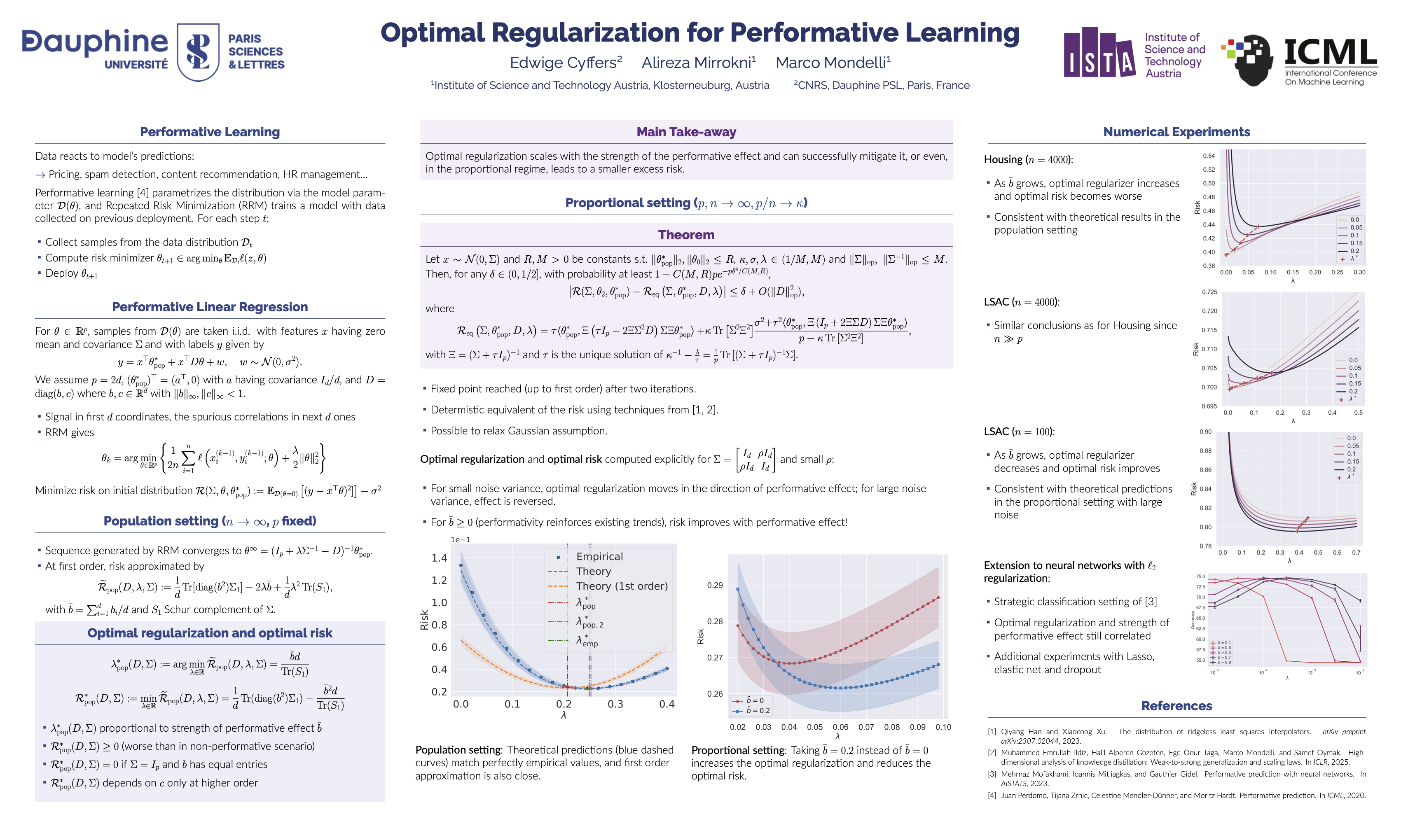
In performative learning, the data distribution reacts to the deployed model—for example, because strategic users adapt their features to game it—which creates a more complex dynamic than in classical supervised learning. One should thus not only optimize the model for the current data but also take into account that the model might steer the distribution in a new direction, without knowing the exact nature of the potential shift. We explore how regularization can help cope with performative effects by studying its impact in high-dimensional ridge regression. We show that, while performative effects worsen the test risk in the population setting, when moving to the over-parameterized regime where the number of features exceeds the number of samples, the optimal regularization in the presence of performativity helps reduce the variance in the estimated parameters, thereby improving performance. We show that the optimal regularization scales with the overall strength of the performative effect, making it possible to set the regularization in anticipation of this effect. We illustrate this finding through empirical evaluations of the optimal regularization parameter on both synthetic and real-world datasets.
Lay Summary
How should we modify the training of machine learning algorithms when the deployed model influences the next data points that will be collected? This problem, coined performative learning, appears in various scenarios, such as people gamifying their features to be selected, or traffic jams being created when everyone is sent to the same road. However, taking this effect into account during learning is difficult, as it requires knowing how the data distribution will change for a given model. Existing results often guarantee performance only when ignoring the shift, or assume a very special structure for the shift. Our paper studies how regularization, a standard tool in optimization, can help mitigate the performative effect. We show that the regularization parameter and the strength of the performative effect can be linked. Interestingly, while the theoretical results assume a specific task, similar behavior can be observed more broadly, even with neural networks.