
Unsupervised Disentanglement Without Compromises : How Functional Orthogonality Enforces Identifiability
Abstract
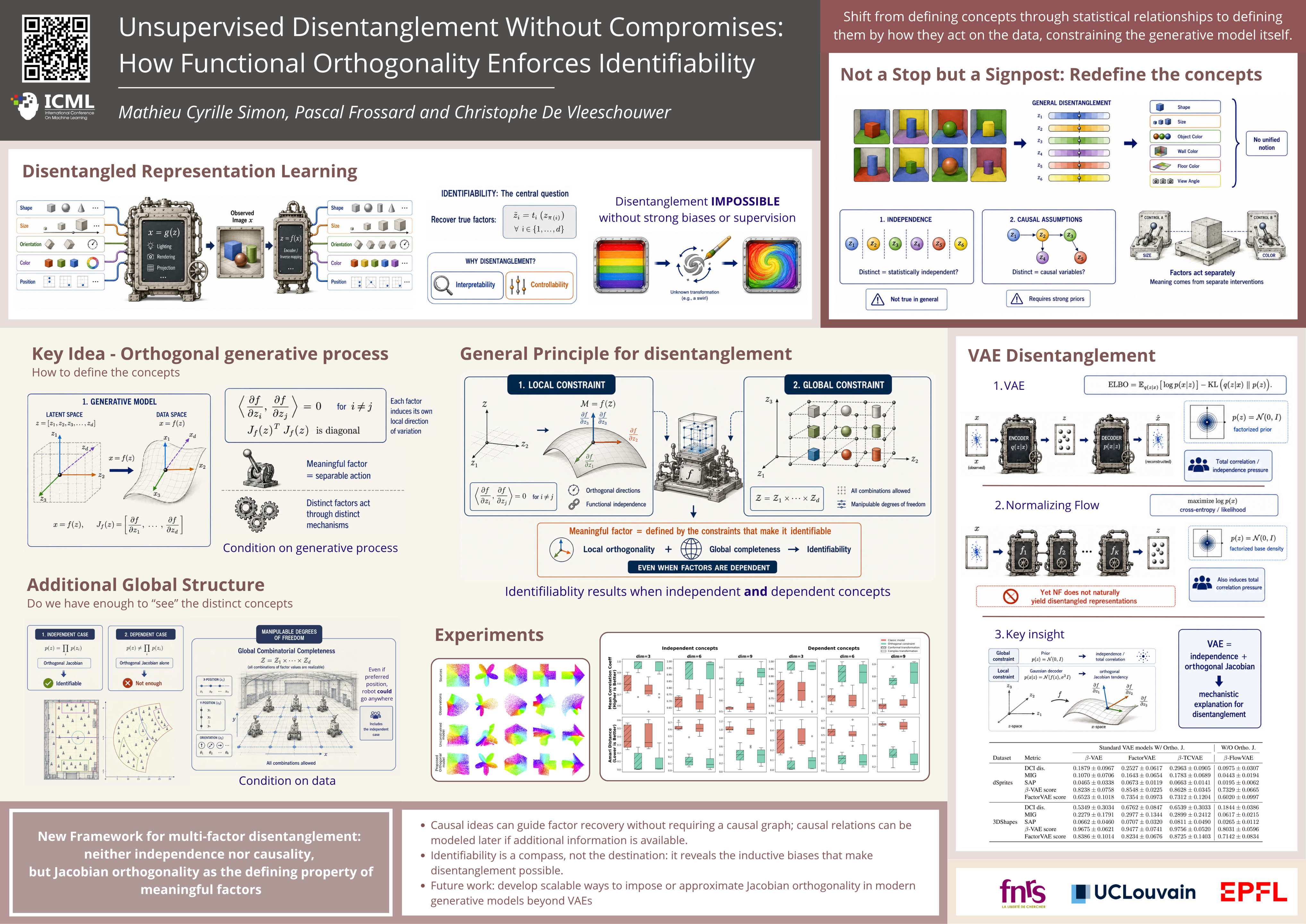
This paper explores unsupervised disentangled representation learning from a functional perspective. We define latent concepts as factors that influence observations through locally orthogonal directions, formalized as an orthogonality constraint on the Jacobian of the generative mapping. We prove that this condition yields identifiability of general nonlinear generative models, without requiring statistical independence or causal assumptions, provided the latent domain admits all combinations of factor values. Experiments with orthogonality-regularized normalizing flows empirically confirm the theory, demonstrate reliable recovery of ground-truth factors, and shed light on the success of VAEs. These findings challenge the prevailing impossibility claims for unsupervised disentanglement and provide a principled alternative foundation.
Lay Summary
A central aspiration of modern machine learning is to build systems that perceive the world the way humans do: not by memorizing raw signals, but by uncovering the underlying causes that generate them. A photograph of a face, for instance, is the product of a small number of independently controllable factors: identity, pose, lighting, expression. Recovering these factors automatically, without human annotation, is the promise of Disentangled Representation Learning, and one that has long been considered theoretically impossible without strong prior assumptions or supervision. This paper challenges that conclusion at its root. The problem, we argue, is not the absence of additional data or labels. It is the absence of a principled definition of what a factor actually is. Classical approaches equate meaningful factors with statistically independent ones, but statistical independence is a fragile proxy: hair length and gender are intuitively distinct concepts yet statistically correlated in natural data. What actually makes a factor meaningful is not how it is distributed, but how it acts. Each factor should influence observations through a geometrically distinct, separable mechanism. Formalizing this as an orthogonality condition on the generative mapping, we prove that the true underlying factors become uniquely recoverable, even when statistically correlated, provided all combinations of factor values are observable. Experiments confirm these predictions and reveal, as a byproduct, the precise mechanism through which Variational Autoencoders achieve their empirical disentanglement ability.