
Rank-guided Diffusion for Noise Few-Shot Learning
Abstract
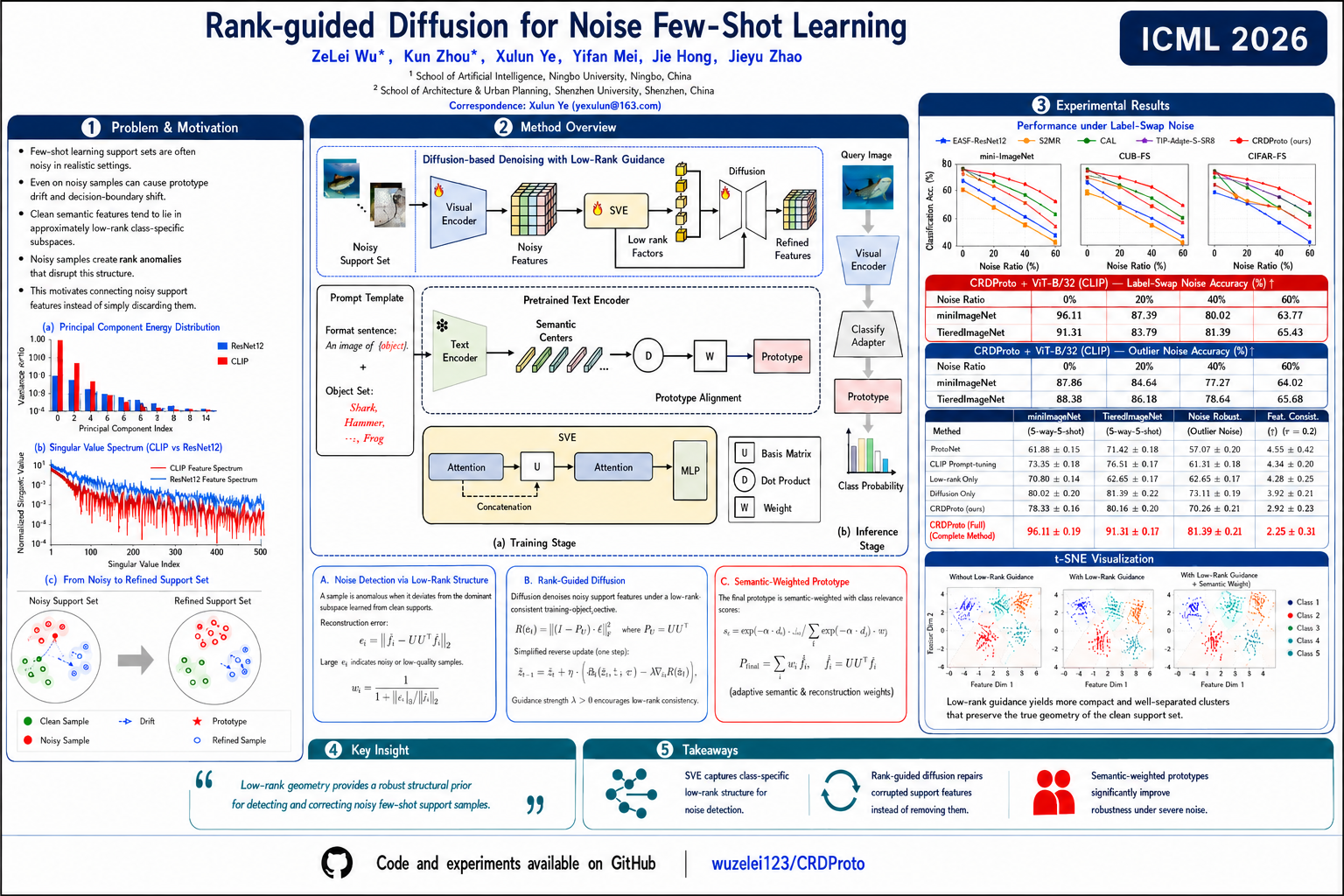
In real-world Few-Shot Learning (FSL), support sets are quickly constructed and inevitably contain noisy samples. With limited examples per class, even a single noisy instance can distort class distributions, cause prototype drift, and reduce generalization. Existing methods mostly assume clean data or require large-scale statistics, which are impractical in FSL’s data-scarce setting. We find that clean samples in semantic feature space lie in low-rank subspaces, while noisy samples cause rank anomalies disrupting this structure. To address this, we propose a differentiable low-rank approximation that estimates the intrinsic rank of the support set and detects anomalous noisy samples. Building on this, a rank-guided diffusion process generates high-quality replacements under low-rank constraints, reconstructing a clean, consistent support set for improved robustness.This low-rank guided approach effectively mitigates prototype drift and significantly reduces errors under noise levels up to 40\% across MiniImageNet, TieredImageNet, and other noisy benchmarks, demonstrating the power of low-rank geometry for noise detection and correction in FSL. Our source code is available at https://github.com/wuzelei123/CRDProto.
Lay Summary
This research addresses a common vulnerability in Few-Shot Learning (FSL): when the few available reference images contain noisy or mislabeled samples, the AI's recognition performance drops drastically. The researchers discovered that while clean samples exhibit a clean low-rank geometric structure in the semantic feature space, noisy samples manifest as structural anomalies. Instead of simply discarding these corrupted data points as previous methods did, this work leverages the generative power of a diffusion model to guide and "re-align" the noisy samples back into their proper geometric subspace. By performing this structural correction rather than elimination, the framework preserves data diversity, eliminates prototype drift, and significantly enhances the robustness and accuracy of computer vision systems when deployed in unpredictable, real-world settings.