
Optimal Learning from Label Proportions with General Loss Functions
Abstract
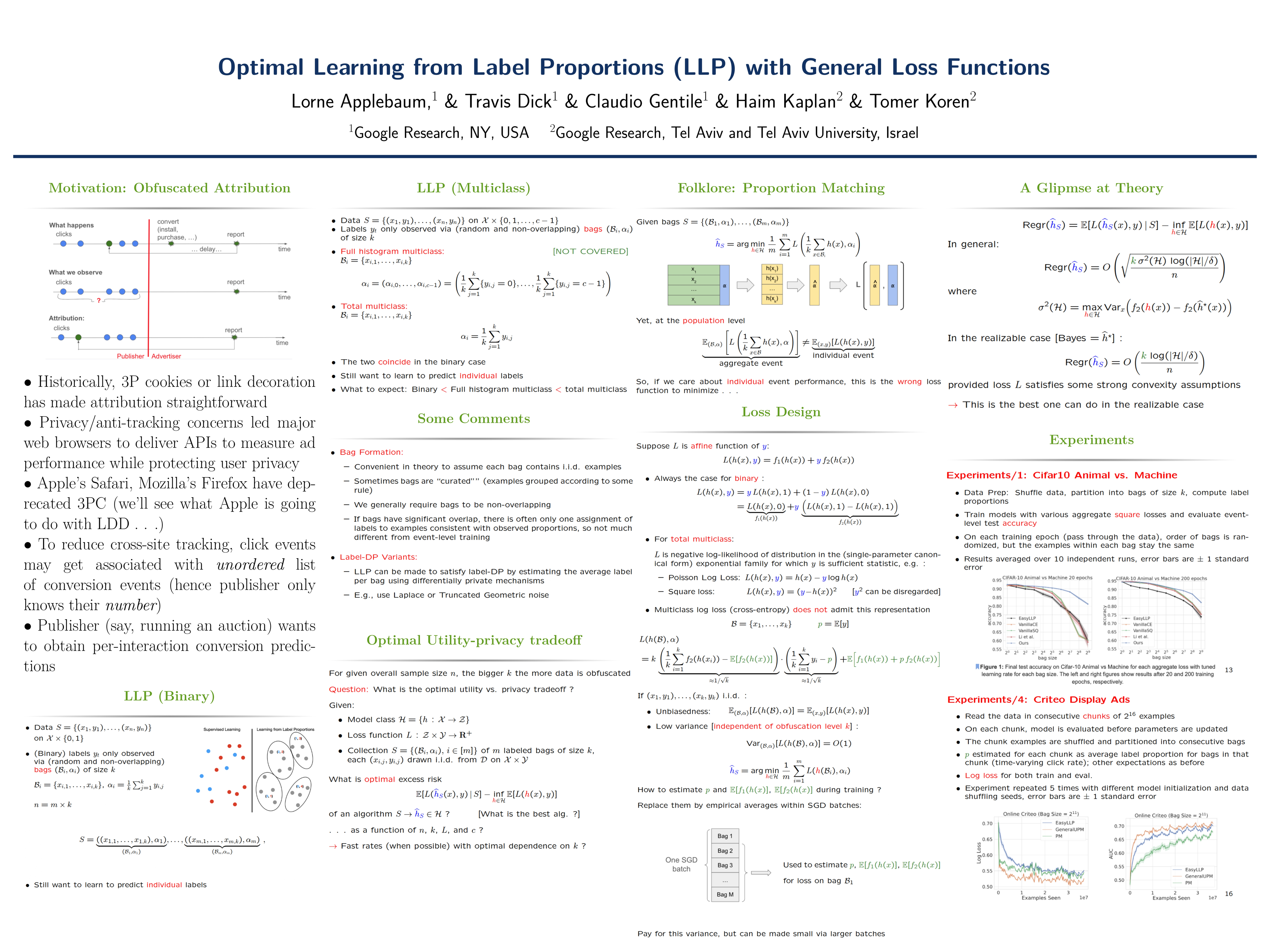
Motivated by problems in online advertising, we address the task of Learning from Label Proportions (LLP). We introduce a novel and versatile low-variance debiasing methodology to learn from aggregate label information, significantly advancing the state of the art in LLP. Our debiasing approach exhibits remarkable flexibility, seamlessly accommodating a broad spectrum of practically relevant loss functions across both binary and multi-class classification settings. By carefully combining our estimators with standard techniques, we improve sample complexity guarantees for a large class of losses of practical relevance. We also empirically validate the efficacy of our proposed approach across a diverse array of benchmark datasets, demonstrating compelling empirical advantages over standard baselines.
Lay Summary
We explore how to train an AI when individual data labels are kept secret for privacy or anti-tracking reasons. Instead of knowing exactly what each person did, the AI only sees the label proportions—the percentage of people who performed an action within a large group (a "bag"). Previously, as these groups got larger, the "noise" (mathematical variance) in the data would increase, making the AI less accurate. This research introduces a debiasing technique that: - Keeps the estimation error low and stable, regardless of how many people are in a group, - Works with anything: It can be used with almost any type of mathematical "loss function" (the way an AI measures its own mistakes), including complex advertising and multi-category tasks. - Learns faster: It reaches the "optimal" learning speed, meaning it gets the most possible information out of the limited group data. This is a major win for online advertising, as major browsers (like Safari and Firefox) have blocked individual tracking to protect privacy, meaning advertisers now only get aggregated reports.