
Bullet Trains: Parallelizing Training of Temporally Precise Spiking Neural Networks
Abstract
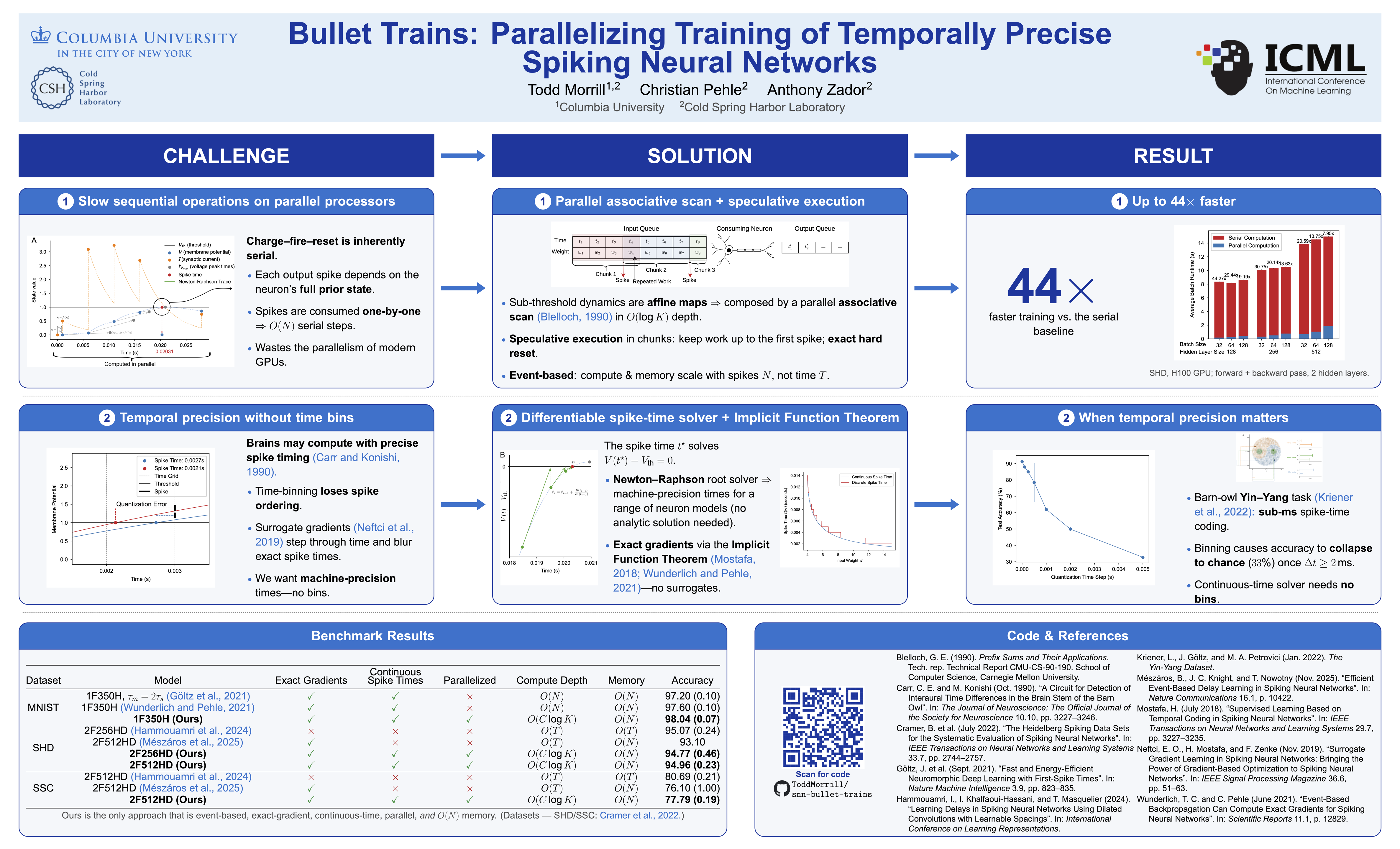
Continuous-time, event-native spiking neural networks (SNNs) operate strictly on spike events, treating spike timing and ordering as the representation rather than an artifact of time discretization. This viewpoint aligns with biological computation and with the native resolution of event sensors and neuromorphic processors, while enabling compute and memory that scale with the number of events. However, two challenges hinder practical, end-to-end trainable event-based SNN systems: 1) exact charge--fire--reset dynamics impose inherently sequential processing of input spikes, and 2) precise spike times must be solved without time bins. We address both. First, we use parallel associative scans to consume multiple input spikes at once, yielding up to 44x speedups over sequential simulation while retaining exact hard-reset dynamics. Second, we implement differentiable spike time solvers that compute spike times to machine-precision without discrete-time approximations or restrictive analytic assumptions. We demonstrate the viability of training SNNs using our solutions on four event-based datasets on GPUs.
Lay Summary
Spiking neural networks (SNNs) use neurons that are more "brain-like" than artificial neural networks. Spiking neurons communicate using spikes, where you can think of a spike as a small signal sent from one neuron to all its neighbors. Building systems that communicate with spikes may be a step toward energy efficiency for AI. The challenge is that training SNNs can be slow, which limits our ability to further develop them. Furthermore, our brains may be using precise timing of spikes to solve problems. For instance, have you ever heard a loud sound and immediately known where it came from? That relies on precise spike timing. We're interested in understanding what capabilities precise spike timing unlocks in SNNs. In this work, we solve the speed problem by parallelizing computations—think of this as multitasking. We also show how one can compute with precise spike times—and that it really does matter for certain problems.