
Aitchison Embeddings for Learning Compositional Graph Representations
Abstract
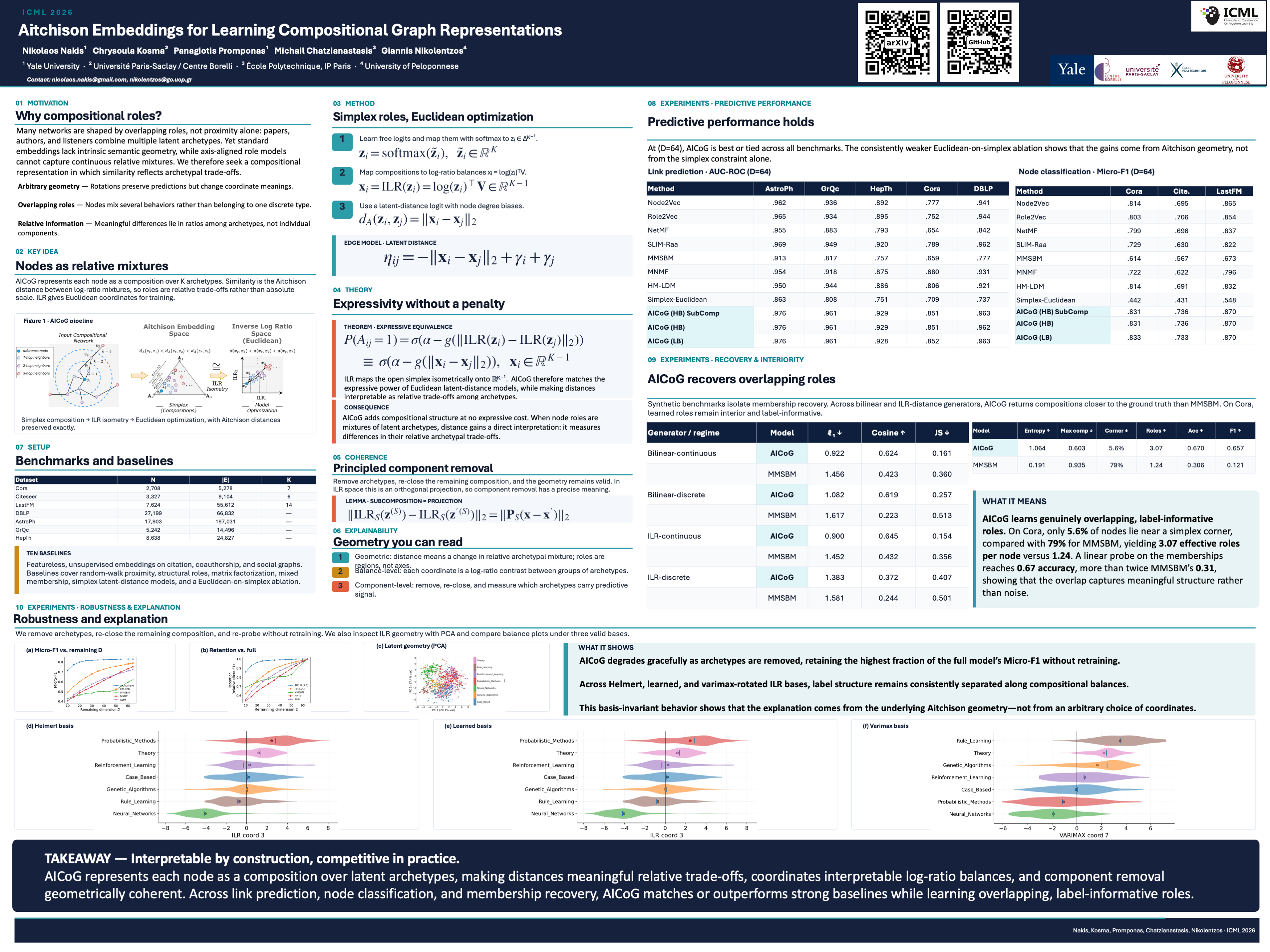
Representation learning is central to graph machine learning, powering tasks such as link prediction and node classification. However, most graph embeddings are hard to interpret, offering limited insight into how learned features relate to graph structure. Many networks naturally admit a role-mixture view, where nodes are best described as mixtures over latent archetypal factors. Motivated by this structure, we propose a compositional graph embedding framework grounded in Aitchison geometry, the canonical geometry for comparing mixtures. Nodes are represented as simplex-valued compositions and embedded via isometric log-ratio (ILR) coordinates, which preserve Aitchison distances while enabling unconstrained optimization in Euclidean space. This yields intrinsically interpretable embeddings whose geometry reflects relative trade-offs among archetypes and supports coherent behavior under component restriction; we consider both fixed and learnable ILR bases. Across node classification and link prediction, our method achieves competitive performance with strong baselines while providing explainability by construction rather than post hoc. Finally, subcompositional coherence enables principled component restriction: removing and renormalizing subsets preserves a well-defined geometry, which we exploit via subcompositional dimensionality removal to probe how archetype groups influence representations and predictions.
Lay Summary
Graph data appear in many settings, such as social networks, scientific collaboration networks, citation networks, and biological systems. A common goal is to turn each node in a graph into a useful numerical representation so that machine learning methods can predict missing links or classify nodes. However, these representations are often difficult to understand: they may work well, but it is unclear what the learned numbers mean. This paper introduces a new way to learn graph representations that is easier to interpret. Instead of describing each node by arbitrary coordinates, we describe it as a mixture of several underlying role-like factors. For example, a person, paper, or organization in a network may not belong to just one role, but may combine several roles in different proportions. Our method compares nodes by looking at the relative balance among these factors, rather than their raw sizes. The approach achieves performance comparable to strong existing methods on link prediction and node classification, while making the learned representations explainable by design. It also allows us to remove or focus on selected groups of factors in a principled way, helping reveal which parts of the representation matter most for predictions.