
(1D) Ordered Tokens Enable Efficient Test-Time Search
Abstract
Lay Summary
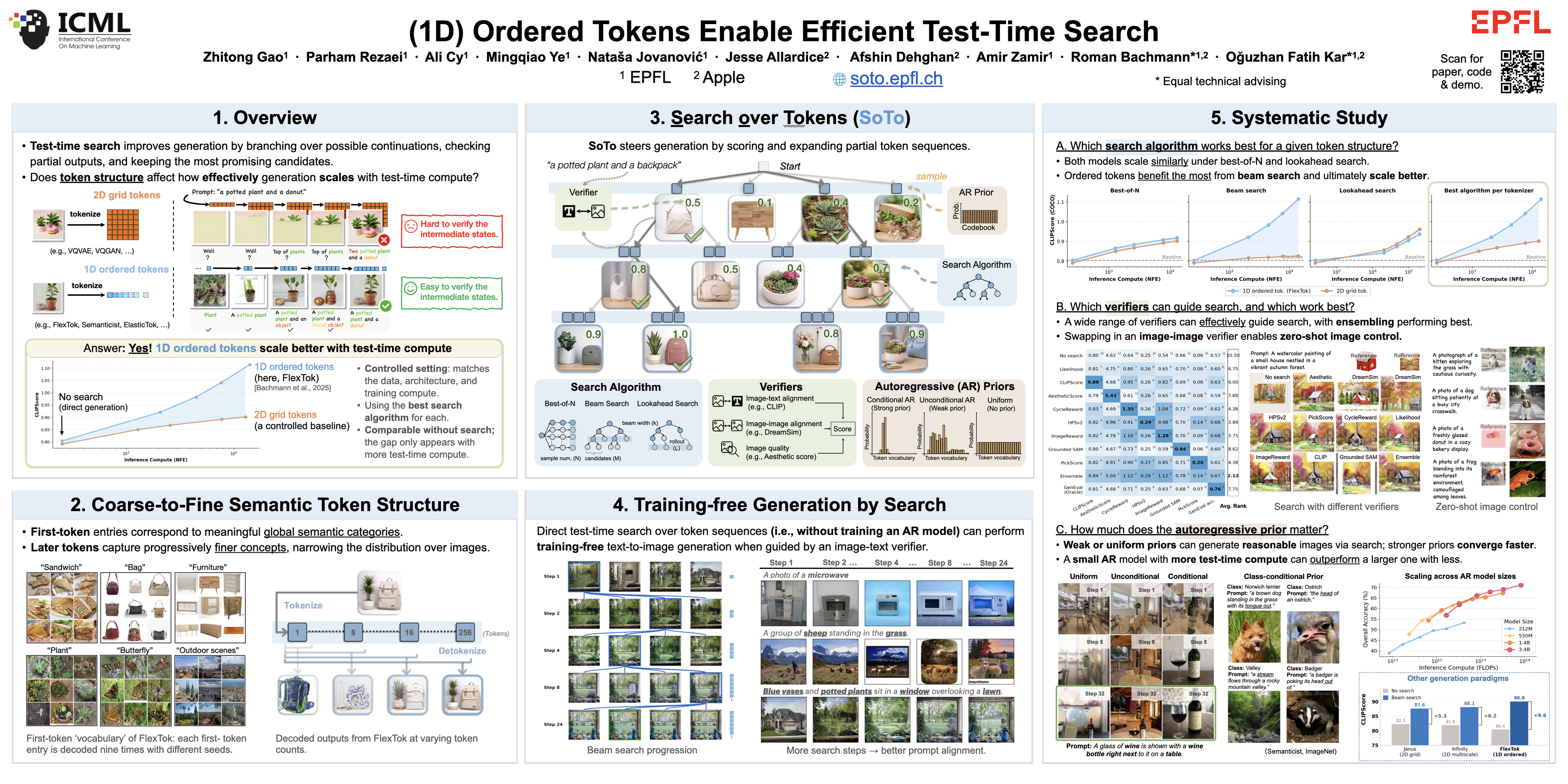
When people ask an AI system to create an image, the result does not always fully match what they had in mind. One way to improve this is to let the system explore several possible directions as it generates the image, check which ones better match the request, and use that feedback to guide the final result. Our work asks: what makes this trial-and-check process, or search, effective? We find that the answer depends strongly on how the system represents an image. Many image-generation systems organize image information in a spatial layout, where intermediate results may not yet say much about the whole image. We study a different organization, where the representation goes from broad ideas to finer details. Because early steps are already meaningful at the level of the whole image, they are easier to check and guide. Our experiments show that this broad-to-detailed organization makes search more effective during image generation. Compared with spatially organized representations under comparable image-generation models, it leads to better results when using extra computation at generation time. Taking this idea further, we also show that reasonable images can sometimes be produced through search alone, by directly exploring ordered image pieces without training a full image-generation model.