
When Attributes Disagree: Gradient Conflict in Image Aesthetic Assessment
Abstract
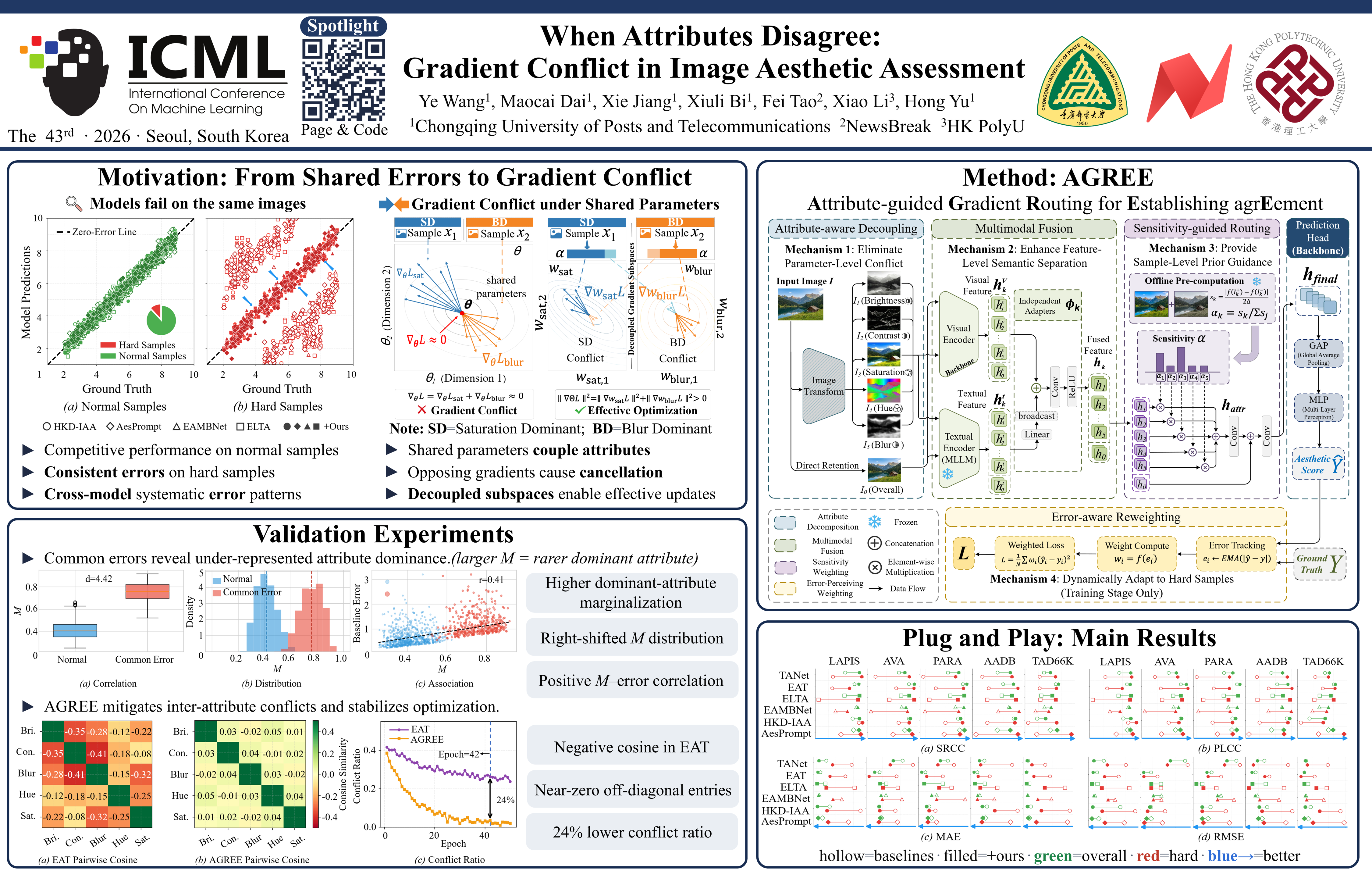
Image Aesthetic Assessment (IAA) predicts an image’s overall aesthetic score, yet aesthetic is influenced by multiple attributes whose relative importance varies with image content and usage scenarios. Under end-to-end training with only overall-score supervision, attribute signals are blended, which can cause gradient conflict across samples dominated by different attributes, resulting in gradient cancellation and persistent systematic bias. To address these issues, we propose AGREE (Attribute-guided Gradient Routing for Establishing Agreement), which learns attribute-specific subspaces and performs gradient routing based on sample-wise attribute sensitivity estimated via perturbation analysis. AGREE further reduces feature coupling across attributes with semantic anchors and improves robustness via error-aware reweighting. Experiments on AVA, LAPIS, AADB, TAD66K, and PARA show consistent improvements over diverse IAA baseline models, and AGREE is plug-and-play for existing end-to-end IAA methods without modifying their original architectures. To our knowledge, this work is among the early efforts in IAA to systematically study gradient conflict and provide an effective solution.