
When Does Adaptation Win? Scaling Laws for Meta-Learning in Quantum Control
Abstract
Lay Summary
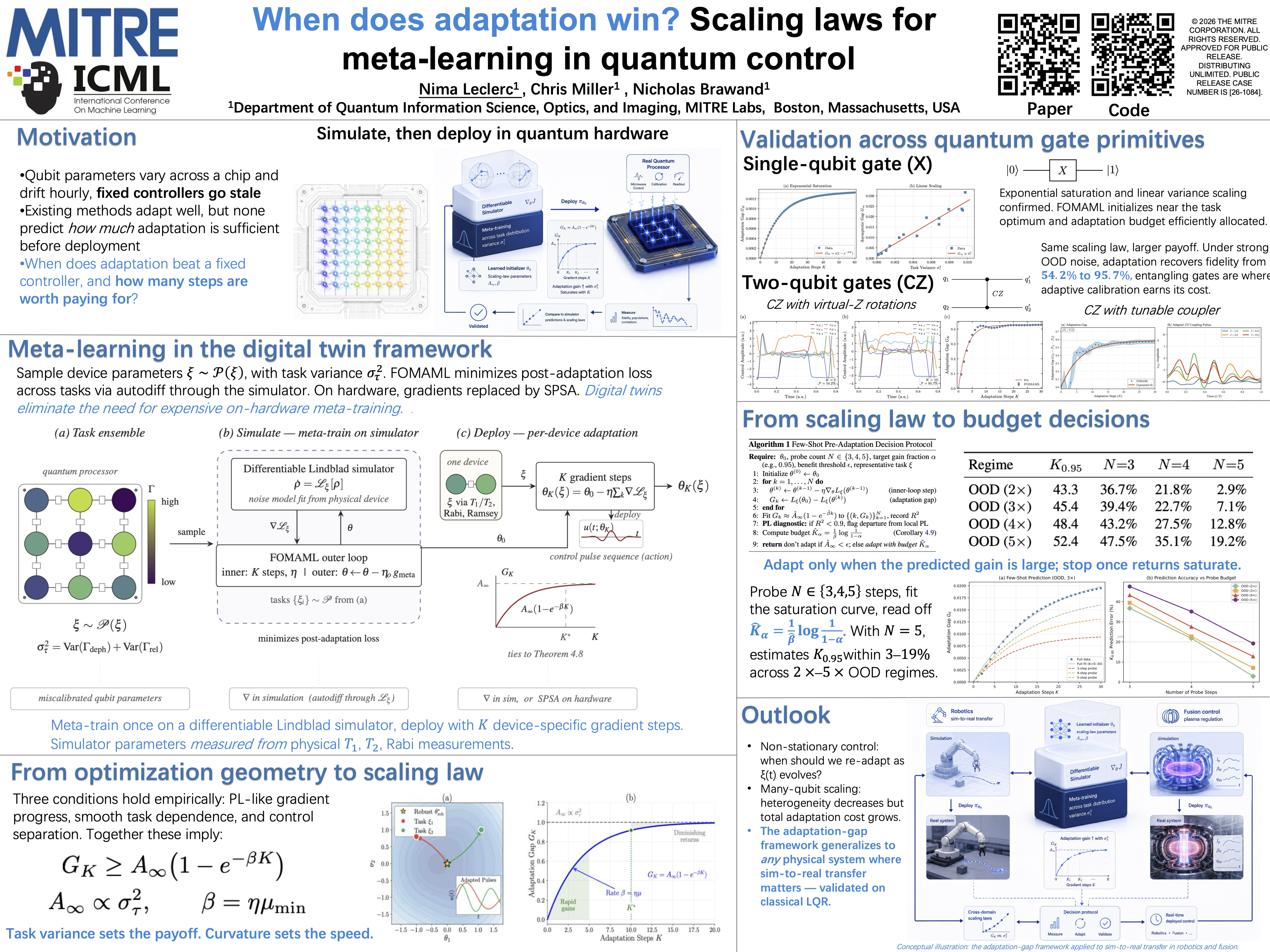
Imagine a piano with 100 keys, where each key drifts out of tune at a different rate and must be retuned individually every day. This is similar to the challenge facing today’s quantum computers: their components constantly drift and behave slightly differently due to microscopic manufacturing imperfections and environmental noise. Our work asks a simple but important question: when is it actually worth tuning a controller to each individual component, instead of using one fixed solution for all of them? We show that the answer follows a surprisingly clean mathematical law. The benefit of adaptation grows predictably with how different the components are from one another, but quickly levels off after only a modest amount of tuning. In practice, this means engineers can estimate ahead of time whether adaptation will meaningfully help, rather than relying on expensive trial-and-error calibration procedures. We also show the same scaling behavior appears in both quantum and classical control systems, suggesting the result reflects a broader principle of adaptive optimization. These findings could help reduce one of the major operational bottlenecks in quantum computing: calibration overhead. Instead of exhaustively tuning every device from scratch, engineers may only need a handful of quick measurements to estimate how much adaptation is worthwhile, potentially reducing the time, energy, and cost required to operate large-scale quantum systems.