
Ultrafast On-Chip Online Learning via Spline Locality in Kolmogorov–Arnold Networks
Abstract
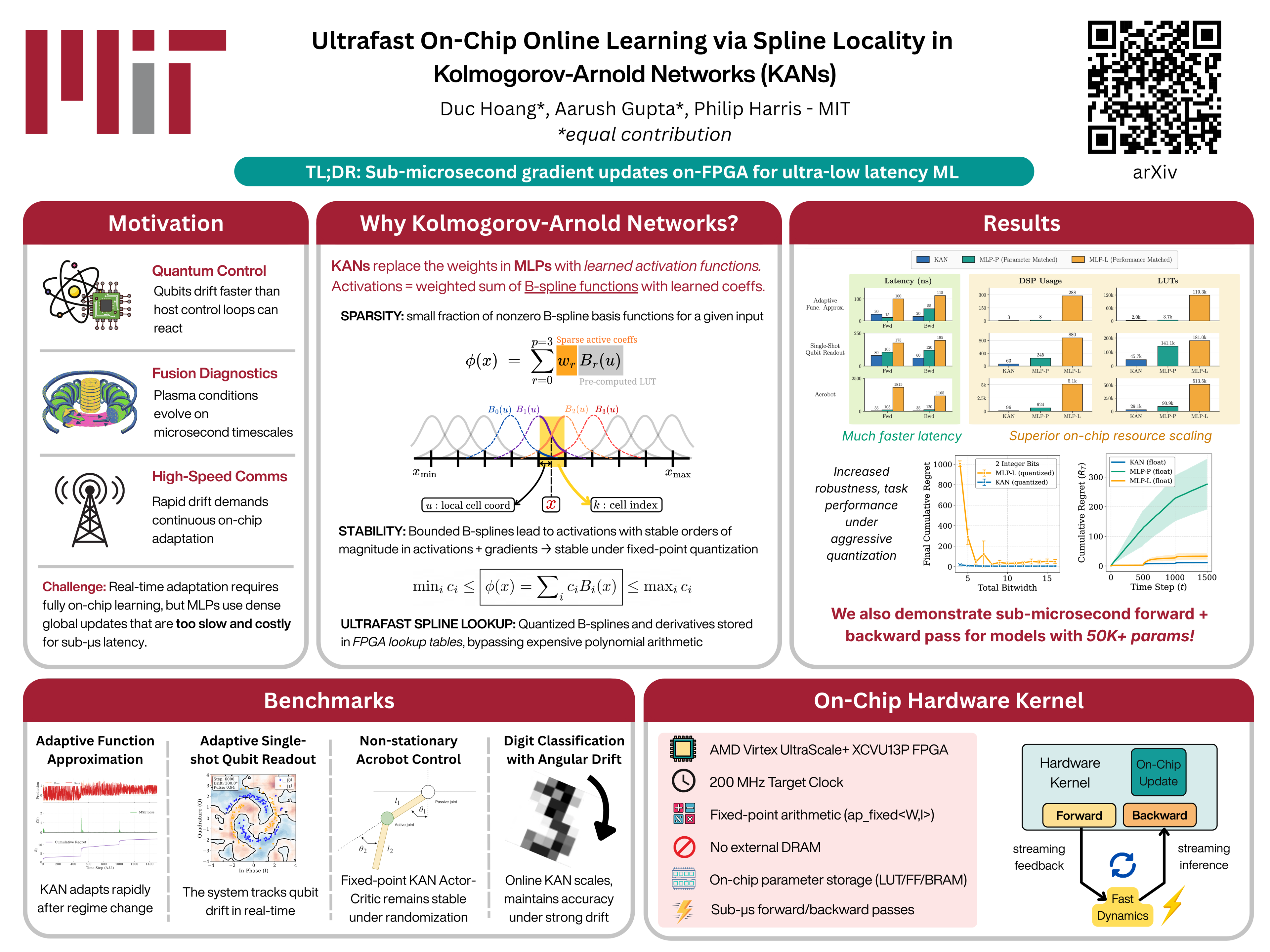
Ultrafast online learning is essential for high-frequency systems, such as controls for quantum computing and nuclear fusion, where adaptation must occur on sub-microsecond timescales. Meeting these requirements demands low-latency, fixed-precision computation under strict memory constraints, a regime in which conventional Multi-Layer Perceptrons (MLPs) are both inefficient and numerically unstable. We identify key properties of Kolmogorov-Arnold Networks (KANs) that align with these constraints. Specifically, we show that: (i) KAN updates exploiting B-spline locality are sparse, enabling superior on-chip resource scaling, and (ii) KANs are inherently robust to fixed-point quantization. By implementing fixed-point online training on Field-Programmable Gate Arrays (FPGAs), a representative platform for on-chip computation, we demonstrate that KAN-based online learners are significantly more efficient and expressive than MLPs across a range of low-latency and resource-constrained tasks. To our knowledge, this work is the first to demonstrate model-free online learning at sub-microsecond latencies.
Lay Summary
Some scientific systems need AI that can learn and react almost instantly: imagine having to make a decision in less time than it takes light to travel the length of a football field. That's the reality for tasks like controlling quantum computers or fusion experiments. We study a kind of AI model called a Kolmogorov-Arnold Network, showing that it is well-suited for these scenarios. Instead of changing the whole model every time it gets new information, a KAN only updates the small parts that are needed. We also show that a KAN can still work well even when the numbers it uses are stored with lower precision, meaning they are rounded or less exact to save time and computing power. Both of these properties help it run faster and use fewer hardware resources. We demonstrate AI-powered adaptation under a millionth of a second for the first time, opening the door to adaptive AI in systems where even the tiniest delay matters.