
DRFusion: Drift-Resilient Temporally Consistent Infrared–Visible Video Fusion
Abstract
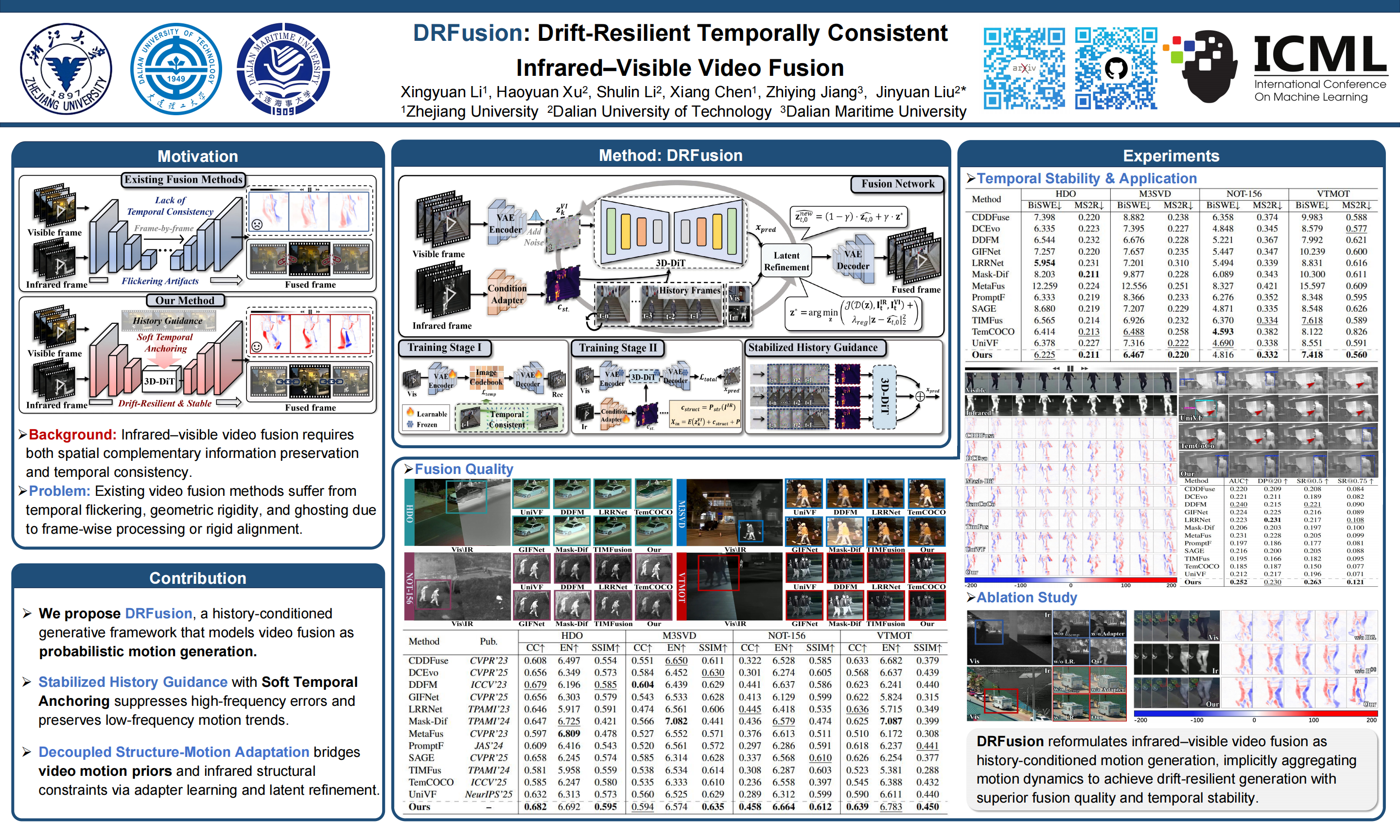
Infrared and visible video fusion is essential for achieving comprehensive perception in dynamic scenes. However, maintaining temporal consistency remains a formidable challenge. Conventional methods relying on optical flow often suffer from geometric rigidity and ghosting artifacts. Moreover, standard diffusion-based fusion models typically operate in a frame-by-frame manner; when extended to autoregressive settings, they lack intrinsic temporal constraints and are prone to severe error accumulation and drifting, where minor artifacts amplify over time. To address these limitations, we propose a drift-resilient video fusion method that reformulates the task as history-conditioned motion generation. We introduce Stabilized History Guidance and Soft Temporal Anchoring to reframe temporal consistency as spectral filtering, implicitly aggregating motion dynamics without rigid alignment. Furthermore, our Decoupled Structure-Motion Adaptation strategy bridges pre-trained priors and structural constraints via two-stage training and latent refinement. Extensive experiments demonstrate that our method achieves state-of-the-art performance in both fusion quality and temporal stability.
Lay Summary
Infrared and visible cameras capture different information: infrared cameras are good at highlighting warm objects, while visible cameras provide rich texture and color details. Combining them into one video can help machines better understand complex scenes, especially at night or in challenging environments. However, many existing fusion methods process each frame separately, which can cause flickering or unstable results over time. This paper proposes DRFusion, a method that uses information from previous frames to produce more stable and reliable fused videos. Experiments show that DRFusion improves both visual quality and temporal stability, making it useful for applications such as surveillance, autonomous driving, and search-and-rescue scenarios.