
Efficient privacy loss accounting for subsampling and random allocation
Abstract
Lay Summary
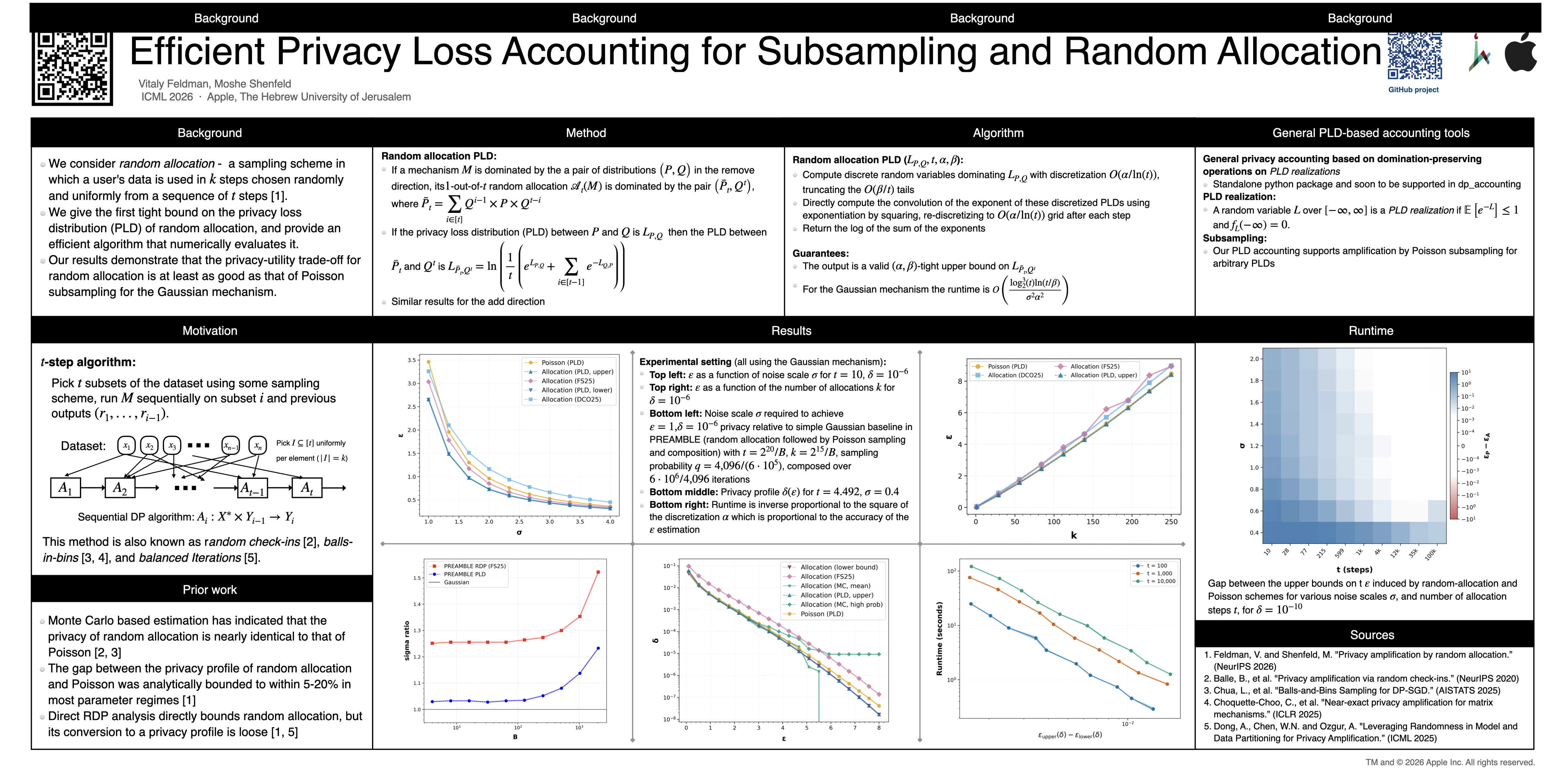
Modern AI systems are often trained on sensitive records, such as people’s text, images, or medical data. To reduce privacy risk, researchers use differential privacy, which limits how much the trained model can reveal about any one record by adding carefully calibrated random noise. Poisson sampling, a standard way to analyze this protection, assumes that each training batch is formed by flipping an independent coin for every record. That assumption is mathematically convenient, but it is not how many training systems form batches, and it can make training less efficient. This paper analyzes a more practical batching method, called random allocation, where each record is used in a fixed number of randomly chosen training steps. Earlier work suggested that this method is more practical and leads to more accurate training, but did not provide a way to calculate its privacy guarantee precisely. We develop such a calculation method. It enables accurate tracking of privacy guarantees for random allocation and improves on previous algorithms.