
Adaptive Token Refinement in Long-Tailed Large Vision-Language Models Fine-Tuning
Abstract
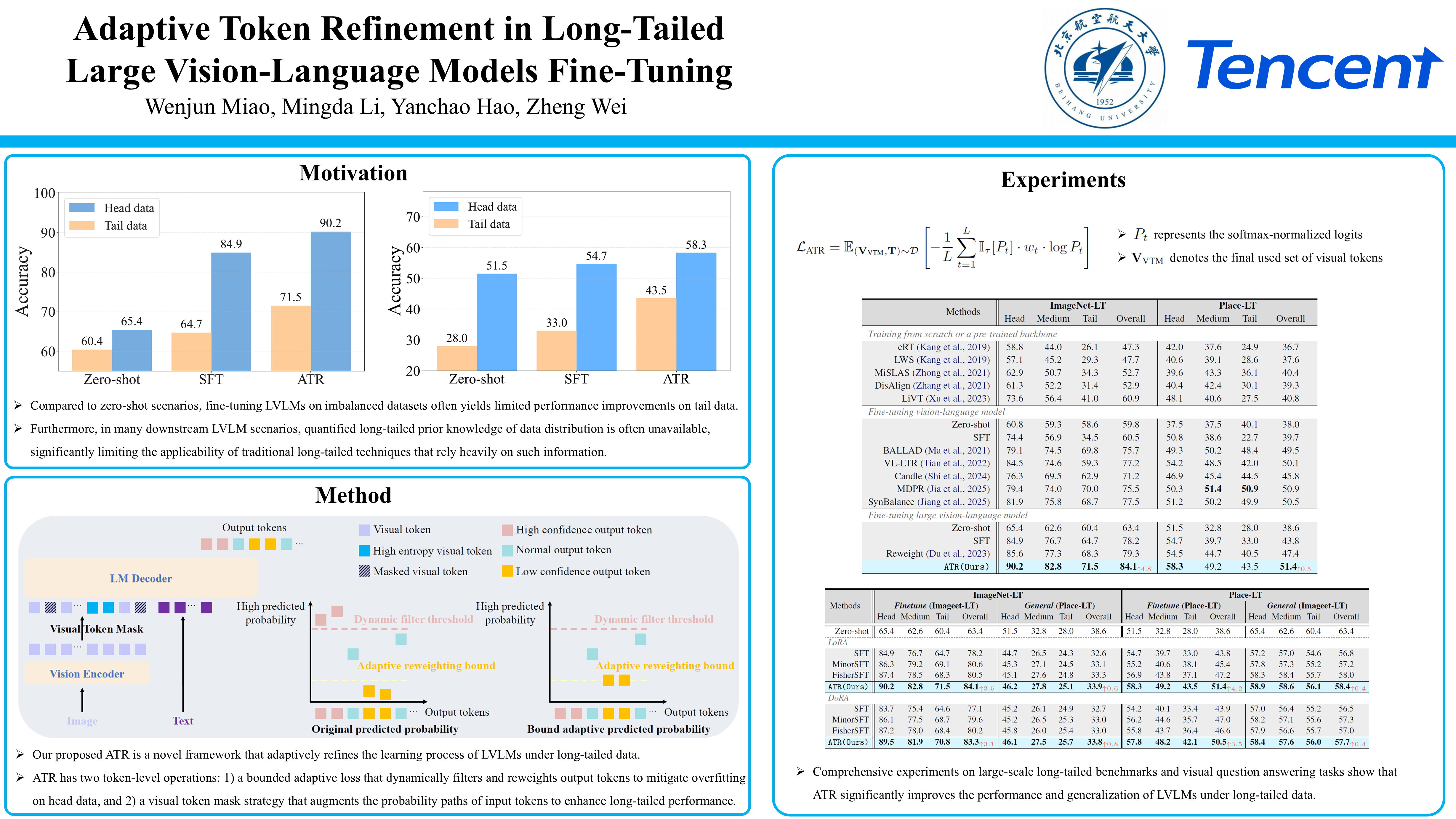
While large vision-language models (LVLMs) have shown remarkable adaptability to downstream applications, their fine-tuning process remains susceptible to bias under long-tailed data. Compared to zero-shot scenarios, fine-tuning LVLMs on imbalanced datasets often yields limited performance improvements on tail data. This is because LVLMs tend to rapidly overfit the head data at an early fine-tuning stage, thereby impairing the learning of the tail data while simultaneously failing to exploit their quantitative advantage. Furthermore, in many downstream LVLM scenarios, quantified long-tailed prior knowledge of data distribution is often unavailable, significantly limiting the applicability of traditional long-tailed techniques that rely heavily on such information. To address these issues, we propose the Adaptive Token Refinement (ATR), a novel framework that adaptively refines the learning process of LVLMs under long-tailed data. Specifically, ATR consists of two token-level operations applied to output and input tokens, respectively: 1) a bounded adaptive loss that dynamically filters and reweights output tokens to mitigate overfitting on head data, and 2) a visual token mask strategy that augments the probability paths of input tokens to enhance long-tailed performance. Extensive experiments demonstrate that ATR consistently enhance both performance and generalization for long-tailed LVLMs fine-tuning.
Lay Summary
This paper studies why fine-tuning large vision-language models on imbalanced datasets often does not help rare “tail” examples much: the model quickly learns the common “head” examples too well, which can hurt its ability to learn from fewer rare cases. The paper propose Adaptive Token Refinement (ATR), a method that improves fine-tuning without needing to know the exact long-tailed data distribution beforehand. ATR works in two ways: it adjusts the loss on output tokens so the model does not over-focus on easy or dominant head-data patterns, and it masks some visual input tokens to create more diverse learning paths, helping the model generalize better to rare cases. Experiments show that ATR improves both overall performance and tail-data performance across several benchmarks.